Pakistani Ecommerce Brands Pay Creators for Reach. The Smart Ones Pay for Proof.
By Sara Khan, WeProms Digital — last updated July 2026.
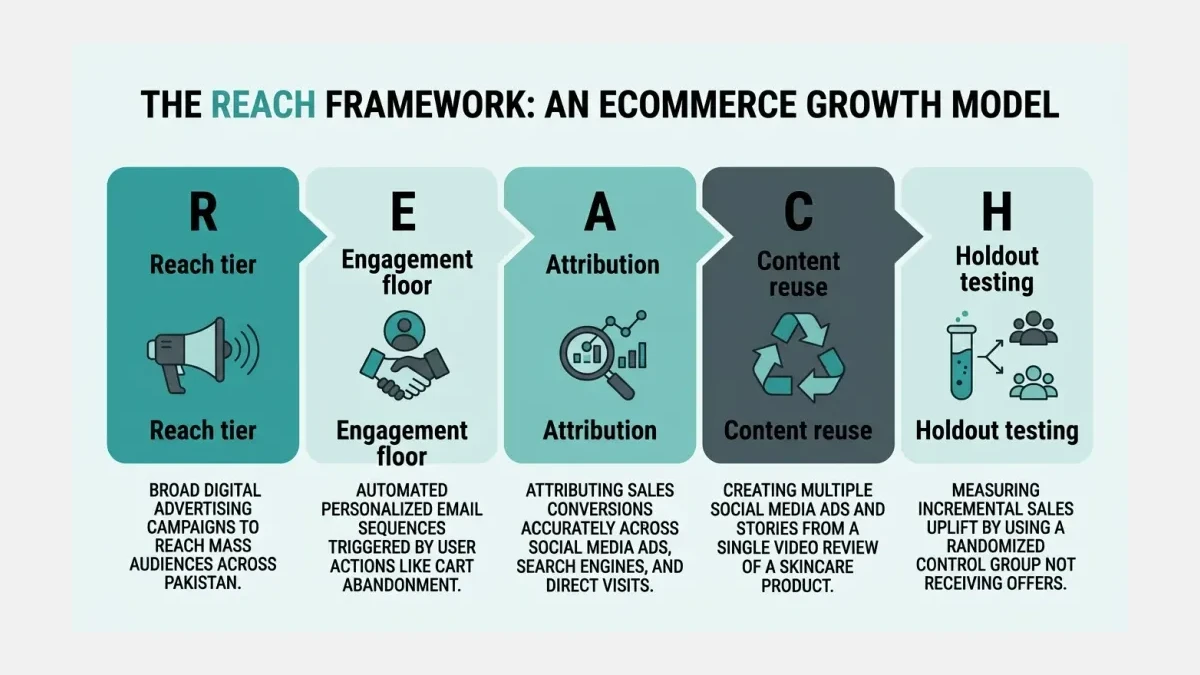
Most Pakistani ecommerce brands measure influencer marketing in likes. The REACH framework measures it in rupees. REACH breaks a creator campaign into five steps: R for Reach tier, E for Engagement floor, A for Attribution, C for Content reuse, and H for Holdout testing. Each step answers one question a store owner in Lahore or Karachi can attach a PKR figure to.
The economics support the shift. A Pakistani micro-influencer with 10,000 to 100,000 followers charges roughly PKR 8,000 to PKR 75,000 per Reel or TikTok video, with most ecommerce integrations landing near PKR 20,000 to PKR 50,000. TikTok micro-influencers in Pakistan deliver about 8.2% engagement, compared with 5.3% for macro creators. The pattern repeats across every vertical: smaller audiences trust harder, and trust is what converts cash-on-delivery shoppers. For the broader playbook on measuring content performance, our guide on content marketing ROI in Pakistan sets the baseline.
R — Reach tier: why the 10,000-to-100,000 follower band outperforms in Pakistan
The first decision is which creator tier to buy. Pakistani brands default to the biggest name they can afford. The data argues the opposite.
Micro-influencer — a creator with roughly 10,000 to 100,000 followers, usually known inside a specific niche such as skincare, modest fashion, or home kitchenware. A micro-influencer reaches fewer people than a celebrity but holds far more trust inside that niche.
Pakistan counts about 66.9 million adult TikTok users and roughly 22 million Instagram users, according to DataReportal and platform-reported figures summarized by the PTA. Inside that audience, the micro tier delivers higher engagement per rupee than any larger tier. The chart above shows the drop-off clearly: engagement falls from roughly 8.2% at micro to 3.4% at mega. A Karachi skincare brand paying PKR 30,000 for a micro Reel reaches fewer feeds than a PKR 300,000 celebrity post, but a larger share of those feeds already buys the category.
The actionable rule is to buy five micro creators before one macro creator at the same total cost. Diversification also protects the campaign if one post underperforms.
E — Engagement floor: the 8.2% number that filters out the wrong creators
Book a free strategy call - we'll audit your current setup and identify the highest-impact fixes.
Not every micro-influencer delivers 8.2%. Some deliver 1%. The engagement floor is the minimum a creator must clear before a brand pays them.
Engagement rate — the percentage of a creator’s audience that interacts with a post through likes, comments, shares, and saves, relative to their follower count or reach. It is the single best signal of whether an audience actually watches.
Set a hard floor at 4% engagement-by-reach for Instagram and 6% for TikTok. Below those lines, the audience is inactive or inflated by fake followers. TikTok itself is now targeting AI-generated spam accounts in high-risk categories, which means follower counts across the platform are less reliable than they were a year ago. Request a screenshot of the creator’s last 10 posts with reach and engagement before contracting.
“Results-first” influencer campaigns track sales, not vanity metrics. The brands that scale are the ones that stop counting impressions and start counting orders.
The underlying mechanic is simple. An 8.2% engagement creator with 40,000 followers produces about 3,280 meaningful interactions per post. A 2% creator with 40,000 followers produces 800. The cost per interaction is four times higher for the second creator, even at the same fee. Setting the floor removes that waste before the campaign begins.
A — Attribution: tracking customer acquisition cost instead of vanity metrics
This is where most Pakistani campaigns break. A brand pays five creators, sees a sales spike, and credits the creators. The spike may have come from a Daraz sale event, a Google Ads push, or seasonal demand.
Customer acquisition cost (CAC) — the total marketing spend divided by the number of new customers acquired in the same period. For influencer work, the goal is an isolated CAC for the creator channel, not a blended number.
Three attribution methods work in Pakistan. First, a unique discount code per creator ties each order back to a specific post. Second, a UTM-tagged link in the creator’s bio or story tracks clicks into GA4. Third, a post-purchase survey asks “where did you hear about us” and records the creator name. Our customer acquisition cost audit for Pakistani SMEs walks through the full calculation.
A defensible target: a creator-channel CAC below the store’s blended CAC from paid ads. If Google Ads brings a customer at PKR 1,200 and a PKR 30,000 creator post brings 40 new customers, the creator CAC is PKR 750. That is the number that justifies renewing the partnership. Likes never justify it.
C — Content reuse: turning one PKR 30,000 post into six weeks of ads
A single creator post is an asset, not a one-day event. The brands that make influencer marketing pay are the ones that reuse the content. User-generated content (UGC) — video or images created by customers and creators rather than the brand’s own studio, used as ad creative because it tests as more trustworthy than polished brand video.
One PKR 30,000 Reel becomes three assets: a spark ad on TikTok, a Reels ad on Instagram, and a website testimonial clip. Each reuse lowers the effective cost of the original post. The same creator content typically outperforms studio ads on click-through rate because it reads as authentic to a Pakistani audience conditioned to distrust glossy advertising.
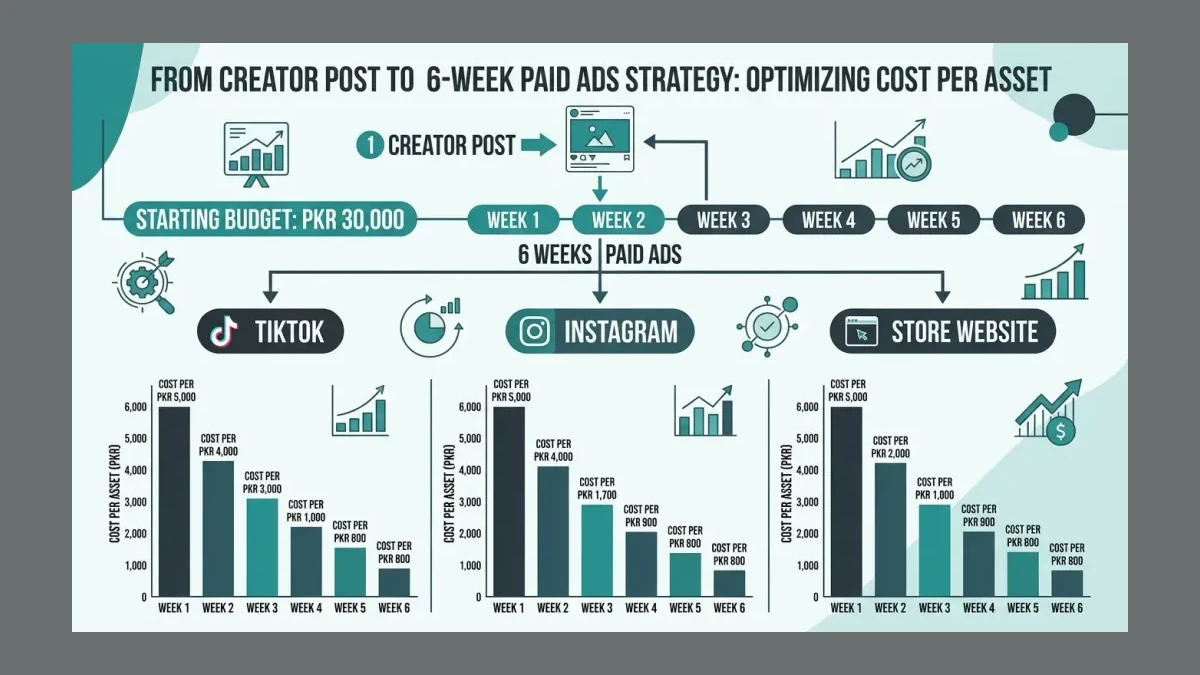
Negotiate usage rights at the contracting stage. The standard Pakistani creator rate covers one organic post for a set period. Paid usage for 30 to 90 days usually adds 30% to 60% to the fee, and that uplift is the cheapest media buy a small brand will make all quarter.
H — Holdout testing: proving the campaign beat cash on delivery returns
How we helped a Pakistani business achieve measurable results.
The final step is the one Pakistani brands skip most often: proving the campaign caused the sales, rather than riding a wave. Cash on delivery still settles 75% to 85% of Pakistani ecommerce orders, and COD return and rejection rates run 20% to 50%. A spike in orders means nothing if half get refused at the door.
Holdout test — a controlled comparison in which one group of customers is exposed to the creator campaign and an identical group is not, so the difference in sales can be attributed to the campaign rather than to other factors.
Run a holdout by pausing creator-driven traffic to one product variant or one city for two weeks while the rest runs normally. If the exposed group outsells the control by a clear margin after COD returns settle, the campaign worked. If the gap disappears after returns, the creator drove impulse orders that did not stick. That distinction is the difference between a profitable channel and an expensive ego exercise. For retaining the customers who do convert, the retention framework for Pakistani ecommerce picks up where acquisition ends.
Creator marketing in Pakistan is no longer an awareness play. Run as REACH, it becomes a measurable acquisition channel with a CAC, a reuse multiplier, and a holdout result. Pakistani creator rates sit 5 to 20 times below Western markets, which means the same framework returns far more here than it does in London or Dubai. WeProms Digital, Pakistan’s leading influencer marketing campaign management agency, builds REACH-based creator programs for ecommerce brands across Lahore, Karachi, and Islamabad. Start with a creator strategy session or email hello@weproms.com to scope a pilot.
Read next: Creator content and AI discovery for Pakistani brands and Customer retention framework for Pakistani ecommerce.
Key Takeaways
- Buy five micro-influencers before one macro creator at the same total spend; the micro tier delivers higher engagement per rupee.
- Set a hard engagement floor of 4% on Instagram and 6% on TikTok, and demand reach screenshots before contracting.
- Isolate creator-channel CAC with unique codes, UTM links, and post-purchase surveys; renew only when it beats blended paid CAC.
- Negotiate 30-to-90-day paid usage rights and reuse each post as TikTok, Instagram, and website ad creative.
- Run a holdout test and judge results after COD returns settle, since 20% to 50% of Pakistani cash-on-delivery orders get refused.
Frequently Asked Questions
How much does a micro-influencer cost in Pakistan?
A Pakistani micro-influencer with 10,000 to 100,000 followers charges roughly PKR 8,000 to PKR 75,000 per Instagram Reel or TikTok video. Most ecommerce integrations cluster around PKR 20,000 to PKR 50,000 per post. Karachi and Lahore creators typically charge 20% to 30% more than Islamabad or Faisalabad creators at the same follower tier.
Is TikTok Shop worth it for Pakistani ecommerce in 2026?
TikTok Shop works for categories that perform well on video, such as fashion, beauty, and kitchenware. Roughly 66.9 million Pakistani adults use TikTok, and creator content ranks higher in the algorithm than brand ads. The catch is fulfillment: with COD on 75% to 85% of orders and 20% to 50% returns, the store must be built to handle rejection rates before scaling live selling.
How do I measure influencer ROI with cash on delivery?
Track three signals: a unique discount code per creator, a UTM-tagged bio link feeding GA4, and a post-purchase survey. Wait for COD orders to settle, subtract refused and returned orders, then divide total creator spend by net new customers. That number is the creator-channel CAC.
Should I pay creators upfront or on commission?
Upfront fees secure better creators and predictable content. Pure commission rarely attracts strong micro-influencers in Pakistan because their COD-heavy audiences make attribution uncertain. A hybrid works well: a reduced upfront fee plus a commission on tracked-code sales.
What does a WeProms creator strategy session include?
WeProms Digital scopes a REACH pilot: a shortlist of micro-influencers that clear the engagement floor, a code-and-link attribution setup, a content-reuse plan, and a holdout design. The session produces a budget and a forecast CAC before any creator is contracted. Reach out through the contact page.
About WeProms Digital
WeProms Digital is Pakistan’s leading influencer marketing campaign management agency, headquartered in Lahore, serving Pakistani SMEs, ecommerce brands, and DTC stores across Lahore, Karachi, Islamabad, Rawalpindi, Faisalabad, and Multan.
The team specializes in micro-influencer selection, creator attribution, and UGC content reuse, with a track record of building creator channels that report an isolated CAC rather than vanity metrics.
Get in touch: hello@weproms.com · WhatsApp +92 300 0133399 · weproms.com/contact-us
Sources & References
- DataReportal — Digital 2026: Pakistan (social media and TikTok users) — 2026
- Pakistan Telecommunication Authority — Top Social Media Platforms in Pakistan — 2026
- eMarketer — Smaller Creators Deliver Efficiency as ROI Pressure Mounts — 2026
- Influencer Marketing Hub — Micro-Influencer Rates and Pricing — 2026
- Shopify Pakistan — Influencer Pricing Guide — 2026
- Later — Micro-Influencer Marketing Strategy: How to Find and Partner with Small Creators — 2026
- Hootsuite — Influencer Pricing and Rates in 2026 — 2026
- Search Engine Journal — TikTok Targets AI-Generated Spam Accounts in High-Risk Topics — 2026
Additional reading from industry feeds: