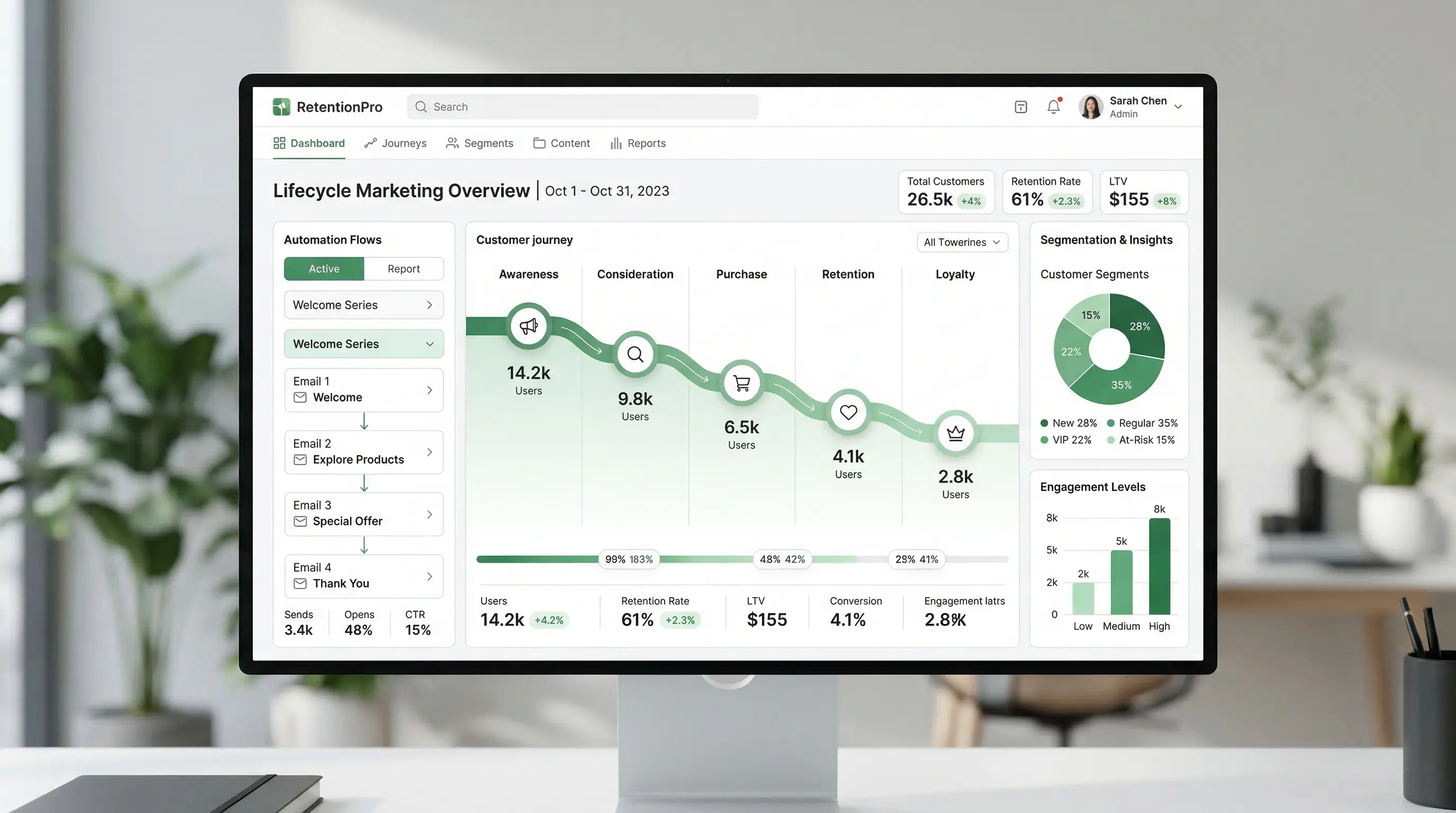
Lifecycle retention automation in ecommerce is the fastest path to margin stability when acquisition costs are volatile. In 2026, profitable ecommerce brands invest in trigger-based customer journeys that improve repeat purchase behavior, increase average order frequency, and recover churned buyers. Research from Bain & Company shows that increasing customer retention by just 5% can boost profits by 25% to 95%, making retention automation one of the highest-ROI investments an ecommerce business can make.
A modern retention framework includes segmentation logic, event-triggered messaging, and continuous optimization based on revenue contribution. This is a systems function, not a one-time email campaign setup. The brands winning in 2026 treat retention as an operating system that runs continuously, adapting to customer behavior in real-time.
Why does lifecycle retention matter more than ever in 2026?
The economics of ecommerce have shifted dramatically. Customer acquisition costs (CAC) have increased by 60% over the past five years across major platforms, while organic reach continues to decline. In Pakistan’s competitive ecommerce market, where Daraz, Foodpanda, and dozens of D2C brands compete for attention, paying for every new customer is unsustainable.
Retention-focused brands create compound returns. A customer who purchases three times per year generates significantly more profit than three one-time buyers, even if the total revenue is identical. The difference lies in eliminated acquisition costs, higher trust levels, and increased willingness to try new products.
The Pakistan market presents unique retention opportunities. With mobile penetration exceeding 85% and growing comfort with digital payments through JazzCash, EasyPaisa, and SadaPay, customers are more accessible than ever. However, brand loyalty remains low, with many shoppers chasing discounts across platforms. Strategic retention automation builds the emotional and functional connections that overcome price-driven switching behavior.
Which lifecycle flows should launch first?
The first flows should cover high-impact revenue moments where customers are most receptive to communication:
Welcome and Onboarding Sequence: Triggered immediately after email or phone signup, this flow establishes brand expectations and drives first purchase. Include brand story, value proposition, and a time-sensitive first-purchase incentive. In Pakistan, WhatsApp-based welcome sequences often outperform email due to higher open rates.
Browse and Cart Abandonment Recovery: When customers view products or add items to cart without completing purchase, automated reminders recover 10-15% of otherwise lost revenue. Time the first message within 1-2 hours for cart abandonment and 24 hours for browse abandonment.
Post-Purchase Education and Cross-Sell: After order confirmation, send shipping updates, product usage tips, and complementary product recommendations. This flow increases customer satisfaction while positioning additional purchases.
Repeat Purchase Trigger Based on Product Cycle: For consumable products or items with predictable replacement cycles, automated replenishment reminders timed to customer usage patterns drive predictable repeat revenue.
Churn-Risk and Win-Back Program: Identify customers who haven’t purchased within their expected cycle and re-engage with compelling offers before they switch to competitors.
Launching these flows first usually creates measurable retention lift within 30-60 days, providing the foundation for more sophisticated automation.
How should segmentation be structured?
Segmentation should combine recency, frequency, monetary value, and product preference signals. Static list-based segmentation quickly becomes outdated as customer behavior shifts. Dynamic segment rules keep journey relevance high as customer behavior changes.
RFM Segmentation Foundation: Recency (when did they last purchase), Frequency (how often do they purchase), and Monetary (how much do they spend) create the backbone of lifecycle segmentation. Customers scoring high on all three dimensions are your VIP segment, deserving premium treatment and early access to new products.
Behavioral Layer: Add product category preferences, browsing behavior, and engagement patterns to RFM data. A customer who frequently views kids’ clothing but purchases women’s fashion has different needs than someone whose views and purchases align.
Lifecycle Stage Classification: Classify customers as New, Active, At-Risk, or Churned based on their purchase history relative to your typical purchase cycle. Each stage requires different messaging strategies and offer levels.
Channel Preference Tracking: In Pakistan, some customers respond better to SMS, others to WhatsApp, and a growing segment prefers email. Track response rates by channel and respect customer preferences.
Dynamic Segment Rules: Build segments that automatically update based on customer actions. When a customer makes a purchase, they should immediately move from “At-Risk” to “Active” across all campaigns.
What triggers should power your automation?
Event-based triggers create timely, relevant messaging that feels personal rather than promotional. The most effective triggers combine customer behavior with contextual signals:
Purchase Events: Order confirmation, shipping notification, delivery confirmation, and post-delivery feedback requests. Each touchpoint is an opportunity to strengthen the relationship and guide toward the next purchase.
Behavioral Events: Product view, category browse, search query, wishlist addition, cart add, and checkout initiation. These signals indicate intent and should trigger relevant follow-up communication.
Time-Based Events: Customer birthday (if collected), membership anniversary, product replenishment timing, and seasonal relevance. Time-based triggers work best when combined with behavioral data.
Engagement Events: Email opens, link clicks, website visits, and app opens. High engagement indicates readiness for purchase messaging, while low engagement suggests need for re-engagement campaigns.
Inactivity Events: No purchase in expected timeframe, no engagement with communications, or abandoned browsing sessions. These triggers power churn prevention and win-back flows.
What metrics prove lifecycle automation is working?
Core lifecycle metrics include repeat purchase rate, revenue per recipient, churn rate, win-back conversion, and time-to-second-order. Teams should monitor these weekly and compare against baseline cohorts.
Repeat Purchase Rate: The percentage of customers who make a second purchase within a defined timeframe. For most ecommerce categories, this should exceed 25% within 90 days of first purchase.
Revenue Per Recipient (RPR): Total revenue generated from automated flows divided by recipients. This metric helps prioritize which flows deserve optimization investment.
Customer Lifetime Value (CLV) Growth: Track CLV for cohorts before and after automation implementation. A well-executed retention program should increase CLV by 15-30% within the first year.
Churn Rate Reduction: Measure the percentage of customers who stop purchasing over time. Effective win-back automation should reduce monthly churn rate by 10-20%.
Email/SMS Deliverability and Engagement: Open rates above 25% (email) and 70% (SMS in Pakistan) indicate healthy list hygiene and relevant content.
Conversion Rate by Flow: Each automated flow should have its own conversion benchmark. Cart abandonment flows typically convert at 5-15%, while post-purchase cross-sell converts at 2-5%.
How do you build a Pakistan-specific retention strategy?
The Pakistani ecommerce market has unique characteristics that require localized retention approaches:
Channel Strategy: WhatsApp dominates as a communication channel, with open rates exceeding 90%. SMS remains effective for transactional messages, while email works for professional and premium segments. Build multi-channel flows that leverage each channel’s strengths.
Payment Context: Cash on delivery (COD) still represents over 60% of ecommerce transactions in Pakistan, leading to higher return rates and different customer psychology. Automated flows should address COD-specific concerns like order confirmation and delivery scheduling.
Seasonal Patterns: Ramadan and Eid seasons drive massive purchasing spikes, while summer monsoons create delivery challenges. Build seasonal automation variants that adjust messaging, offers, and timing accordingly.
Trust Building: Pakistani consumers are increasingly sophisticated but remain cautious of online scams. Retention flows should emphasize authenticity, customer service availability, and easy return policies.
Local Language Options: For many Pakistani customers, Urdu messaging creates stronger emotional connection. Test bilingual flows or create segment-specific language versions.
Mobile-First Design: All retention communication should be optimized for mobile viewing, as most Pakistani consumers access the internet primarily through smartphones.
What technology stack supports lifecycle automation?
Building effective retention automation requires integrated technology:
Customer Data Platform (CDP): Centralizes customer data from all touchpoints, creating unified customer profiles. Options range from enterprise solutions like Segment to ecommerce-specific tools like Klaviyo’s built-in CDP features.
Email Service Provider (ESP): Core automation engine for email flows. Klaviyo, Mailchimp, and Braze offer strong ecommerce integration. For Pakistan-specific features like WhatsApp integration, consider tools like MoEngage or CleverTap.
SMS/WhatsApp Platform: Dedicated messaging platforms or integrated ESP features. Ensure compliance with local regulations and carrier requirements.
Ecommerce Platform Integration: Your automation tools must integrate deeply with your store platform (Shopify, WooCommerce, Magento, or custom) to access real-time purchase and behavioral data.
Analytics and Attribution: Tools like Google Analytics 4, Triple Whale, or Northbeam help attribute revenue to specific automation flows and optimize marketing spend.
Testing and Optimization: A/B testing capabilities within your ESP or dedicated tools like Optimizely for landing pages linked from retention messages.
How often should flows be optimized?
Review lifecycle automation weekly for deliverability, response rates, and conversion behavior. Refresh copy and offers monthly, and rebuild segment logic quarterly to reflect seasonality and product mix shifts.
Weekly Reviews: Check open rates, click rates, and conversion rates for each active flow. Flag significant declines for immediate investigation. Monitor spam complaints and unsubscribes as early warning signs.
Monthly Optimization: Test new subject lines, message copy, and offer structures. Update product recommendations based on inventory and seasonal relevance. Refresh creative assets to prevent creative fatigue.
Quarterly Strategic Reviews: Analyze segment performance and adjust segmentation rules. Evaluate new channel opportunities. Plan seasonal variants for upcoming periods.
Annual Overhauls: Rebuild flows from scratch based on accumulated learnings. Update automation strategy based on market changes and competitive landscape.
What are common mistakes to avoid?
Many ecommerce brands sabotage their retention efforts with avoidable errors:
Over-Messaging: Sending too many messages too quickly trains customers to ignore all communication. Respect frequency caps and give customers control over preferences.
Irrelevant Personalization: Using customer names without relevant content feels manipulative. True personalization requires understanding customer needs and preferences.
Ignoring Unengaged Subscribers: Continuing to message customers who never open or click damages deliverability for all messages. Implement sunset policies that reduce or stop messaging to chronically unengaged contacts.
Treating All Customers Identically: A first-time buyer needs different messaging than a loyal customer. Segment-based communication dramatically outperforms one-size-fits-all approaches.
Neglecting Mobile Experience: If retention messages link to poorly optimized mobile experiences, conversions suffer regardless of message quality.
Testing Without Statistical Rigor: Making changes based on insufficient data leads to false conclusions. Ensure tests reach statistical significance before implementing winners.
How do you measure ROI of retention automation?
Calculate return on investment by tracking:
Incremental Revenue: Revenue generated from automated flows that would not have occurred without automation. Compare against control groups when possible.
Cost Savings: Reduced customer service inquiries, lower acquisition spending on retained customers, and operational efficiencies from automation.
Technology and Labor Costs: Platform fees, integration costs, and staff time dedicated to retention management.
Simple ROI Formula: (Incremental Revenue + Cost Savings - Total Costs) / Total Costs x 100 = ROI Percentage
Most well-executed retention automation programs deliver 300-500% ROI within the first year, with returns compounding as customer lifetime value increases over time.
2026 Retention Implementation Plan
Phase 1: Foundation (Weeks 1-4)
- Audit current customer data and segmentation capabilities
- Define lifecycle stages and event triggers for your specific product category
- Document customer journey maps with key touchpoints
- Select and configure technology stack
- Establish baseline metrics for comparison
Phase 2: Core Flows (Weeks 5-8)
- Build dynamic segmentation with behavior-based rules
- Launch welcome/onboarding sequence
- Implement cart and browse abandonment flows
- Create post-purchase communication series
- Add QA checks for message timing and personalization
Phase 3: Advanced Automation (Weeks 9-12)
- Launch replenishment reminder flows
- Build at-risk identification and churn prevention flows
- Implement win-back campaigns for churned customers
- Create VIP recognition and loyalty programs
- Integrate cross-sell and upsell automation
Phase 4: Optimization (Ongoing)
- Run monthly conversion tests per flow category
- Refine segmentation based on performance data
- Expand to additional channels (SMS, WhatsApp, push)
- Build seasonal and promotional variants
- Document learnings and train team members
Retention Automation Checklist
Use this checklist to ensure comprehensive coverage:
- Welcome sequence active for all new subscribers
- Cart abandonment flow with 3+ touchpoints
- Browse abandonment flow for high-value categories
- Order confirmation with cross-sell recommendations
- Shipping and delivery notifications
- Post-delivery satisfaction survey
- Replenishment reminders for consumable products
- Repeat purchase triggers based on purchase cycle
- At-risk customer identification and re-engagement
- Win-back campaigns for churned customers
- VIP recognition program for top customers
- Birthday/anniversary automation (if data collected)
- Feedback and review request sequences
- Referral program automation
- Quarterly segment logic review scheduled
- Monthly performance dashboard established
Frequently Asked Questions
How long does it take to see results from retention automation?
Most brands see measurable improvements within 30-60 days of launching core flows. However, full ROI realization typically requires 6-12 months as customer lifetime value compounds and automation sophistication increases.
Should small ecommerce businesses invest in retention automation?
Absolutely. Small brands often see faster results because they have fewer customers to segment and can create more personalized experiences. Even basic cart abandonment and post-purchase flows can increase revenue by 10-20%.
How many messages should each flow contain?
Welcome sequences typically perform best with 3-5 messages over 1-2 weeks. Cart abandonment works well with 3 messages over 48-72 hours. Post-purchase flows vary based on product type but usually include 2-4 messages. Test to find optimal length for your audience.
What’s the difference between retention automation and loyalty programs?
Retention automation is the infrastructure that delivers timely, relevant communication throughout the customer lifecycle. Loyalty programs are incentive structures that reward repeat behavior. The most effective approaches combine both, using automation to communicate loyalty benefits and drive program engagement.
How do I handle customers who only purchase during sales?
Segment these customers separately and adjust messaging strategy. Rather than sending full-price offers, focus on early access to sales, bundle offers that increase average order value, and introduction to new products that may justify full-price purchase.
Can retention automation work for B2B ecommerce?
Yes, with adjustments. B2B purchase cycles are typically longer, involve multiple decision-makers, and require more consultative selling. Focus on educational content, reorder reminders based on consumption patterns, and account-based messaging for key relationships.
What’s the biggest mistake brands make with retention automation?
The most common mistake is “set it and forget it” thinking. Retention automation requires ongoing monitoring, testing, and optimization. Brands that treat it as a one-time setup quickly see performance decline as customer behavior and market conditions change.
Retention automation is a long-term operating system. Brands that maintain it with discipline usually outperform acquisition-only strategies by significant margins. In 2026’s competitive landscape, the question is not whether to invest in retention automation, but how quickly you can build and optimize your lifecycle infrastructure.