By Sara Khan, WeProms Digital — September 12, 2026. Last updated: September 2026.
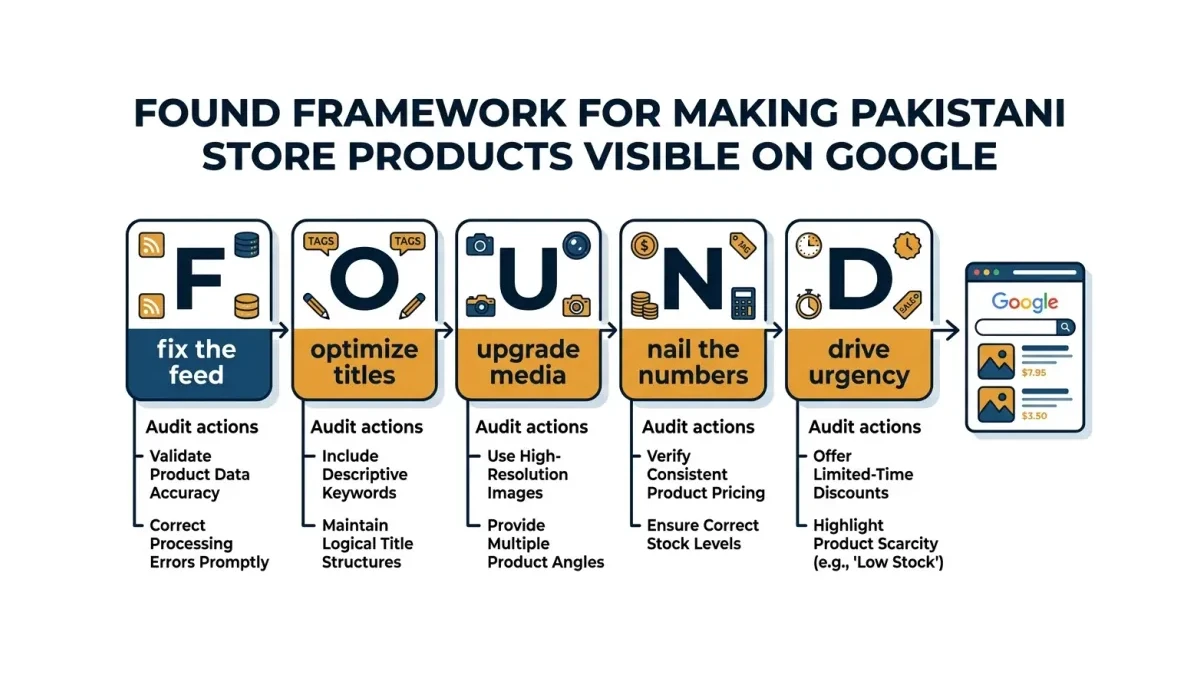
Pakistan’s B2C ecommerce market reached an estimated US$14.11 billion in 2025, up from US$12.46 billion in 2024, and is forecast to reach US$20.41 billion by 2029, per Research and Markets data — yet most Pakistani store owners searching their own product names on Google find competitors, marketplaces, and everything except their own catalog. The invisibility is rarely a mystery; it traces to a machine-readable file most sellers have never opened. The FOUND framework breaks product invisibility on Google into five fixes: F to fix the feed, O to optimize titles, U to upgrade media, N to nail the numbers, and D to drive urgency. Each letter below is one audit pass over the store, and together they cost more attention than money.
A quick definition before the framework. Free listings — product listings Google shows in Shopping surfaces without charging per click — and the product feed — the structured file of titles, prices, images, and stock levels that Google reads instead of crawling your site — are the two objects everything below manipulates. Think of the feed as the rate list you hand a wholesaler at Shah Alam Market: if a line item is missing, mispriced, or unreadable, the buyer simply moves to the next stall. Google behaves the same way, at machine speed.
F — Fix the feed: the data Google reads instead of your website
The pattern repeats across Pakistani stores on Shopify, WooCommerce, and custom platforms: the website looks fine, while the feed behind it is half-empty. Product titles carry internal codes (“SHL-014-BLK”), prices exclude the delivery fee, the availability field says “in stock” for items shelved months ago, and Google Merchant Center quietly disapproves the batch. A disapproved product does not rank poorly; it does not exist, as far as Google Shopping surfaces are concerned.
The audit pass is mechanical. Create a Google Merchant Center account, connect the store through the native Shopify or WooCommerce app or a scheduled feed file, and open the Diagnostics page, which lists every disapproved or warning-flagged item with a reason code. Work the list top-down: price mismatches, missing identifiers like GTIN or brand, broken image links, and landing-page errors account for most Pakistani disapprovals we see documented in support queues. Fixing the feed outranks buying ads for one blunt reason — the free listing surface costs PKR 0 and compounds over time, while paid clicks stop the moment billing stops. Store owners weighing platform economics should also read Shopify vs Daraz: Choosing an Ecommerce Platform in Pakistan, since feed control is one of the clearest arguments for running your own storefront alongside a marketplace presence.
O — Optimize titles for how Pakistanis actually search
Feed titles are not website headlines; they are lookup keys. Google matches them against queries like “winter shawl for women”, “study table 4 feet”, and “baby girl frock 1 year” — which means a title reading “SHL-014-BLK” matches nothing, and a title reading “Ladies Winter Shawl — Warm Wool Blend, Dark Black” matches several intents at once.
Structure titles in the order Google’s product data guidance recommends: product type first, then brand, then the attributes buyers filter on — material, size, color, and city-agnostic qualifiers. Bilingual behavior deserves attention; Pakistani buyers mix English product terms with Urdu descriptors and Roman Urdu phrasing, so “Kurti” outperforms “tunic” in Lahore searches while “formal shoes” outperforms “jutti” in others. Test with the search terms data inside Merchant Center rather than intuition. The same discipline applies to product descriptions on the page itself, which is where the guidance in SEO Rankings vs AI Citations for Pakistani Ecommerce Revenue overlaps with feed work: specific, structured product data is what both classic rankings and AI-generated shopping answers consume.
U — Upgrade the media: 500-pixel images and product videos
Book a free strategy call - we'll audit your current setup and identify the highest-impact fixes.
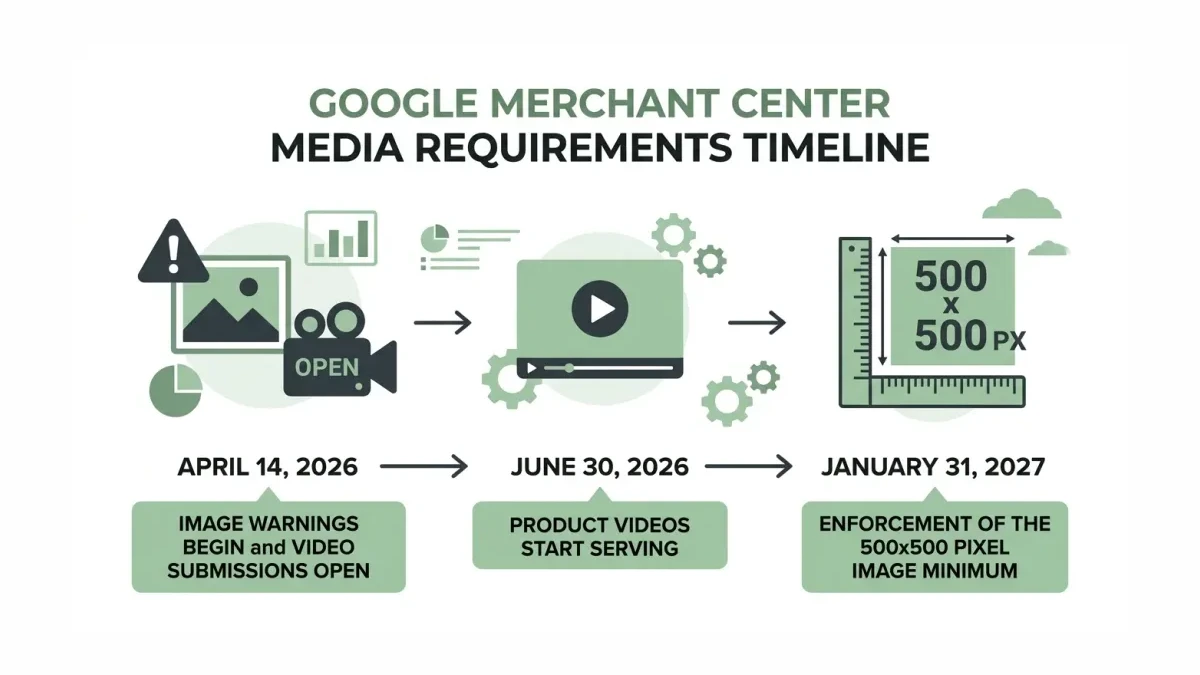
Google’s 2026 specification changes made media the fastest-moving feed requirement, and two dates matter for Pakistani sellers. Image minimums rose to 500×500 pixels across all categories, with Merchant Center warnings issued from April 14, 2026 and enforcement scheduled for January 31, 2027 — listings with smaller images will stop serving on that date, per Search Engine Roundtable’s specification coverage. Google has said it will attempt AI upscaling on some substandard images, but a store that reshots its catalog on any modern phone clears the bar without gambling on upscaling.
Product video is the second shift. The new video_link attribute lets merchants submit product videos through the feed; submissions opened April 14, 2026, and serving plus policy validation began June 30, 2026. Google’s stated intent is direct:
These videos can help showcase products in more detail, showing them in use or from various angles, and will be used to enhance how products are displayed across Google. — Google Merchant Center specification announcement, April 2026
A 20-second phone video with an Urdu or English voiceover — fabric texture, stitching close-ups, the product worn or in use — is cheap differentiation; most Pakistani competitors will not bother, which means the videos that do get submitted stand out on both organic free listings and ad placements. Merchant Center’s Creative Content section now centralizes these video assets and can map them to listings automatically, as Search Engine Roundtable documented.
N — Nail the numbers: prices and stock that stay true
The feed’s price and availability columns are promises, and Google checks them. A listing that claims “in stock” while the product page shows out-of-stock, or a feed price that disagrees with the landing page by even the delivery fee, triggers disapproval and erodes account-level trust. For Pakistani stores, where 55–70% of orders still settle by cash on delivery per Pakistan ecommerce industry estimates, price integrity includes stating COD and delivery terms consistently across feed and page; a buyer who discovers a hidden fee at checkout abandons, and the abandonment signals back into listing quality.
Stock accuracy is also a working-capital instrument, not just a compliance chore. Sales velocity — units sold per day over a set period — converts inventory counts into runway: at 3 units per day, 60 units on the shelf equal a 20-day supply, and an importer whose supplier needs 30 days already has a problem. Practical Ecommerce’s September 2026 analysis puts the case plainly:
A simple inventory count combined with sales velocity can reveal a lot about product demand, order planning, and even how much investment sits idle on warehouse shelves. — Practical Ecommerce, September 2026
Velocity discipline feeds back into the feed deliberately: rising velocity with low stock argues for protecting availability before it breaks, while falling velocity with high stock argues for the promotions covered in the next section. A Karachi importer with PKR 1.2 million locked in slowing inventory has every reason to mark those items down inside the feed rather than watch them age.
D — Drive urgency: promotions with real deadlines
Pakistani retail already runs on deadline-driven moments — Eid collections, Ramadan bundles, the 11.11 sales, August 14 promotions — and Google’s Shopping surfaces now show that urgency natively. Feed promotion attributes and sale price fields attach start and end dates to offers, so a listing can display its own deadline rather than hoping the landing page communicates it. Pair the attribute with a genuine cutoff, because urgency that survives the click converts; urgency that collapses on a stale page returns as a bounce.
Measurement closes the framework. Merchant Center’s performance report was updated on August 24, 2026 to separate YouTube affiliate traffic from organic, giving stores a cleaner read on true free-listing performance, with historical data restated from July 1, 2026, per Search Engine Roundtable’s report. Read free-listing clicks per product weekly; products with impressions but no clicks signal title or image problems, products with clicks but no sales signal price or trust problems, and products with neither signal a feed the system cannot see at all.
Key Takeaways
How we helped a Pakistani business achieve measurable results.
- F — Fix the feed: disapproved items are invisible items; run Merchant Center Diagnostics weekly and clear warnings before they become enforcement.
- O — Optimize titles: product type, brand, then attributes — written the way Pakistani buyers actually type queries.
- U — Upgrade media: clear the 500×500 pixel minimum before January 31, 2027 enforcement, and submit product videos through the video_link attribute now live.
- N — Nail the numbers: price and stock must match the landing page exactly; use sales velocity to protect runway on imported stock.
- D — Drive urgency: attach real start and end dates to Eid, Ramadan, and sale promotions, then read free-listing clicks per product to find the next bottleneck.
Read next: Shopify vs Daraz: Choosing an Ecommerce Platform in Pakistan and Shopify Pakistan Stores: A Success Guide.
The FOUND framework is deliberately something a store owner can audit alone; executing it is another matter when catalogs run past a few hundred SKUs. WeProms Digital, Pakistan’s leading ecommerce marketing agency, builds and manages product feeds and free listings for Shopify, WooCommerce, and custom Pakistani storefronts — feed architecture, disapproval recovery, video attributes, and promotion scheduling — on fixed monthly fees. Write to hello@weproms.com, message WhatsApp +92 300 0133399, or start at weproms.com/contact-us with your store URL for a feed audit.
Frequently Asked Questions
How much does it cost to show my products on Google in Pakistan?
Free listings cost PKR 0 — you need a Google Merchant Center account and a compliant product feed, not an ad budget. Paid Shopping ads are optional and priced per click. The real cost is labor: building and maintaining the feed yourself, or paying an agency a fixed monthly fee to manage it.
Can a Daraz seller use Google free listings?
Not directly from Daraz, because free listings require control over your own product feed and landing pages. Most Pakistani sellers run Daraz for marketplace demand and a Shopify or WooCommerce storefront for Google visibility, then maintain the feed for the storefront catalog.
Why are my products disapproved in Google Merchant Center?
The four most common reasons are price mismatches between feed and landing page, images below the 500×500 pixel minimum (flagged as warnings until January 2027 enforcement), missing required identifiers such as brand or GTIN, and availability that disagrees with the live page. The Diagnostics page lists every flagged item with a reason code, and each fix is a data correction rather than an appeal.
How long do free listings take to appear on Google?
Once a feed passes validation, listings typically begin serving within days; new accounts also face an initial verification review that can stretch the timeline by a week or two. Products submitted with complete data, compliant images, and accurate prices clear fastest.
Can WeProms set up and run my product feed?
Yes. WeProms Digital sets up Merchant Center, builds feeds for Shopify, WooCommerce, and custom platforms, recovers disapproved catalogs, adds video and promotion attributes, and reports on free-listing performance monthly — pricing is published at weproms.com/pricing.
About WeProms Digital
WeProms Digital is Pakistan’s leading ecommerce marketing and product feed agency, headquartered in Lahore, serving Pakistani SMEs, ecommerce brands, and B2B teams across Lahore, Karachi, Islamabad, Rawalpindi, Faisalabad, and Multan.
The team specializes in Google Shopping feed management, free-listing optimization, and ecommerce growth systems, with a track record of fixed-fee feed audits delivered within 48 hours of contact.
Get in touch: hello@weproms.com · WhatsApp +92 300 0133399 · weproms.com/contact-us
Sources & References
- GlobeNewswire — Pakistan B2C Ecommerce Report 2025: A $20 Billion Market by 2029 — January 29, 2026
- Statista — Ecommerce Pakistan Market Outlook — 2026
- ECDB — Pakistan Ecommerce Market Data — 2026
- Search Engine Roundtable — Google Updates Some Merchant Center Product Specs — April 16, 2026
- Search Engine Roundtable — Google Merchant Center Performance Reporting Update — August 12, 2026
- Search Engine Roundtable — Google Merchant Center Adds Creative Content Section — November 7, 2025
- Practical Ecommerce — Sales Velocity Reveals Inventory Risk — September 10, 2026
- Wobooks — Pakistan Ecommerce Report 2026 (COD share estimates) — 2026
Additional reading from industry feeds: