
TL;DR: AI website builders can help Pakistani businesses launch, but a finished storefront still needs careful checkout, payment and mobile testing. There is no verified conversion benchmark here showing that AI-built stores necessarily underperform professional designs. WeProms Digital’s conversion-focused website design service helps businesses assess those practical requirements before committing to a build or redesign.
GoDaddy’s Airo for WordPress illustrates the appeal of conversational website creation. The Martech Series report describes website generation and automated setup. Before buying, confirm which ecommerce features, hosting services and editing options the chosen plan actually includes. A product announcement is a starting point for a shortlist, not an acceptance test for your store.
For a Pakistani entrepreneur launching a snacks brand or selling handcrafted leather goods, the attraction is straightforward: spend less time assembling a website and more time finding customers. That can be a sensible trade-off when demand is uncertain and the catalogue is manageable.
The commercial question comes after generation. Can customers find products, understand delivery terms, use their preferred available payment method and complete an order? A professional build should be judged against those same requirements. The design method alone does not establish a conversion rate or predict revenue.
The custom-versus-template comparison cited previously should not be treated as a reliable forecast for Pakistani stores without checking its sample, methodology and comparability. Budget decisions need evidence from your own customer journey.
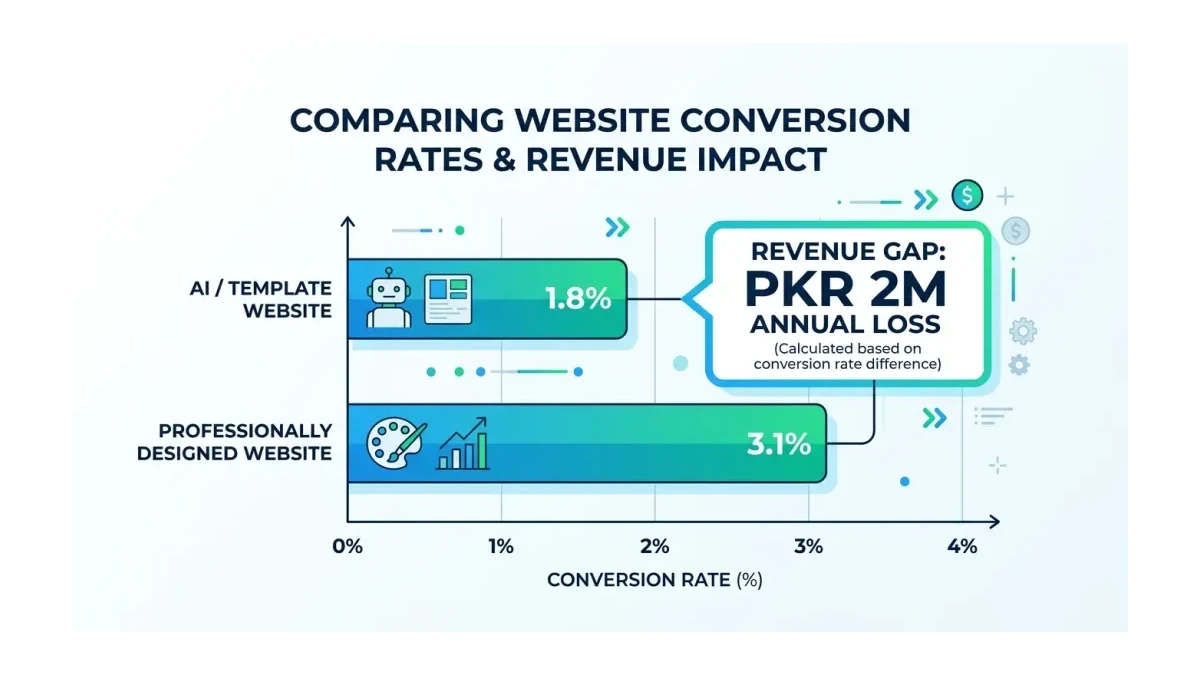
The numerical comparison in this illustration is unverified and should not be used for revenue forecasting.
What does the AI website builder approach get right?
The strongest potential advantages are quicker setup, a manageable initial commitment and an editable starting point. Their value depends on how much work remains before the store can accept and fulfil real orders.
Speed to market matters when a business needs to test demand or prepare for a seasonal launch. Generating page layouts and draft content can shorten the first stage. It does not replace loading accurate product information, checking stock behaviour, configuring delivery or testing order notifications. Judge launch readiness by a completed customer journey, rather than a polished homepage.
Upfront cost can make a builder attractive to a business with uncertain sales. Compare the complete scope before deciding it is cheaper: hosting, domain renewal, paid extensions, payment integration, product entry and support may be separate items. Promotional prices also need to be distinguished from renewal terms. Ask what the quoted package leaves you responsible for finishing.
Basic infrastructure may come bundled with the chosen plan. Check the provider’s current documentation for certificates, backups, caching, updates and recovery support. Avoid assuming that a platform’s speed claim describes your finished shop after product photography, analytics and marketing extensions have been added.
An editable foundation also matters. Ask for a demonstration of routine tasks: changing delivery information, correcting a product description, adding a variant and updating a returns page. If everyday maintenance needs specialist intervention, include that support in the ownership decision.
A small launch can be commercially useful even when the site will later need improvement. Keep product data, content and account access organised so the business can develop the existing store or move when there is a clear reason.
The takeaway: Use a builder when it meets the immediate selling requirements and leaves a workable maintenance path. Revenue alone is not a migration trigger; recurring customer friction or a documented platform limitation is a stronger reason.
Where does the AI-built website break for Pakistani ecommerce?
Problems arise when the generated storefront does not match the business’s payment, delivery, product or support requirements. Those gaps deserve investigation, but they are not inevitable characteristics of AI-built websites. A poorly specified agency build can suffer from the same weaknesses.
Broad market estimates, including ECDB’s Pakistan fashion market data, provide context. They cannot establish how many shoppers abandon your store because of a particular checkout design. Separate the size of the opportunity from the evidence for a specific fix.
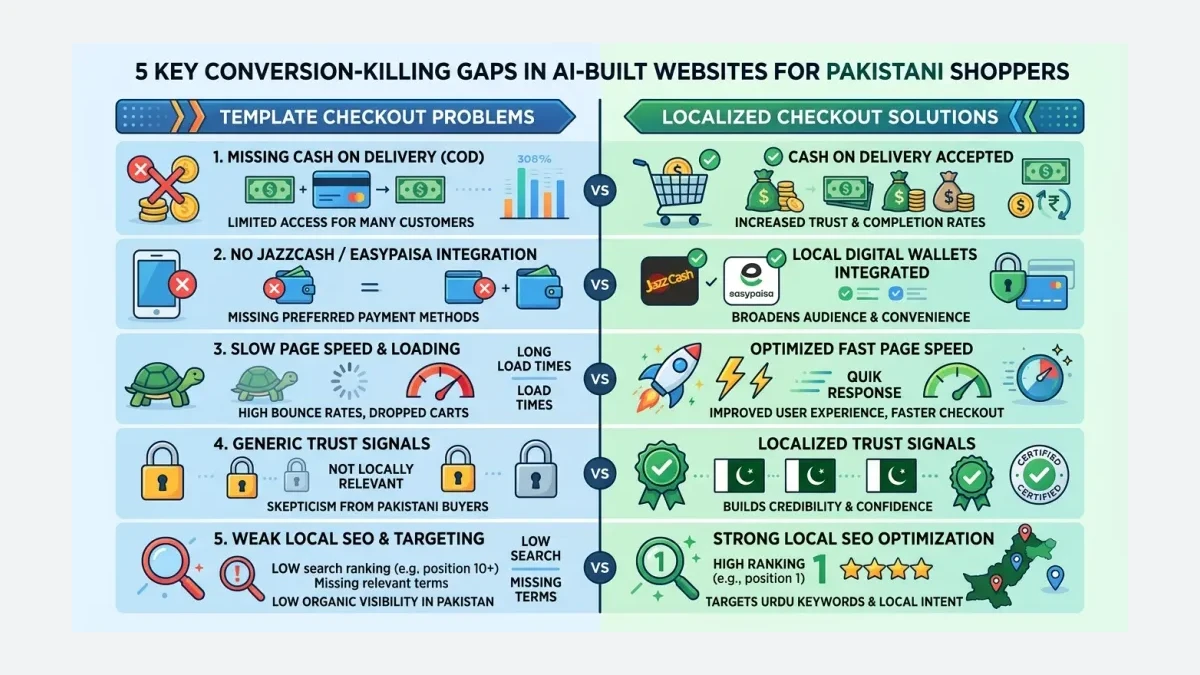
Use the following checks to assess the actual implementation:
| Potential weakness | Conversion concern | Pakistani store check |
|---|---|---|
| Incomplete checkout configuration | Customers cannot use an appropriate payment or delivery option | Test supported COD, JazzCash and Easypaisa journeys |
| Poor catalogue navigation | Shoppers struggle to find or compare products | Check categories, filters, variants and search |
| Incomplete product information | Customers cannot assess suitability or terms | Review descriptions, availability, delivery and returns |
| Heavy pages or unreliable interactions | Shopping becomes slow or frustrating | Test representative phones and connections |
| Generic or unsupported trust claims | Buyers cannot verify the business | Display accurate contact details, policies and genuine reviews |
Checkout deserves particular attention. If you offer cash on delivery, make its availability and conditions clear. If you accept wallet or card payments, ensure the payment option actually works before displaying its logo. A recognised badge does not compensate for a failed transaction or an unexplained delivery charge.
Address fields should reflect how the business delivers orders. Ask customers only for information operations can use, label it clearly and provide helpful error messages. Confirm the address travels correctly into the fulfilment workflow. For a focused review, start with ecommerce checkout optimisation.
Do not assume that an AI builder prevents category pages, payment extensions or subsequent optimisation. Check the specific platform and plan. Likewise, avoid treating missing schema markup as proof that a page is invisible to search or AI systems; that conclusion is too broad to support a redesign decision.
The Cannone Marketing comparison offers another perspective on the trade-offs. Use comparisons to generate questions, then ask providers to demonstrate the capabilities your shop requires.
The takeaway: Document the failing customer task before choosing a remedy. Configuration, content or a focused checkout improvement may resolve it without replacing the website.
How much revenue does a Pakistani SME lose on a template website?
You cannot calculate a store’s lost revenue from the fact that it uses a template. A credible estimate needs its traffic, completed orders, order values and an improvement assumption supported by evidence. Without that information, a large annual loss figure is speculation.
Start by checking the measurement. Decide whether the conversion metric uses sessions or users, and apply that definition consistently. Compare recorded purchases with actual orders. Where cancellations, returns or failed deliveries matter, distinguish an order placed from revenue retained.
Then separate comparable groups. Paid prospecting traffic, returning customers and shoppers arriving through a brand search can behave differently. A change in the mix can move the overall conversion rate even when the checkout itself has not changed.
Use this worksheet instead of assuming that professional design produces a predetermined uplift:
| Metric | Current store | Proposed improvement |
|---|---|---|
| Traffic | Measured visits under a consistent definition | Comparable traffic assumption |
| Conversion rate | Recorded completed-order rate | Evidence-based test hypothesis |
| Orders | Reconciled order count | Visits multiplied by the assumed rate |
| Average order value | Actual order data | State whether it is expected to change |
| Revenue | Orders multiplied by average order value | Modelled revenue under the hypothesis |
| Contribution | Revenue after relevant variable costs | Expected contribution after added costs |
Revenue is only part of the business case. Include payment charges, fulfilment, discounts, cancellations and the cost of implementing and maintaining the change. A redesign that increases order volume can still disappoint if those orders are unprofitable or expensive to support.
Treat retailer comparisons cautiously. Khaadi’s ECDB retailer profile cannot, by itself, establish a suitable target for a smaller store with different products, customers and acquisition channels. Nor does a competitor’s reported rate explain which design decisions caused it.
For a useful forecast, write down the assumption behind each expected improvement. Then assess whether customer feedback, checkout errors, usability observations or a controlled experiment supports it. Keep uncertain gains separate from confirmed savings.
The takeaway: Estimate opportunity from your own funnel and contribution margin. Approve a redesign because the proposed work addresses demonstrated problems, with a way to measure the result.
What does a conversion-focused Pakistani website actually cost?
There is no defensible universal price for a conversion-focused Pakistani ecommerce website. Scope, catalogue complexity, integrations, content, migration and support all affect the quote. A directory listing or international pricing article cannot establish a local package price without a matching specification.
Clutch’s Pakistani developer directory and Innowise’s redesign cost guide can help frame supplier questions. Ask for a written proposal in the currency you will pay, with taxes, recurring fees and exclusions identified.
These broad approaches are useful for comparing scope:
| Approach | Scope to clarify | When to consider it |
|---|---|---|
| Template customisation | Theme setup, content, payment configuration, mobile checks and handover | The existing platform meets the business requirements |
| Semi-custom build | Tailored layouts, catalogue behaviour, integrations and measurement | Standard components need meaningful adaptation |
| Full custom build | Bespoke functionality, integration ownership, testing and ongoing maintenance | Documented requirements cannot be met economically with existing tools |
A higher tier is not automatically a better investment. Ask the supplier to explain why a standard feature or extension cannot meet each proposed custom requirement. Also establish who will maintain custom work after launch and what happens when connected services change.
For builders, include subscriptions and the work required to make the generated shop operational. For agency proposals, check whether photography, copy, product loading, merchant onboarding and post-launch support are included. The AI website builder cost guide for Pakistani stores offers a related budgeting discussion.
WeProms Digital can discuss design and implementation requirements around local payment options, delivery rules and mobile shopping. Those requirements should appear in the agreed scope, with clear acceptance checks and responsibility for any third-party approvals.
Avoid a guaranteed recovery period. Payback depends on the actual improvement in contribution after implementation and ongoing costs. An attractive forecast is not a substitute for demonstrating that the proposed change solves the customer’s problem.
The takeaway: Compare complete, like-for-like proposals. Budget for the smallest effective intervention, and require a measurable rationale before approving a larger rebuild.
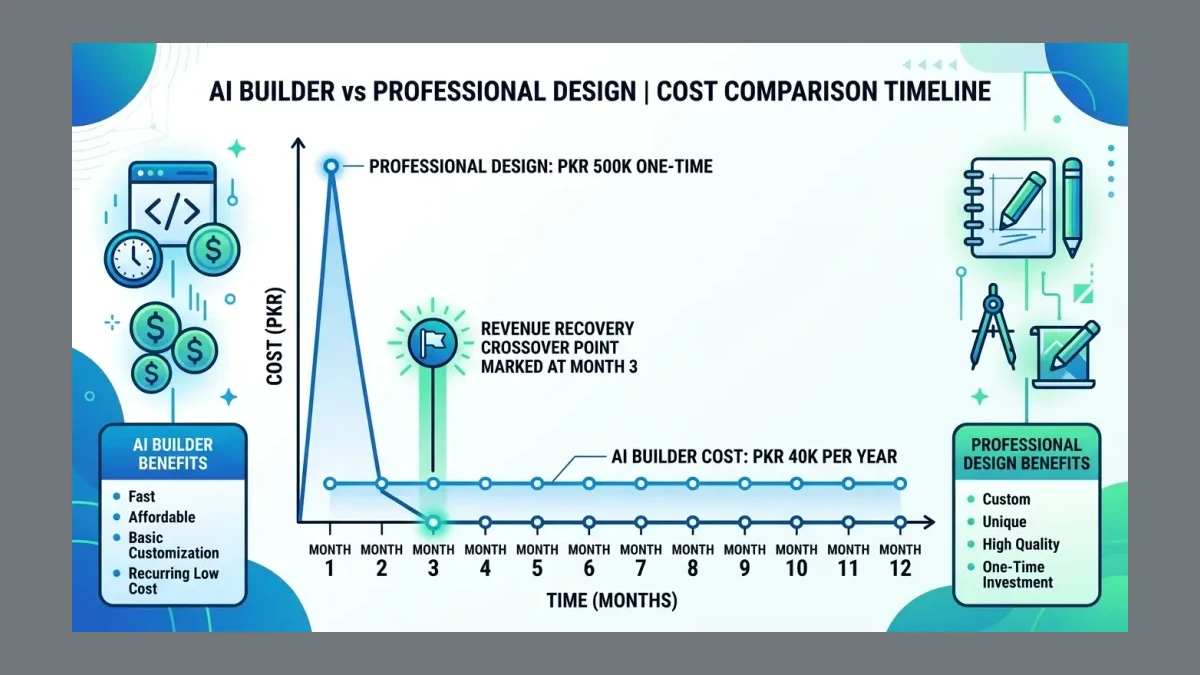
The prices and recovery timeline in this illustration are unverified; obtain a scoped quote and assess payback using your own results.
Why do Pakistani shoppers abandon AI-built sites faster?
There is no verified evidence here that Pakistani shoppers abandon a website faster simply because AI helped build it. The useful question is whether the implementation introduces friction around payment, mobile use or trust. Inspect those areas directly instead of assigning the cause to the builder.
Payment clarity is a practical starting point. Make available methods easy to understand before the customer commits to checkout. Explain any COD eligibility rules, payment charges or delivery restrictions. Do not promise inspection before payment unless your fulfilment arrangement explicitly allows it, and avoid describing COD as eliminating fraud risk.
Customers may have different preferences. Review payment selection, failures and support enquiries before choosing the order in which methods appear. If a payment method is advertised on a product page but unavailable for the customer’s order, explain the restriction clearly.
Mobile experience quality needs testing on the finished store. Check that buttons are easy to tap, text remains readable and product options are understandable. Follow the checkout while entering an address, correcting an error and returning from a payment service. A responsive preview alone does not establish that these interactions work comfortably.
Use representative devices and connections instead of a national average speed as a performance target. The KPMG banking report previously cited should not substitute for measurements of your shop. A focused mobile conversion review can help connect technical issues with customer tasks.
Think of shopping at Liberty Market in Lahore. Clear prices, useful answers and an identifiable seller give a buyer reasons to proceed. Your website needs to provide comparable clarity through product details, contact information and delivery terms.
Trust signals should be genuine. Show accurate business details, relevant registration information where applicable, authentic customer reviews and understandable returns or warranty terms. Do not fabricate local testimonials, merchant badges or team photographs. A payment logo should describe an available service, not imply an endorsement you do not hold.
The takeaway: Follow the entire purchase journey on a phone. Look for unanswered questions and failed tasks, then prioritise fixes using customer evidence rather than assumptions about what every Pakistani shopper wants.
Which Pakistani businesses should avoid AI website builders entirely?
A business should avoid a particular builder when it cannot meet essential operational or customer requirements. Monthly revenue, advertising spend and catalogue size alone do not establish that boundary. A growing brand may remain well served by a standard platform with professional configuration.
Use business requirements to guide the decision:
| Business profile | Builder suitability | Professional input |
|---|---|---|
| Startup testing demand | Consider if core ordering requirements are met | Review launch essentials |
| Store with a straightforward catalogue | Assess product, payment and delivery capabilities | Address specific usability gaps |
| Growing catalogue or complex variants | Test search, filtering and inventory workflows | Plan configuration or integration work |
| Established brand | Assess reliability, ownership and ongoing requirements | Audit before recommending migration |
| B2B services with lead forms | Test form handling and enquiry workflows | Review qualification and follow-up needs |
| Products needing detailed advice or terms | Assess information and support requirements | Review content and purchase decisions |
Escalate when the limitations are concrete: required payment support is unavailable, stock cannot be managed reliably, important information cannot be presented clearly, or the team cannot maintain the store safely. Document the requirement and ask whether configuration can solve it before commissioning a rebuild.
For businesses running Google Ads or Meta Ads, examine the experience after the click. Does the landing page match the advertisement? Are advertised products available? Are delivery charges and purchase conditions clear? A professional redesign does not automatically make acquisition profitable, and a template does not automatically waste the advertising budget.
Compare advertising results using completed, commercially meaningful orders. An apparent improvement in tracked purchases needs checking against cancellations and fulfilment outcomes. Include any change in traffic quality when assessing whether a design intervention helped.
Products that require more consideration need enough information for a confident decision. Electronics may need clear specifications and warranty details; fashion may need sizing and returns information. Build those requirements from actual customer questions rather than an arbitrary order-value threshold.
WeProms Digital can help assess whether the constraint is design, configuration, content or the platform itself. The resulting recommendation should identify the problem, proposed work and evidence that will determine success.
The takeaway: Switch platforms when a documented limitation justifies the cost and disruption. Where the platform remains suitable, targeted improvements may be the more practical investment.
The choice between an AI builder and professional support depends on what the business needs to sell reliably. Generation can help with the starting point; ongoing attention to products, payments, delivery and usability determines whether the store remains fit for purpose.
Before replacing a website, establish where customers struggle and what the existing platform can support. A clear brief makes both a builder-led launch and an agency engagement easier to judge. Keep account ownership, maintenance and measurement responsibilities explicit.
If your store has conversion bottlenecks, WeProms Digital can discuss the scope of an audit or design project. Reach out at hello@weproms.com or message on WhatsApp at +92 300 0133399 with the customer problems you want to resolve.
Read next: Your Pakistani Store Gets Traffic but Few Orders: What a Conversion Audit Can Answer
Frequently Asked Questions
How much does a professional website cost for a Pakistani SME?
The price depends on the agreed scope, integrations, content, migration and support. Request itemised proposals and distinguish launch costs from recurring commitments. A quoted build price does not establish its return on investment; assess the expected contribution from improvements and confirm how results will be measured.
Are AI website builders like GoDaddy Airo good for Pakistani businesses?
They are worth considering when their current capabilities meet the business’s requirements. Check the specific plan, payment options, delivery configuration and maintenance arrangements before committing. Test a realistic order journey. Do not assume either a guaranteed conversion disadvantage or a complete operational store from the generated preview.
Why do Pakistani online shoppers prefer cash on delivery?
For customers who prefer it, paying on delivery can reduce concern about paying an unfamiliar seller in advance. It should not be described as eliminating fraud or guaranteeing inspection before payment. Explain the actual delivery terms and use your own payment and customer feedback data to decide how prominently COD belongs.
How do I add JazzCash and Easypaisa to my Pakistani ecommerce site?
Confirm merchant eligibility and the currently supported integration route with the payment provider and your ecommerce platform. Establish who handles onboarding, configuration, testing and maintenance. Before launch, check payment confirmation, failed or interrupted payments and order reconciliation. Display payment logos only for methods customers can actually use.
What conversion rate should a Pakistani ecommerce store target?
Start with a reliable baseline for your own store and comparable customer segments. Product mix, traffic source, device and purchase intent affect how useful an external benchmark is. Choose an improvement goal linked to observed friction, and evaluate completed orders alongside profitability and fulfilment outcomes.
When should a Pakistani business switch from an AI-built website to professional design?
Seek professional input when customer problems exceed the team’s capacity to diagnose or fix them. Switch platforms when essential requirements cannot be met effectively on the existing system. A revenue milestone or catalogue size is not enough on its own; configuration or focused design work may resolve the issue.
What is the best web design agency in Pakistan for ecommerce conversion?
Compare agencies by relevant work, their diagnosis of your problem, testing approach, implementation scope and support arrangements. Ask how they will distinguish design effects from traffic changes. To discuss WeProms Digital’s approach, contact hello@weproms.com or use WhatsApp.
Key Takeaways
- A builder’s design method does not establish a store’s conversion rate. Evaluate the actual customer journey.
- Check supported payment options, delivery rules and order handling before considering a generated storefront ready to sell.
- Use genuine business information, clear product details and understandable policies to answer customer concerns.
- Compare complete ownership costs and scoped proposals; avoid guaranteed revenue uplifts or payback periods.
- Base a redesign or migration on documented constraints, measured results and the smallest effective remedy.
About WeProms Digital
WeProms Digital works with Pakistani SMEs, ecommerce brands and B2B teams on website design and ecommerce optimisation.
The team’s approach focuses on customer journeys, payment and delivery requirements, mobile usability and measurement. Project scope should reflect the store’s operational needs, with responsibility for third-party services and ongoing maintenance agreed before implementation.
Get in touch: hello@weproms.com · WhatsApp +92 300 0133399
Sources & References
These links provide background reading. They should not be treated as substantiation for a universal Pakistani conversion benchmark, guaranteed revenue uplift or fixed local project price.
- Martech Series — GoDaddy Airo for WordPress
- Webiators — Custom vs Template Websites
- ECDB — Pakistani Fashion Ecommerce Market
- ECDB — Khaadi Retailer Profile
- Cannone Marketing — AI Website Builder vs Professional Web Design
- Clutch — Pakistani Web Developers
- Innowise — Website Redesign Cost Breakdown
- KPMG — Pakistan Banking Perspective
Additional reading from industry feeds: