
TL;DR: Before increasing acquisition spend, check whether visitors can understand your offer, trust your business and complete an order or enquiry. A CRO audit investigates friction and turns the findings into a prioritised improvement plan. WeProms Digital’s conversion rate optimisation programme connects that diagnostic work with implementation and testing.
More website visitors can generate more sales. But when a checkout fails, a landing page confuses buyers or a mobile form is difficult to use, additional traffic sends more potential customers into the same obstacles. Before increasing budgets for SEO, Google Ads or social campaigns, understand what happens after the click.
The commercial question is straightforward: could improving the experience make your existing traffic more valuable? A store that converts more of its qualified visitors can generate additional orders without a corresponding increase in visits. Whether that route is cheaper than acquiring more traffic depends on implementation costs, customer demand, margins and the results achieved.
Conversion rate optimisation (CRO) is the process of improving the proportion of visitors who complete a desired action. That might be buying a product, requesting a quote or submitting an enquiry. Define that action carefully: a WhatsApp click is useful, but it is not automatically a qualified lead or a completed sale.
Picture a queue outside a NADRA office where people cannot find the correct counter or paperwork. Attracting more people does not resolve the confusion. Clear instructions and a workable process help the people already there. A website audit applies that same practical thinking to the journey between arrival and action.
Why Does More Traffic Not Fix a Broken Conversion Funnel?
More traffic does not repair an obstructed conversion journey. A broken payment option remains broken regardless of campaign reach. Conversion rates can still change with audience quality, channel mix, seasonality and offers, so a rising or falling rate alone does not prove the website improved or deteriorated.
Start with your own baseline rather than a supposed national average. Compare similar visitors, devices and landing pages over comparable periods. Separate purchases from enquiries, and define whether the denominator is users or sessions. Otherwise, apparently impressive benchmarks can compare fundamentally different customer actions and measurement methods.
The Pakistan-versus-global figures previously used here lack verified support for a meaningful current comparison. They should not set your revenue forecast or become targets for an audit. A specialist retailer, a wholesale supplier and a clinic have different buying journeys; their conversion rates are not interchangeable measures of website quality.
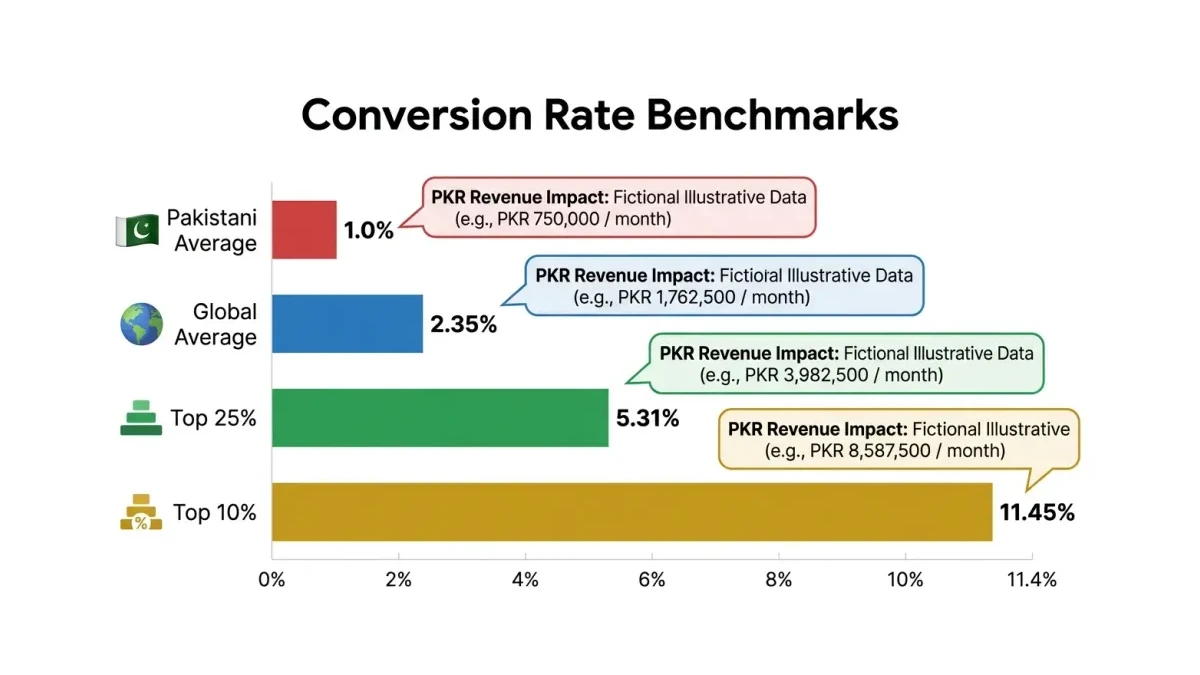
The figures in this existing graphic are unverified. Use your own measured baseline when planning improvements.
Estimate the commercial opportunity from additional completed orders and contribution margin, allowing for cancellations, returns and delivery costs. For a lead-generation business, connect enquiries to qualified opportunities and eventual sales. Revenue from an extra order is not pure profit, and a higher form-submission rate can conceal poorer lead quality.
Traffic investment and CRO can work together. If the site already provides a reliable buying experience but attracts few suitable visitors, acquisition may deserve priority. If campaigns bring interested shoppers who repeatedly encounter preventable obstacles, investigate those obstacles before expanding spend. The audit should help you choose, rather than assume conversion work always wins.
What Does a CRO Audit Reveal That Google Analytics Alone Cannot?
A CRO audit combines measurement, observation and customer feedback to investigate why a journey underperforms. Analytics can show where recorded activity drops away, provided the relevant events are collected correctly. It cannot, by itself, establish whether someone left because of price, confusion, a technical problem or an intention to return later.
Heatmaps show patterns in recorded interactions, such as clicks and scrolling. Session recordings help reviewers inspect navigation, repeated attempts and apparent obstacles. User feedback polls let visitors explain concerns in their own words. Together, these methods produce evidence for hypotheses; they do not reveal every visitor’s motivation with certainty.
Microsoft Clarity is an option to assess for behavioural analysis. Confirm its current installation instructions and data settings before use, then check that the relevant journeys appear in your recordings. Data collection needs a working setup; simply opening an account does not establish that tracking is complete or useful.
An audit should also check whether recorded conversions correspond to real outcomes. A thank-you page might be reached more than once, while a successful WhatsApp sale might never appear as a website purchase. Reconcile the tracking with order records or your lead-management process before estimating the value of any proposed improvement.
A useful UX audit and conversion analysis links each finding to the affected page, observed behaviour and proposed fix. It should distinguish a reproducible defect from a design preference. An estimate of revenue impact is a planning assumption, not a promise that a particular change will recover that amount.
Prioritise findings by likely customer impact, strength of evidence and implementation effort. Include screenshots or reproducible steps so developers can act on the recommendation. The CRO audit checklist for Lahore businesses provides a practical starting point for reviewing the journey and organising findings.
How Does Mobile Conversion Behaviour Differ for Pakistani Shoppers?
For Pakistani shoppers, mobile usability, payment preferences and assisted ordering deserve attention. Their importance varies by business and audience. Do not assume every visitor has the same connection quality, prefers cash on delivery or wants to order through WhatsApp. Check what your customers actually use and where they encounter difficulty.
Compare mobile and desktop journeys within your own data. Look at the landing pages each group reaches, their traffic sources and the actions they attempt. A lower mobile purchase rate may reflect usability problems, but it can also reflect different intent or people researching on a phone before completing an order elsewhere.
Test the site on representative phones and network conditions. Can visitors read product details, dismiss overlays, select a variant and reach the checkout? Check whether sticky banners obscure buttons and whether keyboards cover form controls. A mobile conversion review should examine the complete journey, including errors and recovery.
Speed deserves its own investigation. Large images, unnecessary scripts and unstable layouts can make shopping frustrating, but there is no dependable universal conversion uplift for compressing images. Measure the actual bottleneck, apply an appropriate fix and check the result. Preserve the clarity of product photography when reducing file sizes.
Present payment options clearly before customers invest effort in checkout. Where cash on delivery is available, explain eligibility, charges and confirmation requirements. Where it is unavailable, avoid implying otherwise. Choose the order and presentation of payment methods using customer evidence and operational constraints, then assess both completed orders and fulfilment outcomes.
WhatsApp can support customers who need reassurance or help choosing a product. Make the next step clear and ensure someone can respond. Track whether conversations become qualified enquiries or fulfilled orders. Our guide to ecommerce conversion audits for Pakistani stores explores how to investigate these gaps without treating every contact as a sale.
What Does a CRO Audit Cost for Pakistani Businesses?
A useful CRO quote depends on scope, access to reliable data, journey complexity and the work included after diagnosis. There is no verified current Pakistan-wide price range established here. Ask for a written proposal that separates the audit, implementation, testing tools and ongoing monitoring so you can compare like-for-like offers.
The scope can be organised into these broad categories:
| Audit Scope | Pricing Basis | Pages Analysed | Deliverable |
|---|---|---|---|
| Landing Page Audit | Quote for the agreed campaign journey | Campaign pages and their conversion steps | Evidence-led findings and prioritised recommendations |
| Full Site Audit | Quote for site complexity and research depth | Representative templates and key journeys | Behavioural analysis, measurement review and test plan |
| Ecommerce CRO Audit | Quote for purchase-flow complexity and support | Product discovery, product pages and checkout | Checkout findings, implementation scope and monitoring plan |
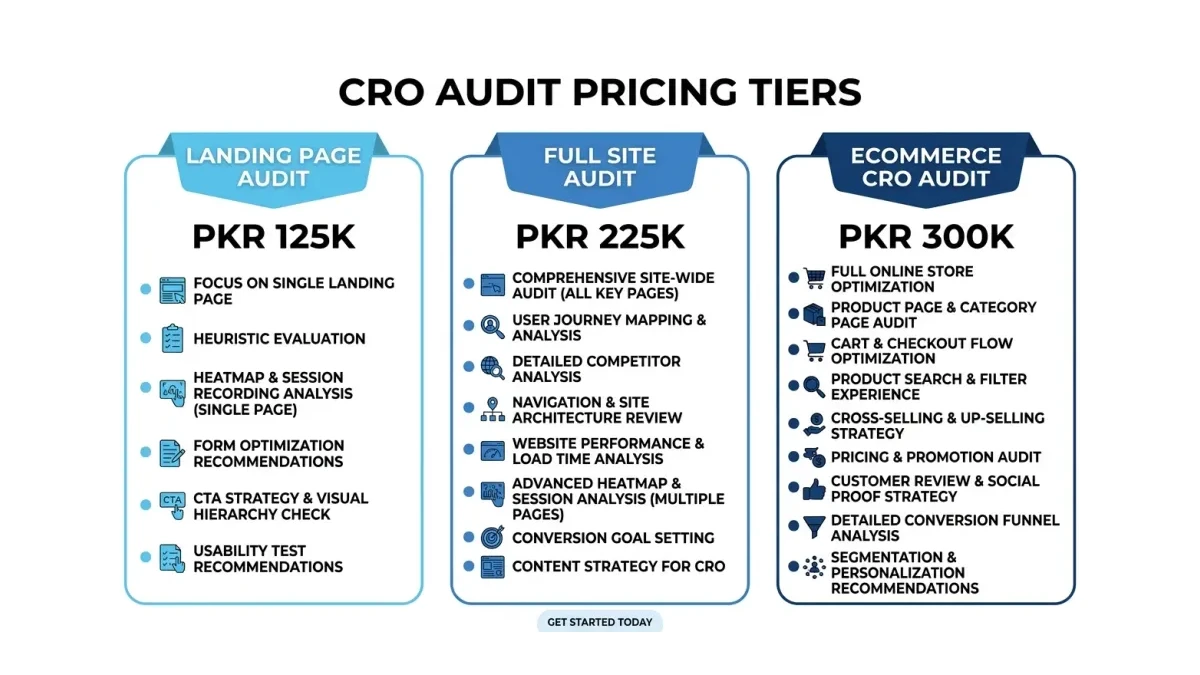
The prices in this existing graphic are unverified and should not be treated as a current rate card.
A landing page audit suits a business sending campaign traffic to a defined offer. The review should follow the visitor beyond the landing page into the form, booking process or checkout. An attractive page offers little commercial benefit if the enquiry fails to reach your team or the payment step does not work.
Assess the investment using realistic assumptions about implementation costs and the value of additional customers. Include development time, research, tool subscriptions and any maintenance required. Ask what happens if the audit finds a problem outside the original scope, and who will verify that each agreed fix works after deployment.
For tools such as Clarity, Hotjar, VWO or Optimizely, check current features, usage limits and pricing directly before budgeting. Avoid assuming that feedback collection, recordings and experimentation are bundled together. Begin with the capabilities your investigation needs, then expand when a clear research or testing requirement justifies the cost.
Which CRO Fixes Can Deliver the Fastest Return for Pakistani Websites?
Start with observable obstacles: failed submissions, unclear charges, unavailable payment methods and controls that do not work on mobile. These deserve attention before cosmetic changes because they can prevent an otherwise willing customer from progressing. The order of work should follow evidence from your site, rather than a universal list of guaranteed winners.
Give each landing page a clear primary action that matches the visitor’s intent. Supporting actions can still be useful: a shopper may need sizing advice before buying, while a prospective client may want to inspect previous work. Make the hierarchy understandable and test whether people can identify the next step without hesitation.
Video can help demonstrate a product or explain a service when it answers a real customer question. It also requires production effort, accessible presentation and attention to page performance. Do not add it solely because of a headline uplift statistic. Keep essential information available in text so visitors can act without watching.
Review whether account creation is necessary before purchase. Guest checkout may remove an avoidable obstacle, but the effect depends on your existing journey and customers. Check that customers can still obtain order updates, correct mistakes and request support. Ecommerce checkout optimisation should cover the full transaction, including delivery information and payment errors.
Trust signals should answer specific doubts. Show clear contact details, accurate delivery expectations, understandable return terms and useful product information. Avoid decorative badges or promises your operations cannot support. Reassurance is strongest when the website’s claims match what customers experience after placing an order.
Treat rollout and measurement as part of the fix. Record what changed, verify the affected journey and watch for unintended consequences. Where appropriate, use a controlled experiment; where traffic is limited, combine careful observation with operational outcomes. A before-and-after improvement can be encouraging without proving that the change caused it.
Read next: Cart abandonment and conversion improvements for Pakistani ecommerce.
If your business attracts visitors but struggles to turn interest into customers, WeProms Digital can help investigate the journey and develop a prioritised roadmap. Discuss scope, implementation responsibilities and monitoring before starting. Contact hello@weproms.com or WhatsApp +92 300 0133399 to explain your conversion goals.
Frequently Asked Questions
What is a CRO audit and why do Pakistani businesses need one?
A CRO audit investigates obstacles between a website visit and a useful customer action. It brings together analytics, journey checks, behavioural observations and customer feedback. Pakistani businesses can use it to identify problems with mobile browsing, enquiries, payment choices or checkout. The case for an audit should come from your business’s evidence, rather than an unsupported national conversion benchmark.
How much does a CRO audit cost in Pakistan?
Pricing depends on the journeys reviewed, research depth, quality of existing measurement and implementation support. Request an itemised quote with clear deliverables and exclusions. Check whether development, experimentation software and follow-up analysis are included. A cheaper report may still require substantial work before recommendations can be deployed, so compare the total likely investment rather than the report price alone.
What conversion rate should a Pakistani website target?
Set a target from your own baseline, business economics and comparable customer journeys. Define the conversion event and denominator consistently, then examine results by device, source and customer type. For ecommerce, assess fulfilled orders and profitability alongside checkout completion. For service businesses, assess qualified enquiries and eventual sales. An arbitrary industry target can encourage changes that increase activity without improving the business.
What tools do you need for a CRO audit?
You need reliable measurement of the journey, a way to inspect usability and a way to gather customer feedback. GA4, Clarity and Hotjar are tools to assess against those needs; experimentation platforms may become useful when you have suitable hypotheses and traffic. Check current availability, plans and implementation requirements directly. Tool access alone does not replace careful interpretation or working conversion tracking.
How does cash on delivery affect CRO for Pakistani websites?
Where customers prefer COD, unclear availability or unexpected conditions can create checkout friction. Explain eligible locations, delivery charges and confirmation requirements before the final step. Evaluate payment presentation using your own customers’ behaviour, then connect placed orders with successful delivery. An increase in COD orders may be less valuable if cancellations, failed deliveries or support costs rise alongside it.
How long does it take to see results from a CRO audit?
The timeline depends on access to data, development capacity, traffic and the customer buying cycle. A reproducible technical defect may be fixed quickly, while a design hypothesis needs observation and testing. Agree on implementation milestones separately from the measurement period. Avoid promising a reliable uplift before enough relevant outcomes have accumulated, particularly when sales volumes are low or demand is seasonal.
Which CRO agency should Pakistani businesses hire?
Look for a team that explains its evidence, checks measurement and distinguishes recommendations from proven results. Ask who implements changes and how success will be assessed. WeProms Digital works with Pakistani businesses on CRO audits and improvement plans. Contact hello@weproms.com or WhatsApp +92 300 0133399 to discuss your website, commercial goals and the support you need.
Key Takeaways
- Investigate the existing journey before increasing acquisition spend when visitors encounter clear obstacles. More traffic can add sales, but it does not repair a broken checkout or confusing form.
- Use a consistent definition of conversion and compare relevant segments. National averages and unrelated industry benchmarks are weak foundations for forecasts when their methods and applicability are unclear.
- Review mobile usability, page performance and payment choices using your own customers’ experience. Do not assume that every Pakistani audience behaves alike or needs the same solution.
- Prioritise reproducible defects and well-supported findings. Clear actions, useful reassurance and simpler checkout steps are hypotheses to assess, rather than sources of guaranteed percentage gains.
- Compare audit proposals by scope, implementation responsibilities and total cost. Tool subscriptions and ongoing analysis should be explicit, and return on investment should reflect margins and fulfilment outcomes.
- Measure after deployment and keep checking the journey. Conversion improvements need maintenance as products, campaigns, customer expectations and the website itself change.
About WeProms Digital
WeProms Digital is based in Lahore and works with Pakistani SMEs, ecommerce brands and B2B companies. Its conversion work focuses on understanding where visitors encounter difficulty and translating findings into practical improvements for the business.
The team specialises in CRO audits, landing page optimisation, ecommerce checkout optimisation and mobile conversion improvement. Discuss the available evidence, implementation scope and reporting approach before agreeing on a project. Targets should reflect your site’s starting point and commercial priorities rather than a promised universal uplift.
Get in touch: hello@weproms.com · WhatsApp +92 300 0133399
Sources & References
These resources provide background reading. Their inclusion does not verify the previously quoted figures or establish current Pakistani benchmarks, agency prices or expected results. Check each source’s methodology, publication context and product terms before applying it to a business decision.
- Digital Applied — Conversion Rate Benchmarks
- Searchlab — Conversion Optimisation Statistics
- LoopEx Digital — CRO Statistics
- DollarPocket — Ecommerce Conversion Rate Optimisation
- Involve Digital — Conversion Rate Optimisation Guide
- Microsoft Clarity
- Baymard Institute — Checkout UX Research
- Buffer — Social Media Marketing Guide
Additional reading from industry feeds: