
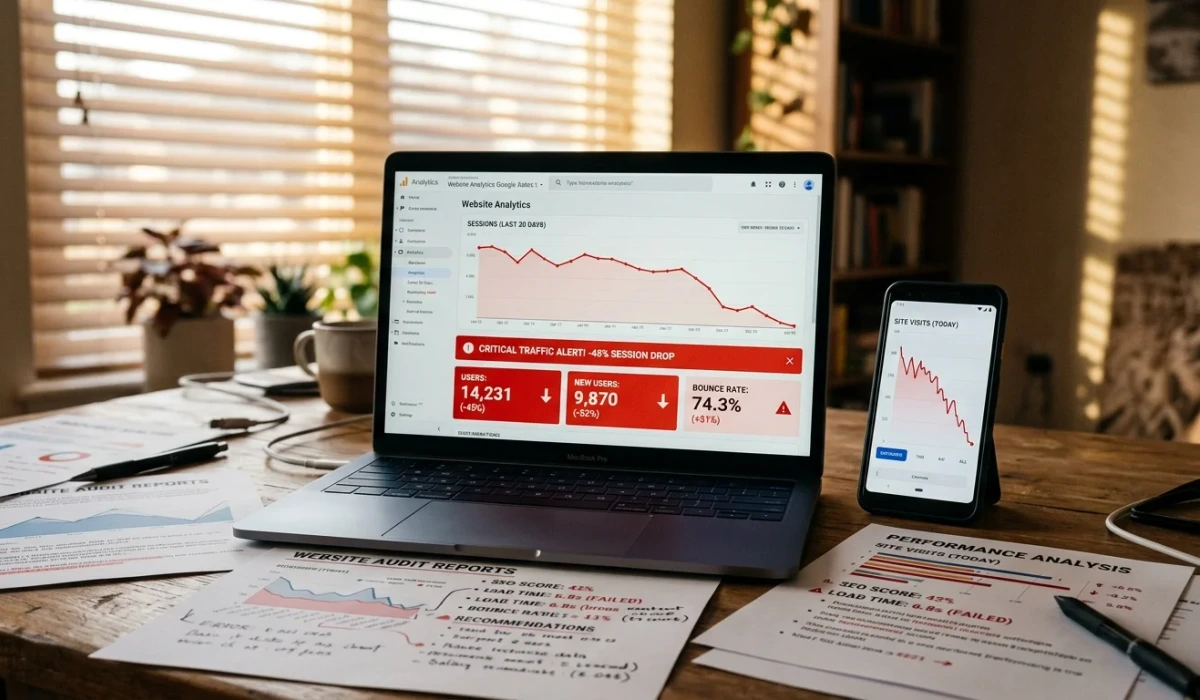
TL;DR: Missing pages in Google Search Console deserve investigation, but they do not automatically indicate a penalty. Check crawl access, indexing directives, canonical signals, content usefulness and deceptive scripts. Core Web Vitals matter for user experience and rankings; failing them is not an automatic reason for removal from Google’s index. WeProms Digital’s technical SEO audit service helps businesses identify which problems actually need fixing.
Imagine a Lahore fashion retailer opening Search Console and finding that indexed pages have fallen sharply. There is no manual action notification, and the website still works. Before blaming an algorithm update, the team needs to establish which URLs disappeared, whether they were previously indexed, and whether Google now indexes another version of the same content.
That distinction matters. A page can lose rankings while remaining indexed. A duplicate URL can disappear while its canonical version remains searchable. A genuinely deindexed product page may stop attracting search visits even though customers can still open it directly. These situations need different responses.
Think of Google’s index as a catalogue rather than a permanent business registration. Google discovers pages, crawls them and decides which versions to include. Your job is to make important pages accessible, useful and clearly connected to the rest of the site, then investigate the evidence when their status changes.
Why might Pakistani website URLs disappear from Google’s index?
Search Engine Roundtable reported concerns about increased deindexing, but the report collected industry observations rather than Pakistan-specific measurements. It also included Google’s response that nothing exceptional was apparent. That does not establish a nationwide surge or prove that a particular update caused your site’s losses.
Google’s technical requirements provide a more useful starting point: Googlebot must be able to access the page, the page must return a successful response, and it must contain indexable content. Meeting those requirements makes a page eligible for indexing; it does not guarantee inclusion.
For a Pakistani business, the practical investigation covers five areas: blocked crawling or unavailable servers; accidental indexing exclusions; conflicting canonical and redirect signals; pages with little distinct value; and scripts that violate spam policies. Performance problems can accompany these issues, but should not be treated as proof of deindexing by themselves.
Start with changes you can trace. Was a staging-site setting copied to production? Did a theme update add an indexing directive? Did a migration leave product links pointing through redirects? Did a firewall begin challenging Googlebot? Match deployment records against affected URL groups before drawing conclusions about an update.
Compare the important canonical URLs you want indexed with the URLs Google actually indexes. A sitemap is a discovery aid, not a promise that every submitted address belongs in search. If clicks fell while those pages stayed indexed, our guide to why Pakistani websites lose Google traffic provides a broader diagnostic starting point.
How does the back button hijacking penalty affect Pakistani websites?
Back button hijacking happens when a site interferes with browser navigation, preventing visitors from returning normally to the page they came from. Google announced its explicit spam-policy update on April 13, 2026, with enforcement starting June 15, 2026. It describes potential manual spam actions or automated demotions, rather than immediate, guaranteed deindexing of every affected URL.
The policy applies to Pakistani websites just as it does elsewhere. There is no evidence here that local themes or marketplaces are disproportionately responsible. Google specifically warns that included libraries and advertising platforms can introduce the behaviour, so a site owner needs to review third-party code as well as custom scripts.
Test a normal visitor journey on mobile and desktop. Arrive from another page, follow links, interact with a pop-up if one appears, and use the browser’s back button. Investigate if visitors are trapped, sent to an unexpected advertising page or prevented from returning to their previous destination.
A reload alone does not establish a violation. Likewise, history.pushState and history.replaceState have legitimate uses in web applications. Ask your developer to inspect how the site changes browser history and whether those changes deceive or obstruct visitors. Removing every history-related call could break working navigation without addressing the actual problem.
Disable the offending behaviour, test the affected templates and check Search Console’s Manual Actions report. If a manual action exists, follow its instructions and submit a reconsideration request after fixing the issue. Keep the evidence of what changed so the review explains the problem and its resolution clearly.
What role do Core Web Vitals play in Google indexing decisions for .pk domains?
Core Web Vitals (CWV) measure loading performance, visual stability and responsiveness. Google says these metrics are used by its ranking systems. They are not listed as minimum technical requirements for indexing, and a poor assessment does not establish why a page disappeared.
There is no verified dataset behind the Pakistan-wide pass rates previously associated with this article. Assess your own pages using field data rather than assuming a national average describes your customers’ experience. Different templates, devices and hosting conditions can produce very different results within the same website.
The diagnostic questions remain practical. Does the main product image arrive late? Do promotional banners push content around? Does a tap on the navigation wait behind unnecessary JavaScript? Our Core Web Vitals audit guide explains how to investigate those symptoms without confusing performance work with indexing eligibility.
Google’s published Core Web Vitals thresholds define a good result as follows. Field assessments use the 75th percentile of recorded experiences, so a quick test on an office connection does not represent every visitor.
| CWV Metric | Good Threshold | What to Inspect | Possible Failure Cause |
|---|---|---|---|
| LCP (loading) | ≤ 2.5 seconds | Main content loading | Large images, slow responses |
| CLS (visual stability) | ≤ 0.1 | Unexpected movement | Unsized media, late widgets |
| INP (responsiveness) | ≤ 200 milliseconds | Delayed interactions | Long JavaScript tasks |
| All three combined | All meet good thresholds | Field assessment | Problems across page templates |
Run representative pages through PageSpeed Insights. Separate real-user field data from the diagnostic lab test. If field data is unavailable, that does not mean the page failed; use the available diagnostics to investigate and test your changes.
Prioritise fixes supported by the results: image delivery, server response, reserved space for media or unnecessary scripts. Better performance can help customers browse and buy. It does not guarantee reindexing, and there is no defensible fixed ratio between paid clicks and organic visits recovered through speed improvements.
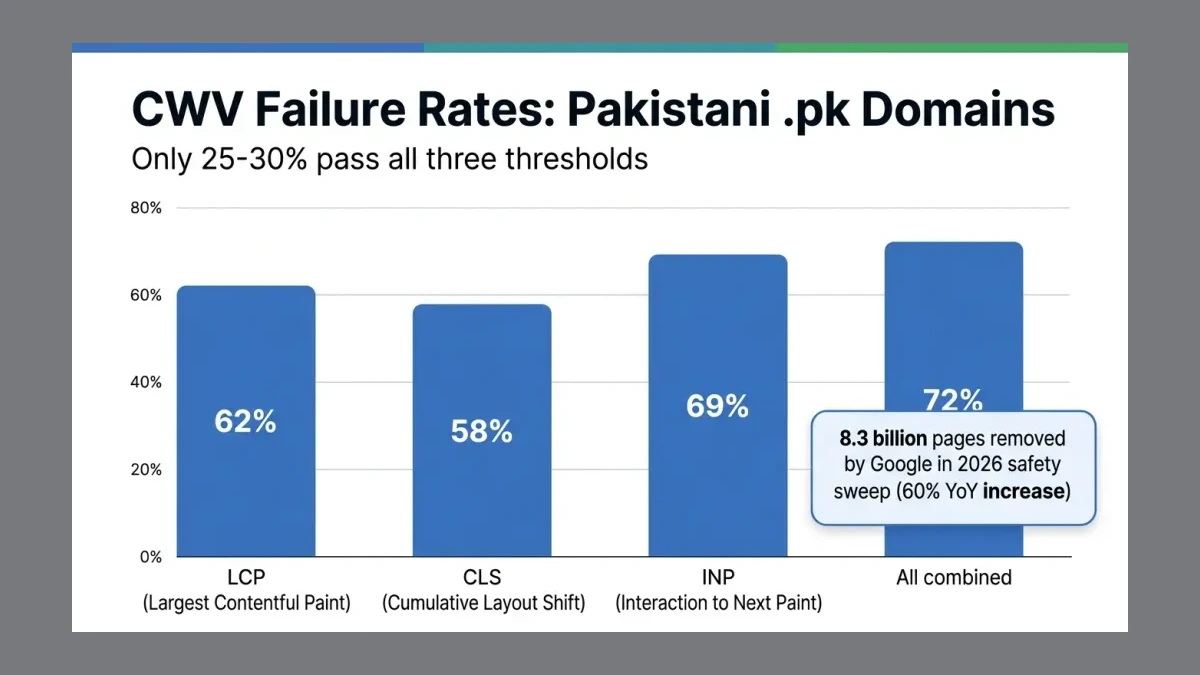
The Pakistan-specific percentages in this graphic are unverified; use the documented thresholds and your site’s measurements above.
Which Pakistani business websites face the highest deindexing risk right now?
Prioritise pages with identifiable problems rather than assigning risk by business category. Repetitive location pages, copied product descriptions, inaccessible application content and deceptive scripts deserve inspection. Their presence does not establish a penalty, and there is no verified ranking of Pakistani sectors by deindexing risk.
For a clinic serving Lahore, Karachi and Islamabad, location pages should explain what a patient can actually find at each branch. Useful differences might include available treatments, clinicians, accessibility, appointment arrangements and contact details. Swapping city names in otherwise interchangeable text gives visitors little reason to choose a particular page.
For an ecommerce store, supplier descriptions may accurately describe a product but offer little distinction from other retailers. Add information that helps customers buy from your business: relevant specifications, delivery coverage, returns information and answers to real product questions. Do not invent details simply to make the wording different.
Google’s Page indexing documentation explains that duplicate or alternate pages often should not be indexed separately. The important question is whether Google selected the right canonical page. An excluded filter URL can be expected; an excluded main product page deserves closer investigation.
Publishing with AI does not, by itself, diagnose an indexing problem. Review the finished content for accuracy, usefulness and policy compliance, particularly where large batches repeat the same information. Our discussion of AI content and Google penalties considers that distinction in more detail.
There is no universal word count that makes a location or product page safe. Improve the page until it answers its intended customer’s questions, and merge genuinely redundant pages where appropriate. Businesses dependent on search can also consider SEO beyond Google while addressing the underlying issue.
How can Pakistani businesses audit their indexing health in Google Search Console?
Google Search Console (GSC) gives you evidence about Google’s discovery, crawling and indexing of your website. Start with the Page indexing report, URL Inspection and Sitemaps. Use the Core Web Vitals report separately for performance diagnosis, and check Manual Actions and Security Issues when investigating a sudden loss of visibility.
First, define which pages should appear in search. Your list should focus on important canonical pages, rather than every filter combination, redirect or retired product URL. Compare changes in that list with Search Console’s indexed totals. A difference between sitemap and indexed counts is an investigation prompt, not a universal penalty threshold.
Next, review excluded URLs by reason and template. Google’s documentation distinguishes these statuses:
- Discovered — currently not indexed: Google knows the URL but has not crawled it yet. Investigate discovery and server capacity where important pages remain affected.
- Crawled — currently not indexed: Google crawled the page without indexing it. The label alone does not identify a specific content defect or penalty.
- Alternate page with proper canonical tag: This is normally expected when another indexed URL is the intended canonical version.
- Not found: Check whether the page was deliberately removed. Repair links or restore content when the missing destination should still exist.
- Redirect error: Inspect the redirect path for loops, broken destinations or other failures.
Use URL Inspection on representative affected pages and commercially important URLs. Compare the indexed information with the live test. Review crawl access, indexing directives, rendered content and the selected canonical. A successful live test can show that a technical problem is resolved without proving the page has already entered the index.
Connect this evidence to search performance and analytics. Pages that previously generated relevant enquiries deserve attention, but do not overlook new pages essential to the business merely because they have no traffic history. Record the URL, observed issue, intended fix and person responsible so the investigation becomes an actionable work list.
“SEOs and site owners are always complaining about indexing issues with Google Search. But some seasoned SEOs are asking if Google is more picky about what it indexes in the past month or so, than it was maybe a year ago.” — Search Engine Roundtable
Treat that observation as context, not a diagnosis. After fixing confirmed problems, keep the sitemap accurate and request indexing for priority URLs where appropriate. Google’s recrawl guidance says crawling can take a few days to a few weeks and does not guarantee indexing. Repeated requests do not accelerate the process.
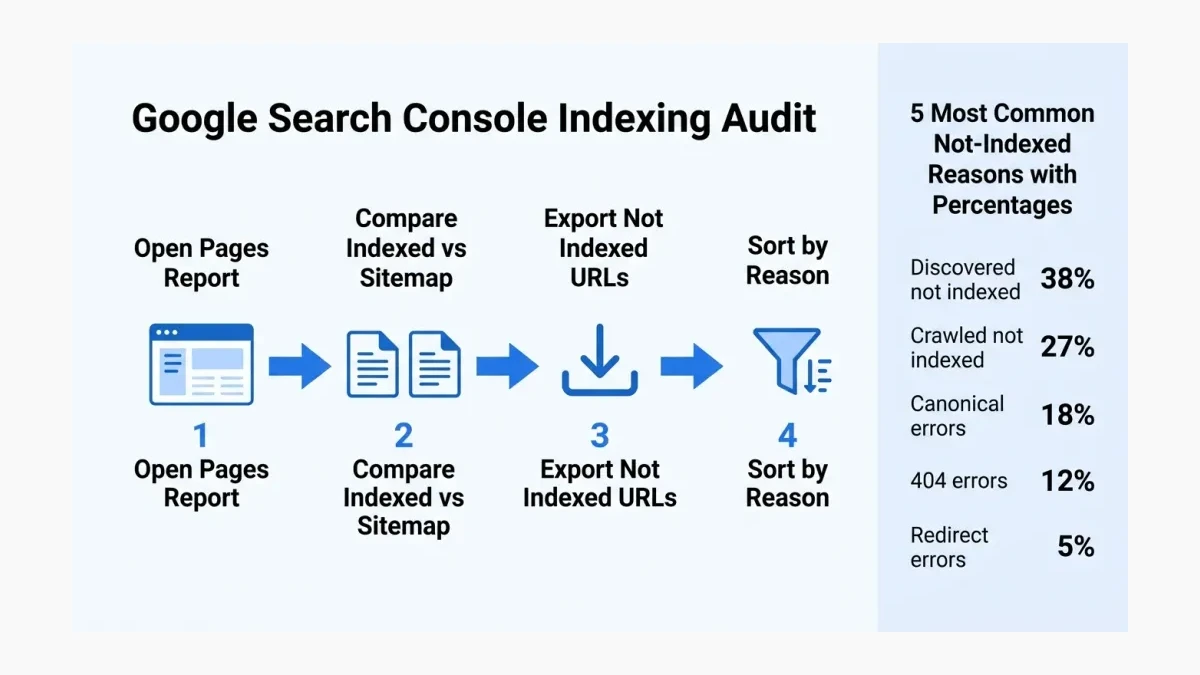
Use the report interpretations above; percentage gaps alone do not establish deindexing.
What is the fastest recovery path for deindexed Pakistani web pages?
The most useful sequence is to confirm the loss, fix the documented cause and monitor Google’s subsequent processing. Recovery depends on the problem and the pages involved. There is no reliable Pakistan-specific turnaround that an agency can promise, and a requested recrawl is not the same as restored search visibility.
During diagnosis, compare affected URL groups with earlier indexing records, search performance and deployment changes. Separate pages previously indexed from pages Google has never included. Check whether an intentional redirect or canonical change explains an apparent loss before attempting to bring every old address back.
During implementation, fix eligibility blockers first. Restore access to important pages, correct unintended indexing directives and repair unavailable destinations. Then address conflicting canonical signals, missing rendered content and genuine content weaknesses. Performance improvements belong in the same maintenance programme, but they should not replace investigation of the actual exclusion reason.
Validate the deployed version, including anything served through a CDN or cache. A fix in a developer’s environment is not enough if Googlebot still receives the old response. Test representative URLs across affected templates, and document what changed so later report movements can be interpreted against real deployment evidence.
During monitoring, inspect priority pages and follow their indexing status alongside impressions, clicks and enquiries. If a page remains excluded, revisit the evidence rather than repeatedly submitting it. Check whether Google has recrawled it, whether it sees the intended content and whether a different canonical remains selected.
Estimate business impact using your own records. Compare lost relevant visits and enquiries with previous performance, allowing for seasonality and demand changes. Paid advertising may help cover a visibility gap, but organic sessions and paid clicks are not interchangeable, and an invented click price cannot establish the cost of your loss.
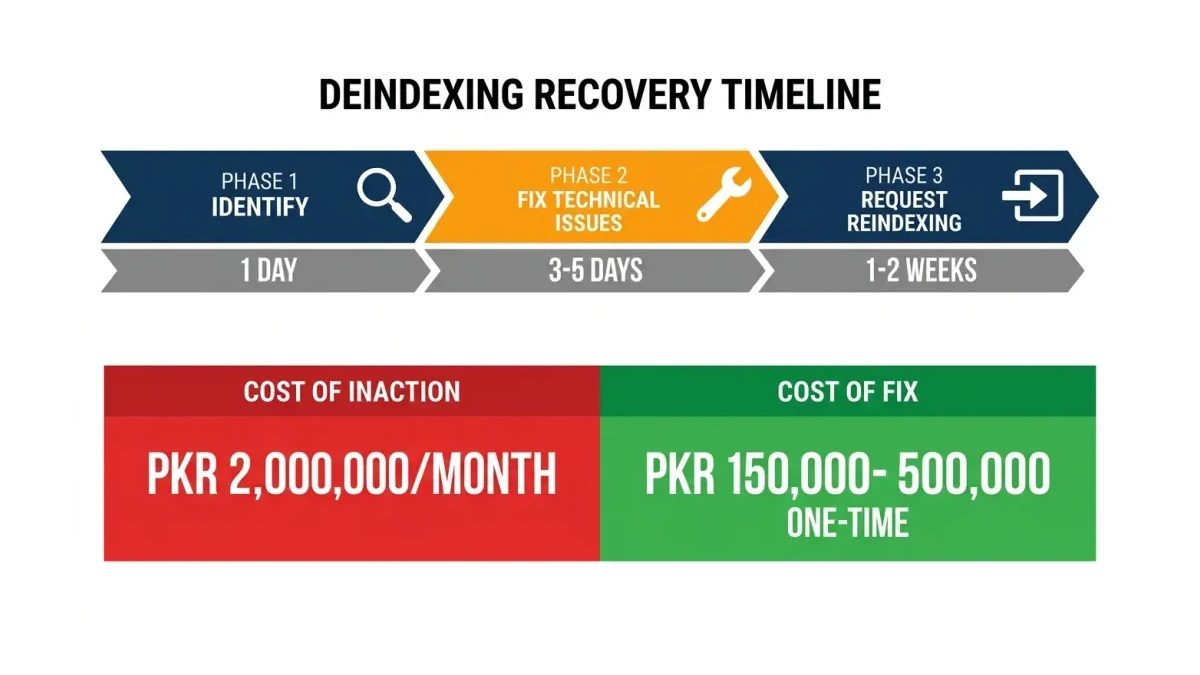
Treat any timelines and costs shown in this graphic as unverified, not as recovery commitments or market benchmarks.
Read next: JavaScript SEO checks for Pakistani websites and internal link audits for Pakistani websites.
WeProms Digital can investigate indexing losses and turn the findings into a prioritised implementation plan. The scope should distinguish confirmed blockers, content improvements and performance work, with verification after deployment. Reach out: hello@weproms.com · WhatsApp +92 300 0133399
Frequently Asked Questions
How do I know if Google has deindexed my Pakistani website pages?
Check important URLs in Search Console’s URL Inspection tool and compare their status with earlier records. A page that was never indexed is different from one removed later. Investigate declining indexed totals by URL group, and check whether another canonical version remains indexed. Neither a sitemap gap nor an informal search alone establishes what happened.
Can a Pakistani website recover fully from deindexing?
Technical exclusions can often be resolved, but restoring eligibility does not guarantee indexing or previous rankings. Identify the cause, verify the deployed fix and monitor Google’s processing. A manual action requires the specific remediation and reconsideration process described in Search Console; an ordinary excluded URL does not automatically require reconsideration.
What is the cost of fixing deindexing issues for a Pakistani business?
The cost depends on the cause, affected templates, platform and implementation scope. Ask for a quote that separates diagnosis, development, content work and verification. An accidental configuration setting may need a very different project from a migration with conflicting URLs. Compare proposals by the evidence and deliverables they include, rather than an unsupported market-wide price range.
Does Google deindex Urdu-language content differently than English content?
The general technical requirements provide the starting point for both. Check that Google can access the Urdu text and that visitors can read and navigate the page properly. Test right-to-left layouts, fonts and mobile rendering directly. Do not assume Urdu pages have weaker links, poorer performance or a separate indexing penalty merely because of their language.
Should I hire an agency to fix deindexing or can I do it myself?
You can investigate many issues with Search Console access and help from the person maintaining your website. Bring in specialist support when the cause remains unclear, important templates are affected or changes require development expertise. Ask an agency to explain its diagnosis and verification method. WeProms Digital’s technical SEO audits can provide that structured investigation without promising a particular indexing outcome.
Key Takeaways
- Industry reports of indexing changes do not establish record deindexing rates for Pakistan. Confirm what happened to your own important URLs.
- Audit crawl access, indexing directives, canonical signals, content usefulness and deceptive scripts before blaming an update.
- Core Web Vitals support user experience and rankings; poor scores are not automatic indexing exclusions.
- Search Console’s exclusion reasons need interpretation. Correctly excluded alternate URLs are often expected, and sitemap gaps have no universal danger threshold.
- Fix confirmed causes, verify the live deployment and monitor processing. Recovery dates, traffic gains and costs depend on the site’s evidence.
About WeProms Digital
WeProms Digital provides technical SEO and search infrastructure services for Pakistani SMEs, ecommerce brands and B2B teams.
The team helps businesses investigate indexing problems, improve Core Web Vitals and implement technical changes. A useful engagement connects each recommendation to an observed issue, identifies who will implement it and defines how the result will be checked.
Get in touch: hello@weproms.com · WhatsApp +92 300 0133399
Sources & References
- Search Engine Roundtable — Google Search May Be Deindexing URLs At Higher Rates
- Google Search Central — Technical Requirements
- Google Search Central — Back Button Hijacking Spam Policy
- Google Search Central — Understanding Page Experience
- Google Search Central — How Google Search Works
- web.dev — Core Web Vitals Thresholds
- Google Search Console Help — Page Indexing Report
- Google PageSpeed Insights
- Google Search Central — Ask Google to Recrawl Your URLs
Additional reading from industry feeds: