
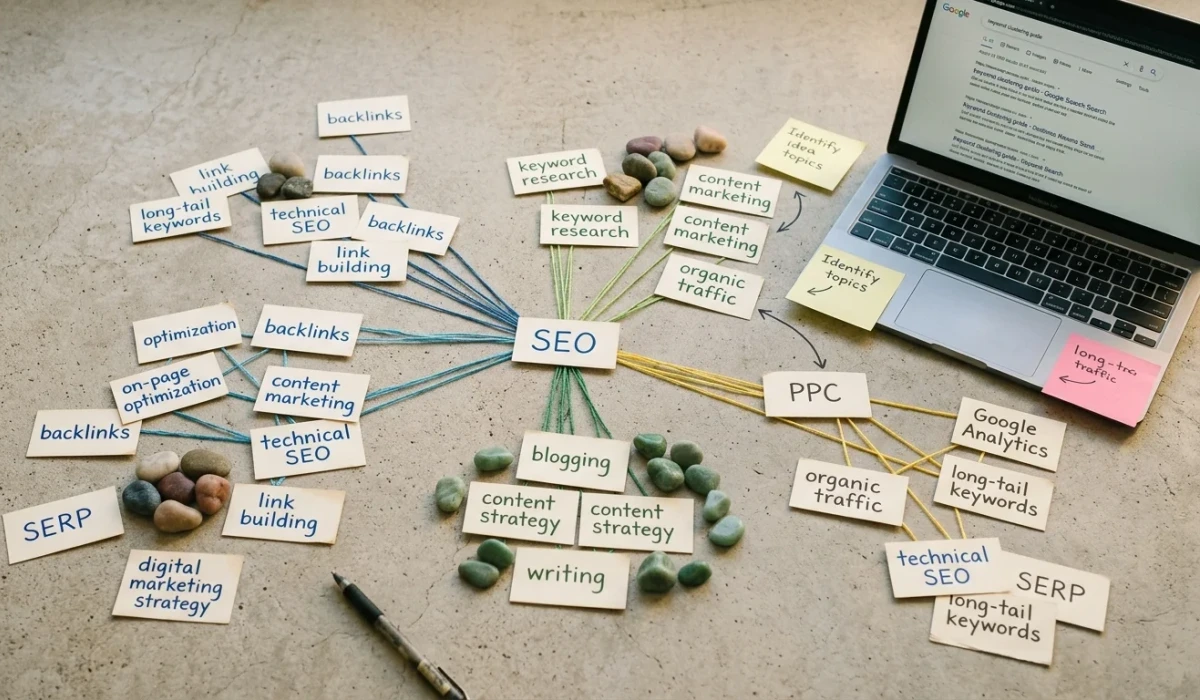
TL;DR: Keyword clustering groups search terms that can be served by the same page. Topic clusters connect pages answering different questions within a broader subject. Together, they help Pakistani businesses organise useful content, improve navigation and support search visibility. There is no universal page count, internal-link quota or guaranteed traffic uplift. Start with your customers’ questions, map them to suitable pages and connect those pages where the links help readers.
Imagine a Lahore law firm publishing separate articles for “property dispute lawyer Lahore,” “property lawyer Lahore fees” and “Lahore property litigation.” Some answer different questions; others repeat the same service description. The firm has content volume, but its pages lack clear roles. Keyword clustering helps decide which searches belong together and which deserve separate treatment.
Topical authority, as used in SEO planning, describes a website’s depth and credibility within a subject. It is not a published Google score calculated from cluster size. A useful property-law resource needs accurate legal explanations, relevant expertise and clear routes to advice. Linking repetitive articles together does not supply those qualities.
Start here: give every page a reason to exist. A visitor should understand what it answers, how it relates to the broader topic and where to go next. That is the practical foundation of a useful cluster.
What Is Keyword Clustering and Why Does It Matter for Pakistani SEO?
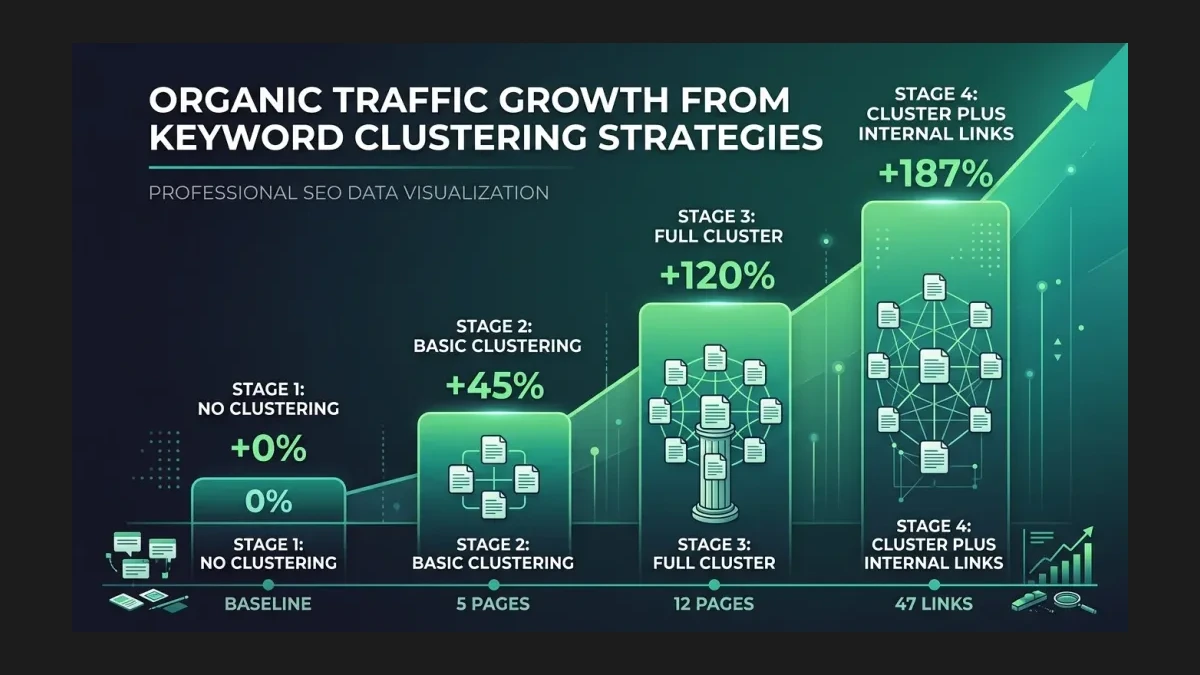
The infographic’s traffic figures should not be treated as expected results or a progression that every cluster follows. Content architecture can support performance, but it cannot predict a particular traffic increase.
Keyword clustering groups related searches that a single page can satisfy. “Best SEO agency Lahore” and “top SEO company in Lahore” may belong together, while “how to audit a website” usually needs different content. Check the search results before grouping them: similar wording does not always mean similar intent.
A topic cluster is the broader architecture connecting those pages. Your agency service page might link to an audit guide, a pricing explanation and a relevant case study. Each serves a distinct need while contributing to the same subject. Confusing keyword groups with topic clusters often produces unnecessary pages for near-identical searches.
For Pakistani businesses, the opportunity depends on the actual market. Do not assume local searches are easy because they include Lahore, Karachi or Islamabad. Inspect competing pages, their usefulness and the intent they satisfy. Consider whether customers search in English, Urdu or Roman Urdu, and use customer enquiries to guide your research.
Upward Engine reports a 187% increase in organic traffic to targeted pages after 47 contextual internal links were added, within 14 days. That is a reported case outcome, not a benchmark for Pakistani websites. It supports investigating existing content, but does not establish that clustering alone caused the increase or that another business should expect it.
Think of a Pakistani bazaar: clear lanes between related shops make browsing easier. Internal links serve a similar navigational purpose. The analogy helps explain the experience; it is not a description of Google’s ranking formula.
Begin by reviewing related posts. Identify overlapping answers, useful standalone resources and missing connections. An internal link audit can help you find pages that readers struggle to reach before you commission more content.
How Many Pages Does a Pakistani Website Need for Topic Authority?
There is no universal minimum. The right scope depends on the subject, your audience and the distinct questions you can answer well. Google explicitly says it has no preferred word count. A pillar page should provide a useful overview, while supporting pages should add detail that would make the overview unwieldy or distract from its purpose.
For a Pakistani agency targeting “SEO Pakistan,” potential supporting subjects include local SEO, technical audits, content strategy, link building and pricing. These are planning candidates, not mandatory pages. Separate city pages need meaningful local information; changing the city name in otherwise identical copy does not create useful coverage.
| Cluster Element | Content Scope | Internal Links | Purpose |
|---|---|---|---|
| Pillar page | Broad overview with clear navigation | Links to relevant supporting pages | Orient the reader |
| Definitional pages | Explain concepts requiring separate treatment | Link to the pillar where useful | Build understanding |
| How-to pages | Explain a specific task or process | Link to the pillar and relevant guides | Support implementation |
| Comparison pages | Explain choices and trade-offs | Link to related services and evidence | Support decisions |
Use this table as an editorial framework. If a definition fits naturally into the pillar, keep it there. If a comparison requires detailed evidence and attracts a different audience, give it a separate page. Page boundaries should follow reader needs rather than a production quota.
Google’s E-E-A-T guidance concerns experience, expertise, authoritativeness and trustworthiness. E-E-A-T itself is not a specific ranking factor, and a larger cluster does not automatically demonstrate expertise. Google also describes its ranking systems as operating at page level, alongside site-wide signals. A cluster is not evaluated solely as a single ranking unit.
Build the pages needed to answer the customer’s questions. Treat page count as the result of that work, not the target.
For a limited budget, prioritise the main service or topic page and the supporting questions closest to a buying decision. Review what already exists before assigning new articles. A topic cluster strategy should specify page purpose, evidence requirements, internal links and ownership, with production paced to your team’s capacity.
How Does Internal Linking Strengthen Keyword Clusters?
Internal links help readers and search engines discover pages and understand their relationships. Google uses link analysis systems, including PageRank, but does not prescribe a link density per word count. Its guidance is to ensure every important page has a link from at least one other page on the site.
A page with few incoming internal links is not automatically invisible. The practical concern is whether it can be discovered through crawlable links and whether readers encounter it at relevant moments. Adding links indiscriminately can make content harder to use without solving either problem.
For a Karachi ecommerce brand, a buying guide might link to relevant categories, product comparisons and care advice. Those destinations should help the shopper continue their task. Internal links support that journey; they do not replace useful products, strong content or external recognition.
A pillar-and-supporting-page structure often benefits from links in both directions. The pillar introduces a subject and points to deeper guidance; the detailed guide links back when the overview supplies useful context. Related supporting pages can also link directly to each other, without forcing every visitor through the pillar.
Write descriptive anchor text that accurately previews the destination. “Local SEO checklist for Pakistani businesses” is more informative than “click here.” Avoid squeezing an exact-match keyword into every link or linking unrelated pages simply because they belong to the same broad category.
An IELTS preparation site, for example, might connect speaking advice with registration guidance where readers need to book an exam. A writing guide belongs in the journey when it answers the next relevant question. Before adding a link, ask what the reader gains from following it. Also check that the destination works, remains current and supports the promise made by the anchor text.
How Does Google’s AI Mode Change Keyword Strategy for Pakistani Sites?
AI Overviews and AI Mode are different Google search experiences. AI Overviews add generated responses to relevant results, while AI Mode supports a more conversational search journey. Google’s guidance says its foundational SEO practices remain relevant to generative AI features; a cluster does not create a separate route around those requirements.
The original article’s fixed AI Overview prevalence and click-loss figures should not be applied to Pakistani searches. Findings vary with the queries, market, devices and period studied. Use external studies to frame questions about your own performance, rather than forecasting losses from a single industry percentage.
| Query Type | What to Check | Content Role | Cluster Strategy |
|---|---|---|---|
| Informational (“what is SEO”) | Whether an AI answer appears and which sources it uses | Explain the subject clearly | Connect the overview to detailed guidance |
| Commercial (“best SEO agency Lahore”) | Comparisons, reviews and service results | Support evaluation | Link claims to evidence and relevant services |
| Local (“SEO services Gulberg Lahore”) | Maps, business listings and local pages | Establish location and service relevance | Use accurate local information |
| Transactional (“hire SEO consultant Pakistan”) | The results and actions available to buyers | Help visitors enquire | Connect supporting advice to conversion pages |
Seer Interactive’s cited update reports an 85% organic CTR recovery for queries with AI Overviews, from its December low into early 2026. The earlier article incorrectly assigned that rebound to queries without AI Overviews. This is a finding from Seer’s dataset, not evidence that Pakistani sites experienced the same change.
There is also no sufficiently substantiated basis here for saying a fixed share of AI citations comes from sites meeting a particular cluster size. Google’s guidance stresses useful content and technical eligibility. It does not prescribe a supporting-page threshold for citations, and inclusion is not guaranteed.
Build informational pages that answer questions with clear explanations, relevant evidence and appropriate expertise. Connect them to service, comparison or product pages when that helps the reader act. A citation can provide visibility, but it is not equivalent to a visit or a qualified enquiry.
For each priority topic, review the results customers actually encounter. Record whether an AI response appears, which pages are referenced and what information your page contributes. Keep the exercise focused on serving the query; copying the structure of cited competitors does not establish why they were selected.
What Tools Do Pakistani Businesses Need for Keyword Clustering?
The work involves keyword research, grouping and content planning. You can begin with a spreadsheet and existing customer information, then choose paid tools when they solve a specific research or workflow problem.
Keyword research tools help discover search terms and estimate demand. Semrush, Ahrefs and Ubersuggest are options to evaluate, but fixed PKR prices quickly become unreliable. Check the current plan, billing period, usage limits and payment currency before budgeting. Keyword data is an estimate, so compare it with customer language and your own search performance.
Google Keyword Planner provides keyword ideas and search estimates. Google’s current help page says you must complete account setup and enter billing information to access basic features such as keyword suggestions. That is different from stating that active advertising spend is always required. Check the account requirements before choosing it as your starting tool.
Cluster analysis can begin manually. Group terms provisionally, inspect their search results and decide whether the same page could satisfy them. Automated clustering tools may speed up larger projects, but review their output. Semantic similarity alone can combine searches that need different answers or split variations that belong together.
Content planning tools can be as simple as a spreadsheet. Record the pillar topic, intended page, target intent, existing URL, content gaps, owner and relevant link destinations. Notion or Trello can help manage assignments if your team already uses them. The planning system matters less than keeping decisions visible.
| Tool Category | Starting Option | What to Check | Paid Options to Evaluate |
|---|---|---|---|
| Keyword research | Existing query data and Keyword Planner | Account access, geography and estimate limitations | Semrush or Ahrefs |
| Cluster analysis | Spreadsheet and manual result review | Whether grouped terms share intent | A dedicated clustering tool |
| Content planning | Existing spreadsheet or task board | Clear owners and page purposes | A suitable team workspace plan |
| Internal link audit | Manual navigation and link inventory | Missing links and unsuitable destinations | A crawler or SEO audit platform |
Avoid buying software before defining the decisions it needs to support. A smaller, carefully reviewed keyword list is often more actionable than an export your team cannot interpret. WeProms Digital’s content strategy services cover research, page planning and editorial direction for businesses needing help with that work.
How Long Does It Take for Keyword Clusters to Improve Rankings?
There is no reliable timetable that applies to every cluster. Results depend on the starting content, technical accessibility, competition, search demand and the quality of the changes. Publishing the final supporting page does not start a predictable countdown to rankings.
Separate implementation milestones from business outcomes. You can confirm that a page is published, linked and accessible. You can then monitor discovery, impressions, clicks and enquiries. Improvement in an early indicator does not necessarily mean the cluster is producing qualified leads.
Do not use a third-party authority score to promise a ranking date. Instead, examine the competing results and what your page adds. A specific local question may be a sensible starting point when your business has relevant experience, but adding a location name does not guarantee low competition.
Existing content deserves attention before expansion. Clarify overlapping pages, repair broken links and connect useful resources. The reported internal-linking case discussed earlier illustrates why this work can be worthwhile; its outcome should not become a deadline or forecast for another site.
Record a baseline and keep a change log. Review the affected pages and queries together, noting seasonality, promotions and other site changes that might influence results. If traffic grows, check whether visitors reach the appropriate service or product pages and complete useful actions.
Measure the cluster’s contribution to enquiries and sales where your tracking allows it. Avoid treating an industry attribution-adoption statistic as proof that your content works. Use the evidence from your own customer journeys to decide whether to improve existing pages, address a missing question or change the cluster’s scope.
The structure around your content helps readers make use of it. Pakistani websites benefit from clear page roles, relevant internal links and reliable answers. Those qualities support search performance, but a neatly linked cluster cannot guarantee that it will outrank stronger competing resources.
If your business needs help planning that structure, WeProms Digital can map keywords, review existing content and plan the connections between pages. Reach out via WhatsApp at +92 300 0133399 or email hello@weproms.com to discuss your cluster strategy.
Read next: The CITE Framework for Google AI citations | Audience-first SEO for Pakistani brands
Frequently Asked Questions
What is keyword clustering in SEO?
Keyword clustering groups searches that can be satisfied by the same page. Topic clusters connect distinct pages within a broader subject. For “CRM Pakistan,” a pricing guide and a product comparison may need separate pages, while close variations of the same pricing query can belong on the same page.
How many pages does a keyword cluster need?
There is no universal minimum. Cover the distinct questions your audience needs answered, using separate pages when the purpose or depth justifies them. Keep short explanations within the pillar when that serves readers better. Neither a prescribed page count nor a word-count target proves expertise.
Does keyword clustering work for Pakistani websites?
It can help Pakistani businesses organise content around customer needs and make related pages easier to find. Results depend on competition, content quality, technical accessibility and relevance. Assess local search results directly rather than assuming Pakistan-specific keywords are easier or will rank within a fixed period.
How does keyword clustering affect Google AI Overviews?
A coherent structure can make related information easier to discover, but it does not guarantee citations. Google says foundational SEO practices remain relevant to its generative AI features. Prioritise useful answers, reliable evidence and eligible pages instead of publishing enough articles to meet an unsupported citation threshold.
What is the cost of keyword clustering for Pakistani businesses?
Costs depend on research, content review, writing, technical work and the tools you select. Existing spreadsheets can support planning, while paid software adds subscription costs. Ask for a scope that distinguishes improving existing pages from creating new ones, and check current tool prices before agreeing a budget.
How do internal links affect keyword cluster performance?
They help people and search engines find related pages and understand their context. Google recommends that important pages receive a link from another page on the site, but sets no ideal link count. Use descriptive anchors and relevant destinations; measure the result rather than assuming a particular traffic uplift.
Key Takeaways
- Group keywords by shared intent, then decide which groups belong on separate pages within the broader topic.
- Build supporting pages to answer distinct customer questions, without treating page counts or word counts as ranking requirements.
- Use internal links to make useful connections. Avoid link quotas and unnecessary exact-match anchors.
- Treat AI visibility and website conversions as related but different outcomes. Neither follows automatically from cluster size.
- Check local search results, establish a baseline and assess changes against your own enquiries and sales.
- Budget for research, evidence and editorial work as well as software. Start with existing content when it already answers the right questions.
About WeProms Digital
WeProms Digital is an SEO and content strategy agency headquartered in Lahore, serving Pakistani SMEs, ecommerce brands and service businesses across Lahore, Karachi, Islamabad, Rawalpindi, Faisalabad and Multan.
The team works on keyword cluster architecture, internal link optimisation and content planning for traditional and AI-assisted search. Engagements can include reviewing existing pages, defining content gaps and mapping useful connections between resources and services.
Get in touch: hello@weproms.com · WhatsApp +92 300 0133399
Sources & References
- HubSpot — Keyword Clustering
- Upward Engine — Internal Linking Strategies — reported case outcome, not an expected uplift.
- SEMrush — Fintech AI Search Case Study: How Wise.com Wins AI Visibility
- Horizon Marketing — Topical Authority That AI Search Engines Trust
- SEER Interactive — AIO Impact on Google CTR
- RankDots — Topical Authority Builder
- Mailchimp — Topical Authority Guide
- SEO Sherpa — Internal Links Guide
Additional reading from industry feeds: