

TL;DR: Marketing tools can generate plenty of activity while leaving customer data scattered across separate systems. For a Pakistani SME using ads, WhatsApp, an online store and email, the priority is to connect the handoffs that affect sales and reporting. Start with campaign tracking, then customer records, then lifecycle automation. Budget for setup, maintenance and usage together, and judge each connection by the manual work it removes or the decisions it improves.
Picture this. A Lahore furniture retailer runs Facebook Ads, closes enquiries through WhatsApp Business, tracks website activity in Google Analytics, manages orders in WooCommerce, sends emails through Mailchimp and stores customer details in a Google Sheet. When a customer clicks an ad, browses the website, messages on WhatsApp and purchases in-store, the team may see unrelated events across separate dashboards.
The problem is not simply owning several tools. It is having no agreed way to connect an enquiry, a customer and an order. Buying another dashboard will not resolve that missing handoff.
Why do Pakistani SMEs have so many disconnected marketing tools?
Marketing stacks often grow through immediate decisions rather than deliberate planning. A business creates a Facebook Page, adds analytics to understand traffic, starts sending newsletters and adopts WhatsApp for customer conversations. Each decision can make sense on its own. The gaps appear when nobody takes responsibility for how information moves between systems.
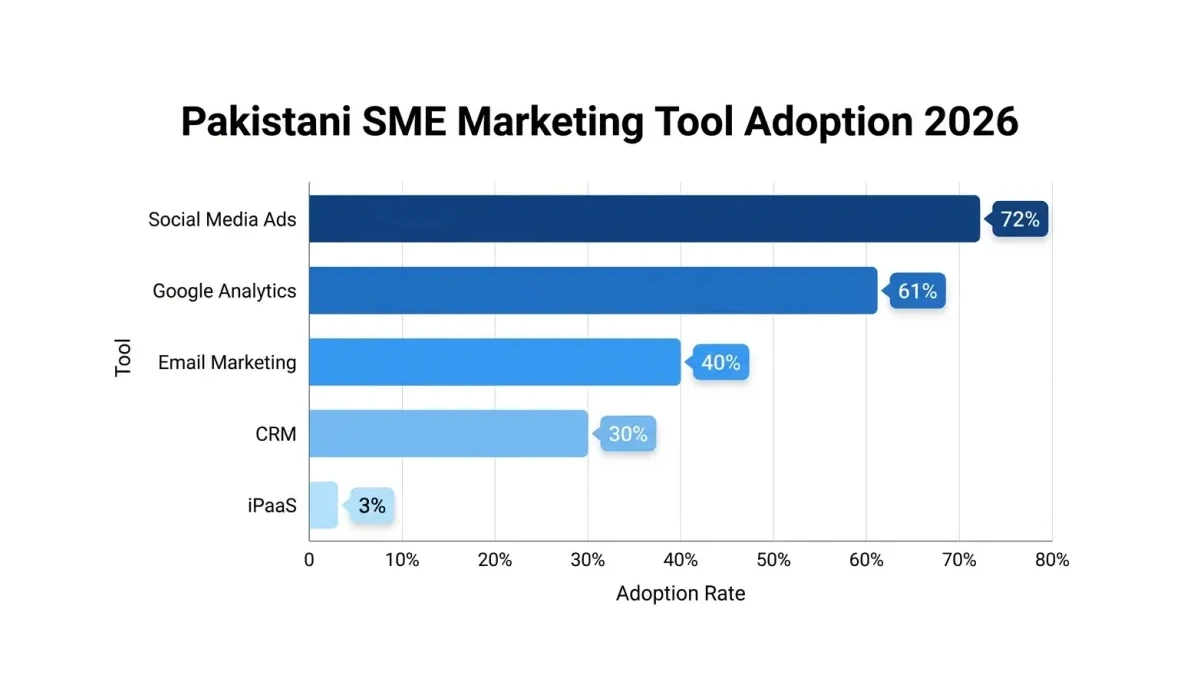
iPaaS (Integration Platform as a Service) describes cloud-based software used to connect applications and automate data flows. The original adoption estimates for Pakistani SMEs could not be substantiated, so they should not guide a purchasing decision. Your own workflow is a more useful starting point: where does someone copy, export or retype information?
An integration plan should identify the system that owns each record, the event that starts a transfer and the person responsible when it fails. Without those decisions, automation can move inconsistent information faster while leaving the underlying reporting problem intact.
The adoption figures in the following infographic are unverified and should not be treated as measured rates for Pakistani SMEs.
What does the integration gap cost a Pakistani SME?
The cost has two useful categories: unnecessary operating work and weaker marketing decisions. Neither can be estimated reliably from the number of tools alone.
Direct tool waste: Review subscriptions alongside the work people do around them. Look for overlapping features, unused licences, repeated exports and reports that nobody uses. A standalone tool may still be valuable; its isolation becomes costly when it creates avoidable work or prevents a necessary handoff.
Use actual invoices and a record of staff activity to build the budget. Separate advertising spend from software fees, and include connector subscriptions, implementation and ongoing support. Foreign-currency billing also needs its own allowance rather than a fixed PKR conversion copied from an old comparison.
| Tool Category | Cost to Review | Example Platforms | Integration Question |
|---|---|---|---|
| Social Media Ads | Media spend and reporting costs | Meta Ads Manager, TikTok Ads | Can qualified leads and sales be reconciled with campaigns? |
| Analytics | Collection, reporting and connector costs | Google Analytics 4, Google Search Console | Are campaign labels consistent with sales records? |
| Email Marketing | Subscription, contacts and sending usage | Mailchimp, Klaviyo, Brevo | Do customer status and preferences stay consistent? |
| CRM | Licences, configuration and maintenance | HubSpot, Zoho, structured spreadsheets | Which system owns the customer record? |
| SEO Tools | Subscription and reporting work | Semrush, Ahrefs, Ubersuggest | Does exported data support a useful decision? |
| WhatsApp Business | Messaging, provider and integration charges | WhatsApp Business App, API-based services | How are enquiries handed to the sales team? |
Lost attribution visibility: When a Karachi apparel brand cannot connect a purchase to the enquiry that preceded it, campaign evaluation becomes harder. That does not prove a particular amount of lost revenue. It does mean the team needs to distinguish confirmed sales, platform-reported conversions and outcomes whose source remains unknown.
Think of a restaurant where the cashier, kitchen and delivery driver keep separate order records. The problem becomes visible when an order changes and only one record is updated. Marketing integrations need the same discipline: shared identifiers, clear ownership and a way to resolve conflicting information.
How does the Cyclr iPaaS model apply to Pakistani marketing teams?
The Cyclr example raises a useful planning question: who will maintain the connections after they are built? The original article cited a Cyclr discussion on Martech Zone. Treat that as background reading, rather than evidence for local costs or adoption rates.
Do not assume that every product in the integration category serves the same buyer. Before selecting Cyclr, Zapier, Make or another option, establish whether you need internal workflow automation, integrations embedded in software you sell, or custom development. Ask vendors to demonstrate your actual workflow rather than a broadly similar example.
For an SME, a useful demonstration might involve transferring a store order into the CRM, identifying an existing customer and handling a later refund. The successful creation of a contact is only part of the job. Updates, duplicates and failed transfers matter just as much.
Compare the maintenance burden as well as the initial build. Who renews credentials? Where do errors appear? Can the team replay a failed transfer without creating another record? These questions make an integration proposal more useful than a promise that every tool will automatically talk to every other tool.
What is the minimum viable integration stack for a Pakistani SME?
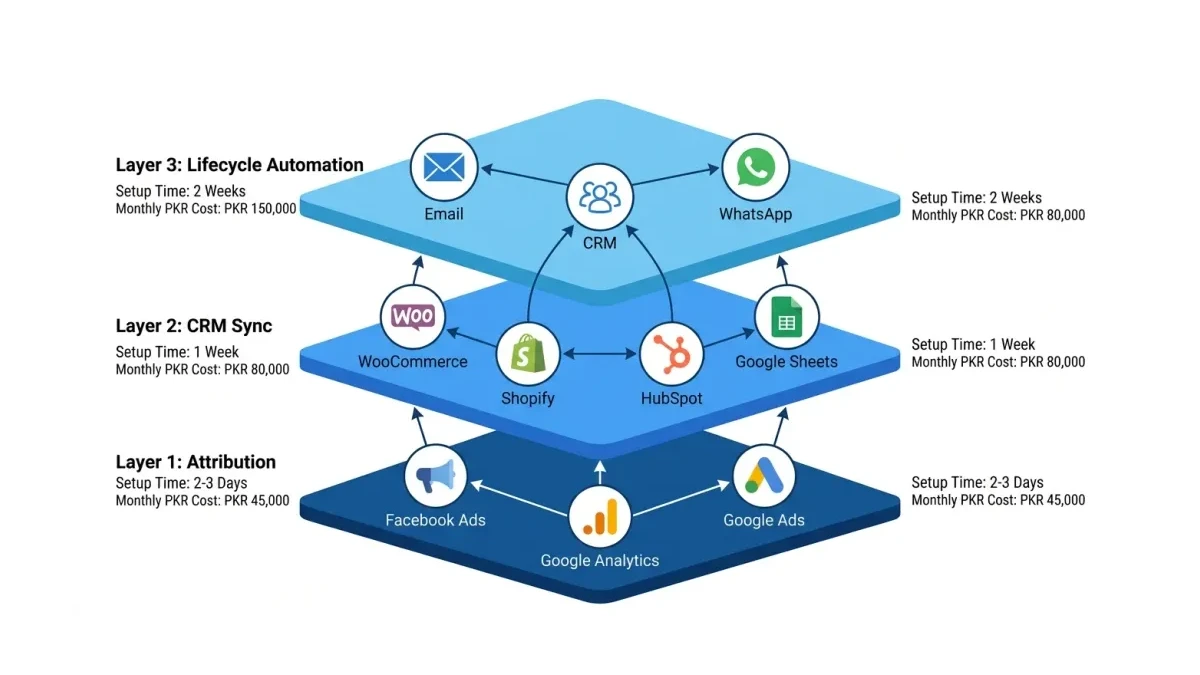
Start with the customer journey you need to understand. Keep the three-layer approach, but define a testable outcome for each layer before choosing software.
Layer 1: Attribution — connect campaign information to website activity. Check the current linking options for each advertising platform and analytics property. Agree campaign naming and tagging conventions, then test whether a visit and its intended action appear as expected. Avoid assuming that every advertising platform has the same native connection or that a connection alone resolves attribution.
Layer 2: CRM sync — connect sales channels to customer records. Decide which system owns customer details and order status. Map the fields needed for follow-up, including source information where available. Test a new customer, a returning customer and an updated order. An integration should not silently overwrite useful sales information with an incomplete form submission.
Layer 3: Lifecycle automation — connect customer status to follow-up. Choose a workflow such as an abandoned-cart reminder or a response to a submitted enquiry. Confirm the channel’s current requirements, customer permissions and suppression rules before enabling messages. Define when the workflow should stop, especially after a purchase, unsubscribe or conversation with the sales team.
| Integration Layer | Tools Connected | Setup Check | Cost Drivers | Intended Outcome |
|---|---|---|---|---|
| Layer 1: Attribution | Campaign information → analytics | Validate tags and intended actions | Tracking setup and reporting needs | More consistent campaign reporting |
| Layer 2: CRM Sync | Store or enquiry form → CRM | Test matching, updates and duplicates | Connector access and workflow usage | More complete customer records |
| Layer 3: Lifecycle | CRM → email or messaging | Test permissions, timing and suppression | Platform, provider and message usage | Timely, relevant follow-up |
Build the budget from these requirements. A monthly subscription cannot sensibly be compared directly with an annual waste estimate; use the same period and include staff time, setup and support on both sides.
Start with an attribution check this week. Follow a campaign link through to the intended website action and inspect what reaches the sales record. Write down the missing handoff before buying a connector. A marketing measurement and reconciliation plan can help define which records should agree and which differences need explanation.
Why do Pakistani SMEs resist adopting integration platforms?
Cost, technical uncertainty and familiar working habits can all make a team hesitate. Address each with evidence from the business rather than an assumed national adoption pattern.
Cost perception. A subscription is visible on an invoice; manual reconciliation is buried inside salaries. Ask staff to record the recurring tasks involved, including checking exports and correcting mistakes. Compare that work with the total proposed integration cost. Some workflows will justify automation quickly; others may be too infrequent to warrant another subscription.
Technical intimidation. API keys, webhooks and authentication can feel unfamiliar. A visual builder may make the workflow easier to follow, but the team still needs to understand the data being transferred and the access it grants. Choose an owner who can explain the process and recognise when it has stopped working.
Status quo bias. Campaigns still go out and orders still arrive, so the damage can remain hard to see. Demonstrate a specific improvement: an enquiry reaches the correct salesperson, an order updates the existing customer record, or a report no longer needs repeated copying. That is more persuasive than promising a completely automated business.
Keep the first workflow narrow enough to inspect. Document how it works, retain a fallback process and review the result with the people who use the data daily.
How does AI change the marketing integration landscape for Pakistani businesses?
The original article presented Model Context Protocol (MCP) as a route for AI tools to interact with business systems. Evaluate such proposals against the connections, permissions and actions actually available in the products you plan to use. A broad demonstration is not confirmation that your accounts and workflows are supported.
An assistant that compares advertising results with store orders sounds useful. Before relying on it, establish whether campaign labels, customer identifiers and order statuses are consistent. Otherwise, a polished answer may conceal the same unresolved differences that already affect your dashboards.
For workflows that change records or send messages, decide which actions need review and how changes will be logged. Ask how you would investigate an incorrect update and prevent it from repeating. These requirements belong in the implementation brief, alongside the desired output.
Basic integration work remains worthwhile when it removes a real operational problem. There is no need to buy middleware solely to prepare for a promised AI future. Start with marketing data governance and quality: clear definitions, named owners and dependable records give both people and automated systems a better foundation.
When should a Pakistani SME hire help versus building integrations in-house?
Base the decision on workflow complexity, consequences of failure and technical capacity. Tool count alone is a poor threshold: a small stack can contain a difficult payment workflow, while a larger stack may have straightforward connections.
An internal team member may be able to manage a well-documented connection when the requirements are clear and errors are easy to spot. Give that person time to test, document and monitor it. A successful initial transfer does not remove the need for ongoing ownership.
Specialist help becomes useful when records must be matched across systems, source information is missing, permissions are unclear or failures affect customer communications. Ask for a written scope covering field mapping, error handling, testing and handover. Agree what counts as completion before comparing quotes.
For local payment or marketplace workflows, request evidence that the proposed approach works with your specific account and access level. Avoid accepting an integration promise based only on the platform’s name. Establish who will handle provider changes and what happens if the required access is unavailable.
There is no reliable universal setup duration or first-month payback guarantee. Assess value through the workflow you are improving: less repeated entry, more complete sales records, faster follow-up or better-supported budget decisions. Keep attribution limitations visible rather than promising that every rupee will become traceable.
WeProms Digital can help scope a marketing tech stack integration around those requirements. Contact hello@weproms.com or WhatsApp +92 300 0133399 with your current tools and the handoff you want to improve.
Read next: Dashboards Don’t Decide: Building a Marketing Data Pipeline That Actually Works | PRISM Framework for Pakistani Marketing Data
Frequently Asked Questions
What is iPaaS and does my Pakistani business need it?
iPaaS is software for connecting applications and automating data transfers. Consider it when recurring manual handoffs create enough work or errors to justify the cost. First check whether your existing tools can support the required workflow. You may need middleware, a supported direct connection or a documented manual process. Choose according to the task, not a fixed minimum number of tools.
How much does Zapier or Make cost in Pakistan?
Check their current pricing and billing terms before budgeting. The earlier plan names, allowances and PKR conversions could not be verified and should not be used for purchasing. Estimate your actual workflow volume, including repeated actions, retries and seasonal peaks. Confirm whether required connectors are available on the proposed plan, then allow for currency conversion, applicable charges and maintenance. A free tier is useful only if its limits fit the workflow.
Can I connect JazzCash or Easypaisa transaction data to my CRM?
Ask the provider what your merchant account supports. Confirm whether transaction notifications, reporting exports or another approved integration method are available for your use case. Do not assume either universal API access or a blanket absence of APIs. Define which fields you need, how refunds are represented and how transactions will match CRM records. WeProms Digital can help assess the requirements through hello@weproms.com.
How long does it take to set up a marketing integration stack?
Scope the work before setting a deadline. Account access, connector availability, data quality and exception handling all affect the effort required. Ask for separate milestones for configuration, testing and handover. Include realistic cases such as duplicate customers, changed orders and interrupted transfers. Treat a workflow as ready when the team can verify its output and manage failures, rather than when the first demonstration succeeds.
Is Google Analytics 4 enough to track all my marketing performance?
Do not assume your analytics reports include every sales conversation or offline outcome. Review what your implementation actually collects, then compare it with CRM and order records. For WhatsApp enquiries, phone calls and in-store purchases, establish how the outcome is recorded and whether a reliable link to the original enquiry exists. Keep unmatched sales visible instead of assigning them a source without evidence.
Should I hire WeProms Digital to set up my marketing integrations?
Consider help if the team cannot resolve a recurring data handoff or maintain it confidently. Bring examples of missing records, duplicated work or reports that disagree. A useful assessment should identify the problem, outline an appropriate connection and explain how success will be checked. Contact WeProms at hello@weproms.com or WhatsApp to discuss the scope.
Key Takeaways
- Audit manual handoffs before adding another marketing tool. Disconnected records are an operational problem, not proof of a particular national waste figure.
- Separate advertising spend, software subscriptions, implementation and staff time when assessing integration costs.
- Use the three-layer sequence: campaign tracking, customer-record sync and lifecycle follow-up. Test each layer before extending it.
- Evaluate AI workflows against available access, data quality and review controls. Avoid buying infrastructure solely on future promises.
- Choose internal ownership or specialist support according to complexity and maintenance needs, rather than tool count or guaranteed payback claims.
About WeProms Digital
WeProms Digital works with Pakistani SMEs, ecommerce brands and B2B teams on marketing strategy and connected marketing systems.
The team’s work spans digital marketing strategy, CRM workflows, analytics and lifecycle automation. An integration brief should connect these activities to a clear business requirement, with agreed responsibilities for testing and ongoing operation.
Get in touch: hello@weproms.com · WhatsApp +92 300 0133399
Sources & References
These retained background links are not evidence for Pakistan-specific adoption rates, costs or delivery timelines. Check current product documentation before implementation.
- Cyclr — Turn Your API into MCP Servers for the AI Economy
- Markets and Markets — US Artificial Intelligence Market Report
- BigCommerce — Ecommerce Integrations Guide
- Technology Checker — Cloudways Technology Stack Data
- Orbilon Tech — Hyperautomation in 2026
- APIANT — AI Operability for Integration Platforms
- Shopify Pakistan — AI Marketing Statistics
Additional reading from industry feeds: