TL;DR: Micro-influencers can give Pakistani ecommerce brands relevant audiences and useful advertising content, but higher ROAS is a testing objective, not a guaranteed outcome. Select creators for audience fit, agree paid usage rights, and measure fulfilled sales against campaign costs. WeProms Digital, a social media marketing agency in Pakistan, helps brands connect creator selection, paid distribution and revenue reporting.
A micro-influencer strategy starts with a commercial question: can this creator help you acquire customers profitably? Follower count alone cannot answer it. A relevant audience, a credible demonstration and a clear purchase route matter more than a large headline reach.
For Pakistani ecommerce brands, this means comparing creators against the same product economics used for paid advertising. Include the cost of content, samples, usage rights and distribution. Then check whether the orders attributed to the campaign were delivered and retained.
Global influencer benchmarks can suggest what to test, but they cannot establish a Pakistani rupee return. Entrepreneurs HQ’s statistics roundup combines research from different sources and periods. Its headline benchmarks should not become promises about local creator fees, audience trust or sales. The aim is to build your own evidence before committing more budget.
Why Do Micro-Influencers Outperform Mega Stars for Pakistani Ecommerce?
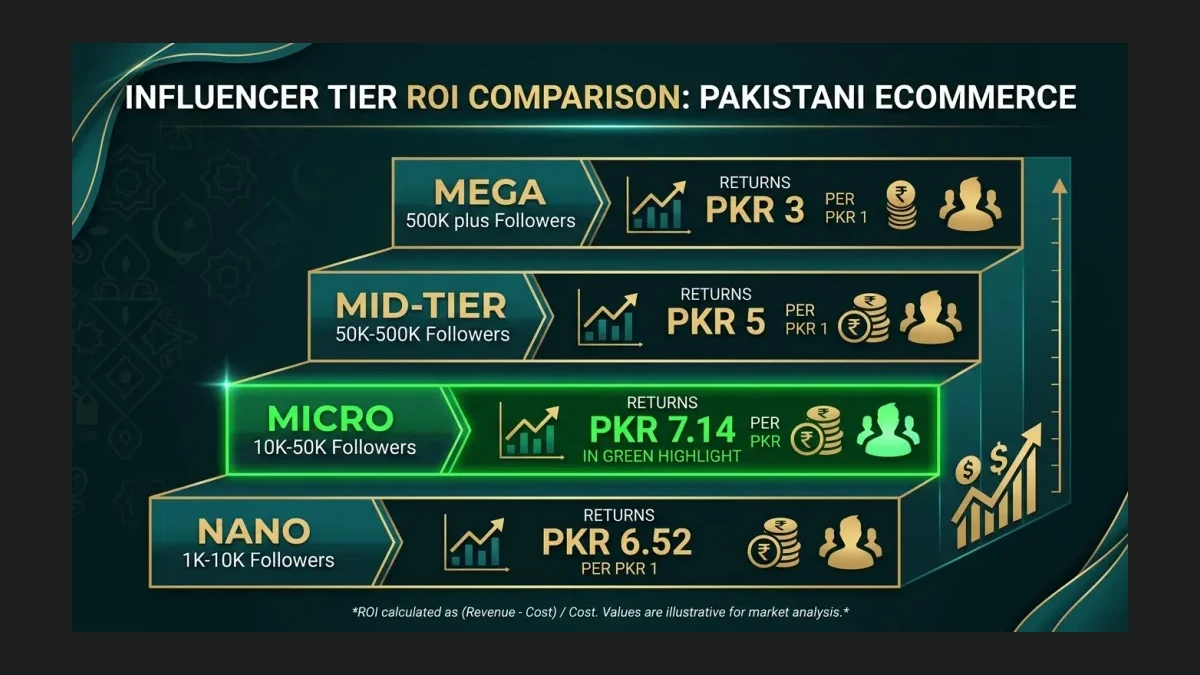
Micro-influencers are creators with relatively small, focused audiences. Definitions vary across reports, so use follower tiers as a planning shorthand. They tell you little about whether a creator’s followers live in your delivery area or want your product.
The potential advantage is audience specificity. A Karachi skincare creator who regularly discusses affordable products may offer a useful setting for a local skincare brand. A celebrity can provide broader visibility, but that audience may include people outside the brand’s price range, geography or category.
Ask shortlisted creators for recent audience insights and examples of comparable sponsored work. Read the comments: questions about sizing, delivery, ingredients or availability can be more useful than generic praise. Check whether the creator answers those questions accurately and whether sponsored posts fit their usual content.
Wayward’s partnership advertising announcement illustrates the industry’s interest in turning recommendations into paid media. Vendor announcements offer context, but they do not establish that a particular Pakistani store will achieve the same results.
The tradeoff is coordination. Working with smaller creators means more briefs, approvals, shipments and reporting. Their audiences may also overlap. A creator roster only improves performance when the additional relevance and content value justify that operational effort.
| Planning question | Nano creators | Micro creators | Mid-tier creators | Mega creators |
|---|---|---|---|---|
| Audience to inspect | Local or specialist community | Category and location fit | Relevance across a broader audience | Geographic and category overlap |
| Commercial evidence | Relevant enquiries and orders | Comparable campaign results | Results across audience segments | Sales evidence alongside reach |
| Cost to request | Content and usage quote | Content and usage quote | Content and usage quote | Content and usage quote |
| Main planning concern | Limited distribution | Coordination across creators | Maintaining audience relevance | Concentrated budget exposure |
Use this table to structure evaluation, not rank creators automatically. A larger creator with a strong product fit can outperform a poorly selected smaller account. Negotiate against the deliverables and evidence available, rather than assuming that a follower tier guarantees trust.
How Do Partnership Ads Amplify Pakistani Influencer Content?
Partnership advertising lets a brand run advertising with a creator or partner’s identity. It connects creator content with paid distribution, making it possible to test that content beyond its initial organic audience.
Meta’s partnership ad guidance says advertisers need permission from the partner whose handle appears in the ad. Permission can apply to specific content or an ongoing account relationship, and creators can revoke it. Agree commercial usage rights as well as arranging the required platform permissions.
Billo’s partnership ad analysis reports historical TikTok internal findings of 142% higher engagement, 43% higher conversion rates and 30% higher video completion for Spark Ads compared with non-Spark ads. These are platform study results, not Pakistani forecasts. The article also combines examples with different objectives, so its findings should not be treated as a universal sales uplift.
For a skincare brand, the workflow might begin with creators testing the product and producing honest demonstrations. Review the content for accuracy, audience response and suitability for advertising. Secure the necessary rights, then test promising assets against existing brand creative under comparable campaign conditions.
Imagine scrolling past a polished serum advertisement, then stopping at a familiar creator explaining the texture, packaging and how it fits their routine. That demonstration may answer questions the brand advertisement missed. It still needs a credible offer and a working purchase journey; familiarity cannot compensate for either.
The brief should specify deliverables, review responsibilities, usage duration, permitted edits and where the content may appear. Require clear sponsorship disclosure and avoid unsupported product results. Influencer campaign management should cover these details before filming, so successful content can move into paid testing without a fresh negotiation over every asset.
What Budget Split Between Micro and Mega Influencers Works in Pakistan?
There is no verified universal split that delivers the best return for Pakistani ecommerce. Start with the campaign objective, available creator quotes and the amount you can afford to test. Keep content production and distribution visible as separate budget lines.
A practical allocation process is:
- Prioritise relevant micro-creators: fund creators whose audiences match your customers and whose demonstrations address genuine purchase questions. Compare their full proposals, including revisions and usage rights.
- Use larger creators selectively: consider them when broader awareness or a particular audience justifies the cost. Define how that objective will be evaluated before signing.
- Reserve capacity for smaller creators and testing: allow room for new voices, alternative creative approaches and paid distribution. Leave enough flexibility to repeat what works.
Do not promise a fixed volume of content from an arbitrary monthly total. A detailed demonstration, a simple unboxing and an asset licensed for advertising are different purchases. Product samples, shipping, editing and creator management also consume budget.
Ask every shortlisted creator to quote against the same brief. Record what is included, what costs extra and what happens if a deliverable needs correction. This makes proposals comparable and prevents a cheap initial quote becoming an expensive campaign.
Creator material may also support product pages or retargeting when the agreement permits reuse. Digital Applied’s partner marketing roundup provides broader context, but a benchmark for co-branded content does not establish the conversion effect of your chosen assets. Test their placement against your existing customer evidence.
Which Pakistani Platforms Work Best for Influencer-Driven Ecommerce?
Choose platforms using your own customers and shortlisted creators. Category labels and broad demographic assumptions are useful starting points, but they should not dictate where the entire campaign runs. Inspect audience location, content quality and the practical route to purchase.
Instagram can suit visually demonstrable products such as clothing, skincare and homeware. However, Meta’s supported-country list does not include Pakistan for Shops and associated product-tagging features. Do not build a local campaign around assumed native checkout access. Plan a clear route to your website or another supported purchase destination.
TikTok is worth testing when the product benefits from an engaging demonstration or a creator’s familiar presentation style. Review how comparable sponsored content performs, rather than assuming that high entertainment views indicate buying intent. Confirm the available advertising workflow for the relevant account before committing to paid amplification.
Daraz can be the destination when your customers already buy there. Daraz publishes a Pakistan affiliate programme page; confirm current eligibility, linking arrangements and reporting with the programme before agreeing deliverables. Avoid promising live-shopping features without checking their availability for the intended seller and creator.
WhatsApp Business can support product questions and order assistance where that matches your customer service process. Agree who handles enquiries, how campaign interest is recorded and how customers reach checkout. Do not assume that a message or broadcast will outperform a website visit without measuring the actual outcome.
Instagram, TikTok, Daraz and WhatsApp can play complementary roles, but the campaign need not use them all. Keep Facebook or YouTube in consideration when customer evidence supports them. The best combination is the one that creates relevant demand and gives buyers a reliable next step.
How Do Pakistani Brands Measure Influencer Campaign ROAS Accurately?
Likes and comments help explain response to content. They do not establish sales or profitability. Before launch, define the reporting period, revenue basis and costs included, then apply those definitions consistently across creators and paid campaigns.
Use complementary tracking methods:
-
Unique discount codes per creator. Assign identifiable codes where your checkout supports them. Codes help connect orders with promotions, but customers may share them or buy without using them. Treat code usage as evidence of a connection, not proof that the creator caused every order.
-
UTM-tagged links. Tag destination links consistently by creator and campaign. Google’s documentation explains how manual tags populate traffic-source dimensions. Tags identify traffic; purchase tracking must also be configured and checked. Do not assume your marketplace destination provides the same analytics access as your own store.
-
Advertising-platform conversion reporting. Review results attributed to creator ads alongside store orders and analytics. Record the attribution settings used. Platform reports and link-based reports answer different questions, so a discrepancy is something to investigate rather than automatically correct in favour of the largest result.
For paid amplification, report attributed revenue divided by advertising spend, with the attribution basis stated. Also show the return against total creator campaign costs, including fees, samples, licensing and production. Avoid comparing a creator-fee-only calculation with a paid campaign whose denominator includes all distribution costs.
Reconcile orders before presenting a combined total. Discount codes, analytics and ad reports can describe the same purchase; adding their revenue together would overstate results. Account for cancellations, refunds and failed deliveries, particularly where an order is recorded before payment is collected.
Influencer measurement and ROI reporting should make these assumptions visible. Where practical, compare exposed and unexposed audiences or periods to investigate whether creator activity generated additional sales. Attribution is useful evidence, but it is not the same as incrementality.
Treat a platform benchmark as a test hypothesis. Judge your campaign against reconciled revenue, its full costs and the margin left after fulfilment.
What Common Mistakes Do Pakistani Brands Make With Influencer Budgets?
The most expensive mistakes usually begin before content goes live: an unclear objective, an incomplete brief or a measurement plan written after launch. Avoiding them makes the eventual results easier to interpret.
Mistake one: concentrating the budget without evidence. A celebrity booking may be appropriate for broad awareness, but it should not be evaluated as though sales were guaranteed. Equally, splitting the budget across smaller accounts does not automatically improve results. Compare audience relevance, creative quality and commercial terms before deciding how much concentration is sensible.
Mistake two: leaving paid usage unresolved. Content that attracts promising organic responses may deserve an advertising test. Without agreed rights and platform permissions, that option can be delayed or unavailable. Modern Retail’s reporting on creator content provides industry context for paid distribution; it does not quantify revenue your store loses by staying organic.
Mistake three: reporting attention as revenue. A widely viewed video might support awareness while producing few immediate orders. A narrowly viewed demonstration might generate profitable purchases. Judge each against its stated objective, and avoid declaring either successful solely because its reach looks impressive.
The remedy is a written decision rule. Specify what evidence would justify repeating a creator, testing an alternative asset or ending the partnership. Include fulfilment outcomes and customer quality, rather than stopping at checkout revenue.
Review the landing page and stock position alongside the content. If buyers cannot find the featured item or understand delivery terms, changing the creator may not solve the problem. Campaign reporting should distinguish a weak audience match from a purchase journey that needs repair.
When Should Pakistani Ecommerce Brands Start With Micro-Influencer Marketing?
Start when the product, fulfilment process and measurement setup are ready for a useful test. A large global creator-economy estimate does not tell you whether your store is ready, and there is no universal advertising-spend threshold that makes creator partnerships profitable.
Choose a product with a clear use case, adequate stock and enough margin to support acquisition. Prepare a page that answers the questions a creator will generate. Decide whether the first test is primarily evaluating audience access, content quality or paid advertising performance.
Keep the initial commitment manageable while allowing enough time for production, publishing, purchase decisions and delivery. A fixed short reporting window can misrepresent products with longer buying cycles. Agree when results will be reviewed and which outstanding orders remain provisional.
If the campaign produces commercially useful evidence, expand gradually. Compare creator ads with existing creative under similar conditions and account for changes in offers, audiences or stock. Strong early ROAS does not guarantee that the same result will hold as spending increases.
WeProms Digital plans creator selection, campaign execution and reporting for Pakistani ecommerce brands. Contact us via WhatsApp +92 300 0133399 or hello@weproms.com to discuss a campaign audit. Bring recent order data, advertising costs and creator proposals so the discussion can focus on realistic economics.
Read next: Influencer partnerships in Pakistan: long-term over one-off · Why last-click attribution can distort ROAS
Frequently Asked Questions
How much do Pakistani micro-influencers charge per post?
Request current quotes for a defined brief rather than relying on a universal rate card. Price depends on audience relevance, production requirements, revisions, exclusivity and paid usage rights. Ask whether samples, travel or additional edits are included. Compare creators using the total cost of the content you can actually use, alongside evidence of audience fit and comparable campaign performance.
What is a good ROAS for Pakistani influencer campaigns?
A useful target comes from your margins, fulfilment costs, returns and acquisition goals. There is no verified national benchmark that makes every micro-influencer campaign profitable. Separate advertising ROAS from total campaign return, and use fulfilled revenue consistently. A high revenue multiple can still leave little profit if discounts, shipping subsidies and creator costs consume the margin.
How do Pakistani brands track influencer sales accurately?
Combine creator-specific codes, tagged links, store order records and advertising reports where available. Check the purchase-tracking setup before launch. Reconcile overlapping orders and document attribution settings instead of adding every reported sale together. For cash-on-delivery orders, distinguish initial orders from collected revenue. These steps produce a more useful view than engagement metrics alone, although attribution still has limitations.
Should Pakistani ecommerce brands use Instagram or TikTok for influencer marketing?
Choose using audience evidence and the product’s demonstration needs. Test creators whose followers match your delivery locations and customers, then compare purchase outcomes and content usefulness. A creator’s strength on one platform does not guarantee the same response elsewhere. Confirm advertising access and purchase routes before briefing; Pakistani stores should not assume Instagram Shops or native checkout is available.
Is influencer marketing effective for Pakistani B2B companies?
It can be worth testing with relevant industry experts, professional communities and specialist creators. Evaluate qualified enquiries, sales conversations and pipeline contribution against the longer buying process. A broad global ROI figure cannot establish likely results for a Pakistani service provider. Ask whether the creator reaches decision-makers and can explain the service credibly before treating their audience size as commercial value.
What is the best social media marketing agency in Pakistan for influencer campaigns?
Choose an agency that can explain creator selection, commercial terms, advertising permissions and revenue reconciliation. Ask for relevant campaign evidence and clear cost definitions. WeProms Digital supports these activities for Pakistani ecommerce brands, including content coordination and campaign reporting. Discuss your product margins, customer locations and existing measurement setup before agreeing a scope. Contact the team through the email or WhatsApp details below.
Key Takeaways
- Micro-creators offer a way to test focused audiences and credible product demonstrations; follower size alone does not establish sales potential.
- Partnership ads require appropriate creator permissions and commercial usage terms. Plan those before production so promising assets can be tested efficiently.
- Build the budget from comparable quotes, campaign objectives and distribution needs. Avoid treating an unsupported percentage split as a proven local formula.
- Reuse creator content only within the agreed rights, and test whether it improves your product pages or advertising. Published conversion lifts are not guarantees.
- Combine codes, tagged links and advertising reports with reconciled order records. Keep overlapping attribution, cancellations and delivery outcomes visible.
- Scale according to profitable outcomes and operational capacity. Judge larger creators and smaller creators against the same clear commercial objectives.
About WeProms Digital
WeProms Digital serves Pakistani SMEs, ecommerce brands and B2B teams across Lahore, Karachi, Islamabad, Rawalpindi, Faisalabad and Multan.
The team supports micro-influencer strategy, partnership advertising and campaign measurement. Work covers creator selection, content coordination, paid distribution and reporting that connects campaign activity with store outcomes. The aim is to give brands a clear basis for deciding which partnerships to repeat and where their next advertising budget should go.
Get in touch: hello@weproms.com · WhatsApp +92 300 0133399
Sources & References
- Wayward (Morningstar/PR Newswire) — Partnership media launch announcement — vendor context, not a Pakistani performance benchmark.
- Billo — Partnership Ad Performance — historical platform findings and campaign examples.
- inBeat — Creator Economy Statistics — broader industry reading.
- Digital Applied — Influencer Marketing Statistics — secondary benchmark compilation.
- Entrepreneurs HQ — Influencer Marketing Statistics — research from different sources and periods.
- Digital Applied — Partner Channel Marketing Statistics — broader partner marketing context.
- Modern Retail — Creator Content Has Become Critical for Retail Media Networks — industry reporting.
Additional reading from industry feeds: