

TL;DR: Social media activity does not automatically translate into measurable sales. The REACH framework — Reach, Engagement, Attribution, Content Mix, Habit — helps Pakistani brands audit the connection between content, customer actions and revenue. WeProms Digital’s social media marketing team uses the framework to identify measurement gaps, prioritise useful content and connect reporting to business outcomes in PKR.
For a Pakistani business investing in social media, the useful question is whether that activity contributes to profitable customer relationships. A Lahore fashion brand might attract followers without generating website visits. A Karachi restaurant might receive enthusiastic comments without knowing whether those conversations lead to reservations. These are examples of measurement gaps, not evidence that social media cannot work.
The problem is not necessarily effort. Teams can post consistently and still lack the information needed to judge results. Followers grow, engagement looks encouraging, but nobody can explain which activity deserves more budget. Measuring social media only by follower count is like counting the people who walked past your stall at Liberty Market without checking who bought something.
REACH is a five-step social media ROI audit framework for Pakistani brands. Reach examines who sees your content; Engagement assesses their response; Attribution investigates the connection to sales; Content Mix compares formats; and Habit reviews your publishing routine. Applied together, these checkpoints help you distinguish promising activity from unproven assumptions. They support financial decisions, but a social media dashboard alone is not a profit-and-loss statement.
R — Reach: Who Actually Sees Your Pakistani Brand’s Content?
Reach describes the unique audience reported as seeing your content within a selected period. Start by checking how each platform defines the metric. Keep paid and organic distribution separate where possible, and compare equivalent reporting periods rather than mixing a campaign total with an average post result.
Follower count is a different measure. Some followers may never see a particular post, while people who do not follow the account may encounter it. A Rawalpindi gym could therefore have a large following and limited distribution, or a modest following and a post that travels well beyond its regular audience.
The audit question is broader than “what percentage of followers saw this?” Ask whether content reaches relevant potential customers. Review available audience information alongside reach, including location and the distinction between followers and non-followers. For a local business, wider distribution is useful only when it can support the area and customers the business serves.
A reach-to-follower ratio can be a useful comparison within your own account, but it does not establish how many followers actually saw a post. Avoid treating a universal percentage as a pass-or-fail threshold. Compare similar posts against your normal results and investigate changes in promotion, topic, format or audience before diagnosing a content problem.
Visual discovery platforms may be worth testing for product-led businesses. Sprout Social’s Pinterest marketing guide provides background, but it should not substitute for evidence about your Pakistani customers. Assess whether discovery produces useful visits or enquiries, and include the production effort required to maintain another channel.
Audit step: Pull 30-day reach data from each platform. Separate paid and organic results where available, record relevant audience details and compare performance with your own baseline. Flag unexplained declines for investigation rather than assuming every low-reach post needs additional budget.
E — Engagement: Are Your Followers Interacting or Just Scrolling?
Engagement covers actions such as likes, comments, shares, saves and clicks. These actions help you understand how people respond, but they are not interchangeable. A product enquiry, a complaint and a casual reaction can all increase an engagement total while requiring very different decisions from the business.
Engagement rate by reach divides recorded interactions by reported reach. It is useful when you want to examine the response among the audience exposed to content. State which interactions you include and apply the same calculation consistently. Otherwise, a change in reporting definitions can look like an improvement in content performance.
Rates calculated against followers answer a different question and should be labelled accordingly. Neither denominator proves commercial success. When reviewing an agency report, check the formula before comparing it with another account, platform or published benchmark. A percentage without its denominator and reporting period is difficult to interpret responsibly.
Use your own posts to establish a working baseline. Separate paid from organic activity and compare content with similar objectives. A giveaway may attract reactions from people unlikely to buy; a product demonstration may produce fewer interactions but more useful enquiries. Read the comments and examine the quality of the response alongside the headline rate.
Engagement can help identify relevant content, but there is no reliable universal multiplier that converts an engagement increase into additional reach. Treat an apparent relationship as something to test. The practical goal is to learn which topics help customers understand, trust or choose the business, then check whether those responses progress towards sales.
Audit step: Calculate engagement rate by reach over 30 days. Compare your top 10 posts with your bottom 10, checking topic, format, caption and promotion. Record what people actually did, and identify a content hypothesis you can test rather than copying the most-liked post without context.
A — Attribution: Which Social Media Posts Actually Drive Revenue?
Attribution connects recorded marketing touchpoints with outcomes such as purchases, qualified leads or reservations. A WhatsApp click indicates interest; it does not establish that a conversation or sale followed. Keep those stages distinct so that an inexpensive click is not reported as an acquired customer.
Consider a Lahore boutique sending visitors to its homepage without campaign tags. The owner may see social traffic in analytics but struggle to distinguish campaigns or content. If sales then happen through WhatsApp or in-store, website reporting provides only part of the picture. The audit needs to examine both the tracking setup and the sales process.
Start with UTM parameters on trackable links you control. Use a consistent naming convention for platform, campaign and content, then test that the destination and reporting work as intended. Avoid forcing post-level precision where several posts share the same profile link. Our guide to marketing attribution for Pakistani SMEs explores how to connect these records to business decisions.
Next, review the actions recorded in Google Analytics 4 and distinguish completed business outcomes from intermediate actions. Check purchases against order records and enquiries against the sales team’s records. For WhatsApp-led sales, agree how staff will record the enquiry source and final outcome without relying on memory at the end of the month.
Do not assume analytics can reconstruct every customer journey or show every social impression before a purchase. Review the attribution settings and reports available in your account, and describe their limitations in plain language. Attributed revenue is evidence under a chosen measurement approach; it does not automatically prove that social media caused the sale.
Audit step: Review social traffic and campaign detail in GA4, test tagged links, and trace sample enquiries through to their recorded outcome. Investigate missing campaign data before declaring attribution broken. Use a marketing measurement and reconciliation plan to agree how analytics, order records and sales reporting will be compared.
C — Content Mix: Is Your Format Strategy Working for Pakistani Audiences?
Content mix is the combination of static images, carousels, short videos, stories, longer videos and text posts in your output. Each format should have a purpose. A useful comparison considers the intended customer action and production effort, rather than assuming that whichever format attracts the largest audience must be best.
Break your last 90 days of posts into format categories. Record reach, interactions, relevant clicks and any traceable outcomes. Note which posts received paid promotion or supported a major offer. Without that context, you may credit the format for results driven by advertising spend, product demand or a particularly strong promotion.
| Format | Reach Review | Engagement Review | Possible Uses |
|---|---|---|---|
| Static Image | Compare similar product and offer posts | Check clicks and relevant comments | Product announcements, testimonials |
| Carousel | Compare distribution across topics | Review saves, shares and useful responses | Educational content, product comparisons |
| Short Video (Reels/TikTok) | Review discovery and relevant audience | Check viewing response and enquiries | Demonstrations, brand awareness |
| Stories | Compare results within the format | Review replies and available link actions | Time-sensitive offers, behind-the-scenes |
| Long-form Video | Assess distribution to interested viewers | Review viewing response and follow-up actions | Tutorials, product deep dives |
Treat this table as an audit worksheet, not a set of Pakistani platform benchmarks. Short video may deserve more production time when it consistently delivers valuable responses, but that conclusion should come from your account. Static content that answers buying questions or supports existing customers may still earn its place.
The operational question is whether effort matches value. Compare production requirements with useful outcomes before moving the entire budget to a popular format. Your social media strategy and content plan should also leave room to test new ideas without abandoning formats that already support sales.
Audit step: Categorise your last 90 posts by format and objective. Compare reach, engagement and traceable outcomes, noting production effort and paid support. Prioritise formats that contribute to the intended result, then review whether the change improves the overall mix.
H — Habit: Is Your Posting Schedule Consistent Enough to Build Audience?
Habit examines whether your team can maintain a useful publishing and response routine. Consistency helps you plan, serve your audience and collect comparable evidence. It should not be treated as a guaranteed algorithmic reward or an obligation to publish content that has no clear purpose.
A business may publish heavily before an Eid sale and then go quiet while the team fulfils orders. That pattern deserves investigation, but it does not establish a fixed platform penalty or recovery period. Ask whether the gaps leave customer questions unanswered, interrupt a campaign or make it difficult to learn from results.
Choose a schedule that reflects available production capacity, audience needs and the role of each channel. Avoid importing posting minimums from unrelated accounts. A team that cannot maintain quality, approve content or respond to enquiries needs a more realistic plan before it needs a busier calendar.
Test timing using your own audience and sales information. Lunch breaks, evenings and commuting periods can be hypotheses, not established nationwide peak windows. Compare similar content across different publishing times and consider when staff can respond. A post that generates enquiries while nobody is available to help may expose an operational gap.
Consistency should make the business easier to recognise and contact. It is not proof that an AI search system will recommend it. For broader discussion of community and visibility, see Search Engine Journal’s article on community, revenue and AI visibility.
Audit step: Review your posting and response habits over the past 90 days. Identify avoidable gaps, approval delays and unanswered enquiries. Build a 30-day calendar with clear topics, formats, publishing responsibilities and response coverage, then assess whether the team can sustain it.
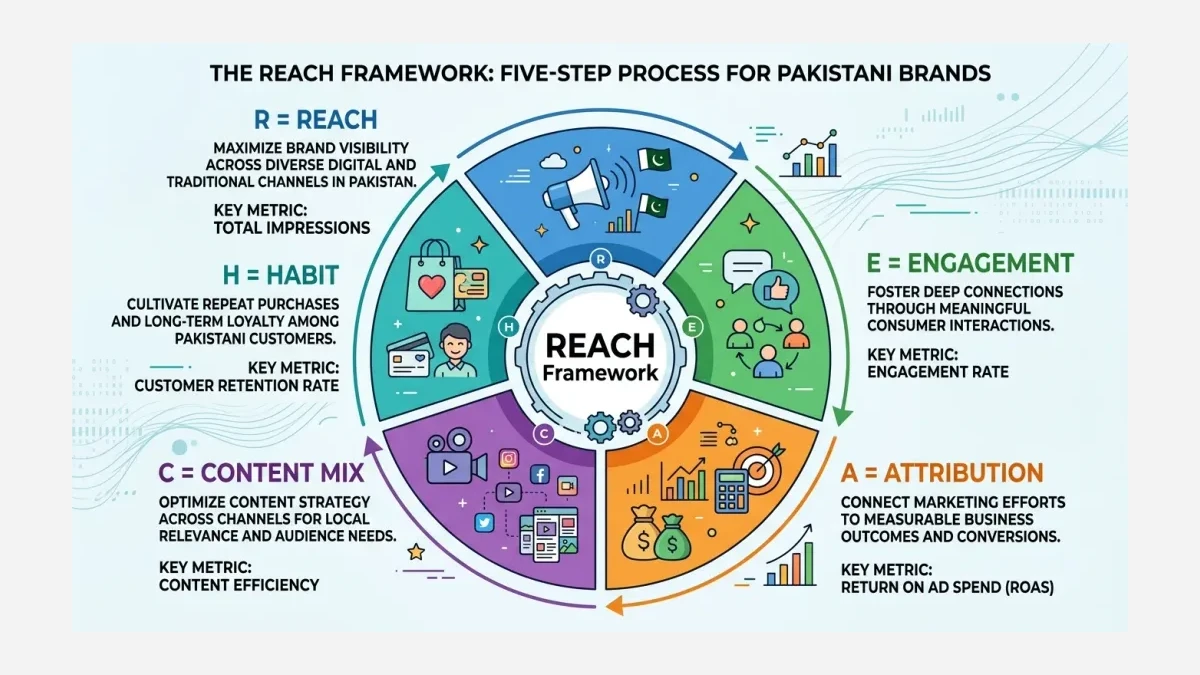
What Results Can Pakistani Brands Expect From a Social Media Audit?
A useful audit should produce clearer measurement, prioritised fixes and a practical testing plan. Engagement, traffic and sales may improve, but there is no defensible universal uplift or deadline for every Pakistani brand. Results depend on the starting point, offer, audience, creative quality and ability to act on the findings.
The cost also depends on scope. Ask whether a proposal covers account review, tracking checks, content analysis, implementation and follow-up reporting. For monthly management, clarify what is included in production, advertising, community responses and reporting. Compare deliverables and responsibilities rather than treating an unsourced market price range as a purchasing guide.
For ROI reporting, agree which costs and financial returns belong in the calculation. Revenue alone does not tell you whether the activity was profitable. Include relevant advertising, agency and production costs, and work with finance to decide how product margins, returns and fulfilment affect the assessment. Keep that calculation separate from engagement reporting.
WeProms Digital applies REACH to structure this work: examining distribution, reviewing customer responses, checking measurement and developing a sustainable content routine. If your spending cannot be connected to business outcomes, start by identifying the missing evidence. Contact the team through the social media marketing service or via WhatsApp at +92 300 0133399.
Read next: CROWD Framework: Community Marketing for AI Visibility | Content Marketing ROI for Pakistani Businesses
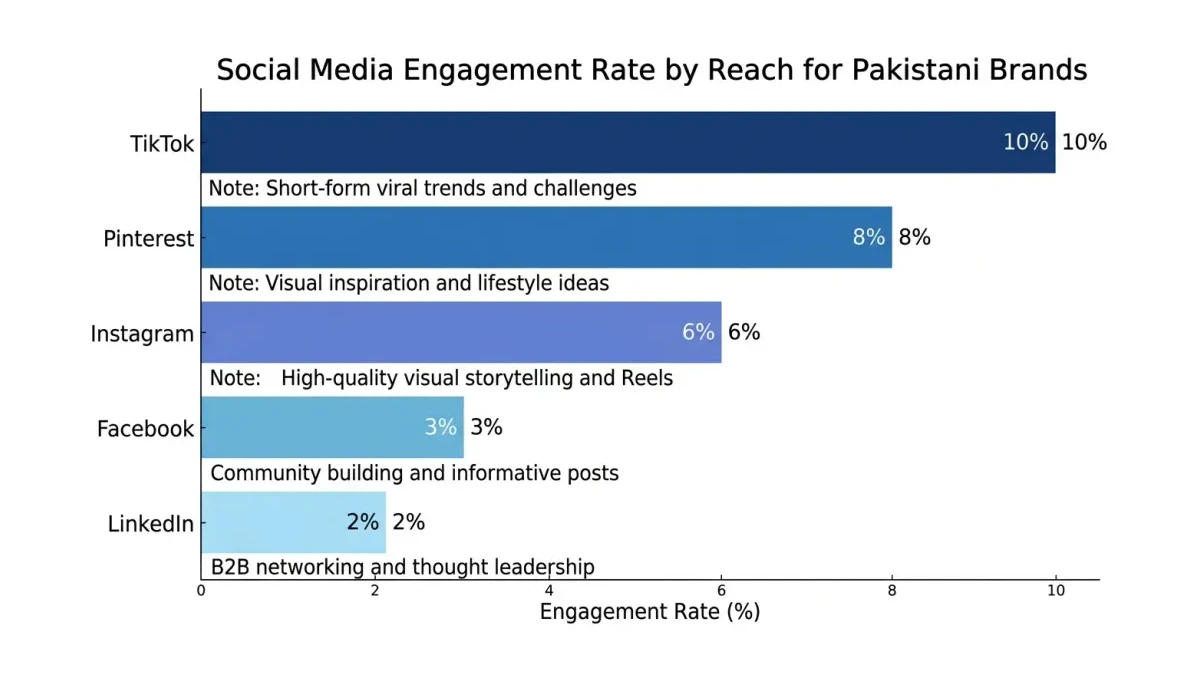
Treat platform comparisons as prompts for investigation; use your own current account data when setting performance targets.
Frequently Asked Questions
How much does social media marketing cost in Pakistan?
Costs vary with platform coverage, content production, advertising support and reporting requirements. Request an itemised proposal and clarify whether media spend, video production, tracking implementation and community management are included. Compare agency and freelance proposals against the same scope, including who owns the accounts and what happens when additional work is needed.
What is a good social media engagement rate for Pakistani brands?
Start with a baseline from your own account and compare content with similar objectives. State whether the denominator is reach, impressions or followers, and identify the interactions included. A useful rate shows improvement in relevant audience response; it should also be reviewed alongside enquiry quality and business outcomes before judging success.
Which social media platform works best for Pakistani businesses?
Choose platforms according to where your customers discover products, seek information and contact businesses. Test the options that fit your audience and sales process, including messaging channels when relevant. Compare qualified enquiries, completed sales and servicing costs before declaring a winner. A platform that works for a fashion retailer may not suit a specialist B2B supplier.
How do I measure social media ROI for my Pakistani business?
Tag trackable links, review the actions recorded in analytics and connect enquiries with sales records where possible. Compare the attributable financial contribution with the relevant costs using an agreed calculation. State what tracking cannot capture. Reporting gaps make the estimate less complete; they do not justify presenting every click or platform-reported conversion as confirmed revenue.
Should Pakistani businesses hire a social media agency?
Consider an agency when your team lacks the capacity or expertise to execute a useful plan. Ask how the agency will assess the current setup, handle content approvals, manage enquiries and report commercial outcomes. Professional support is a cost to evaluate, not a guaranteed source of recovered revenue. Agree responsibilities and success measures before committing.
How often should Pakistani brands post on social media?
Use a frequency your team can sustain while producing useful content and responding to customers. Review audience activity and test timing within your own account. Increase output when there is a clear purpose and sufficient capacity, then check whether results justify the extra work. Avoid treating a generic posting schedule as an algorithmic requirement.
What is the REACH framework for social media auditing?
REACH stands for Reach, Engagement, Attribution, Content Mix and Habit. It organises an audit around audience exposure, response, business outcomes, format choices and publishing routines. Each checkpoint should produce a finding, supporting evidence and a practical action. Together, they help Pakistani brands decide what to measure, fix, test or stop.
Key Takeaways
- Start with the audience your content actually reaches, and distinguish relevant distribution from follower growth.
- Use REACH to examine connected parts of your social media activity rather than judging isolated dashboard metrics.
- Define engagement consistently and compare similar posts; unsourced national benchmarks are a weak basis for budget decisions.
- Connect trackable links, analytics and sales records while acknowledging missing touchpoints and attribution limits.
- Judge financial returns alongside costs, and choose a content schedule your team can maintain and evaluate.
About WeProms Digital
WeProms Digital is a social media marketing agency headquartered in Lahore, serving Pakistani SMEs, ecommerce brands and B2B teams across Lahore, Karachi, Islamabad, Rawalpindi, Faisalabad and Multan.
The team specialises in social media strategy, content creation and performance analytics. Structured audit frameworks such as REACH help organise measurement reviews, content decisions and reporting around the outcomes each business needs to understand.
Get in touch: hello@weproms.com | WhatsApp +92 300 0133399 | Social media marketing services
Sources & References
These links provide background reading. They should not be treated as verified sources for Pakistani pricing, platform benchmarks or guaranteed performance improvements.
- DataReportal — Digital 2026 Pakistan
- Sprout Social — Pinterest for Small Business Marketing
- Search Engine Journal — From Reddit to Revenue: Building Real Community
- Litmus — The Dangers of Generative AI in Email Marketing
- KPMG Pakistan — Pakistan Banking Perspective 2026
- Ahrefs — Claude Skills for SEO and Marketing
- MarketingProfs — AI Update, May 2026
- Campaign — Heineken Concludes Global Media Review
Additional reading from industry feeds: