

TL;DR: AI-generated video can reduce production work, but those savings need to be weighed against audience response. International research found that 31% of consumers trust brands less when they notice AI-generated marketing, while 7% trust them more. These are not Pakistan-specific video results. For Pakistani brands, the practical question is whether synthetic content makes products clearer or makes the brand less credible. WeProms Digital’s social media marketing team helps brands assess that trade-off through content planning and testing.
AI-generated video promises Pakistani brands a tempting shortcut: a founder can appear on camera without recording every script, and a team can create variations without repeating a shoot. But generating a clip is only part of production. Someone still needs to develop the message, check the product details, review pronunciation and decide whether the result deserves an audience’s attention.
The evidence warrants caution, rather than a blanket rejection of AI. Deloitte’s Digital Consumer Trends 2026 research in Ireland found that 70% of respondents wished they spent less time on their devices. That does not measure Pakistani behaviour, but it illustrates why publishing more is an incomplete strategy. A cheaper production pipeline matters only when its output helps the business.
Why Does AI-Generated Video Erode Brand Trust Instead of Building It?
AI-generated video uses generative tools to create footage, avatars or other visual elements. It can still involve human scripting, editing and review. That distinction matters: using AI to support production presents different trust questions from presenting a synthetic person as a real customer describing an experience they never had.
According to eMarketer’s reporting on Klaviyo and Datalily research, 31% of consumers said visible AI-generated marketing made them trust a brand less, while 7% said it made them trust it more. The survey covered consumers in markets outside Pakistan and addressed marketing generally. It signals a potential trust cost; it does not establish a local conversion penalty or prove that every generated video underperforms.
Think of walking through Anarkali Bazaar in Lahore. If neighbouring shops repeat an indistinguishable sales pitch, the words become background noise. A similar problem can arise when brands use interchangeable scripts, avatars and promises. The issue is not simply the software. It is whether the finished content gives viewers a credible reason to choose this particular business.
A convincing video still needs a credible message. Production savings cannot tell you whether viewers believe the claim or understand the product.
The Native Advertising Institute’s discussion of audience trust and AI also raises concerns about suspected AI content and the environments surrounding advertisements. However, it does not support the original article’s precise claims about disclosure expectations or customers leaving after an inauthentic experience. The useful lesson is to avoid misleading viewers about authorship, product performance or customer experiences.
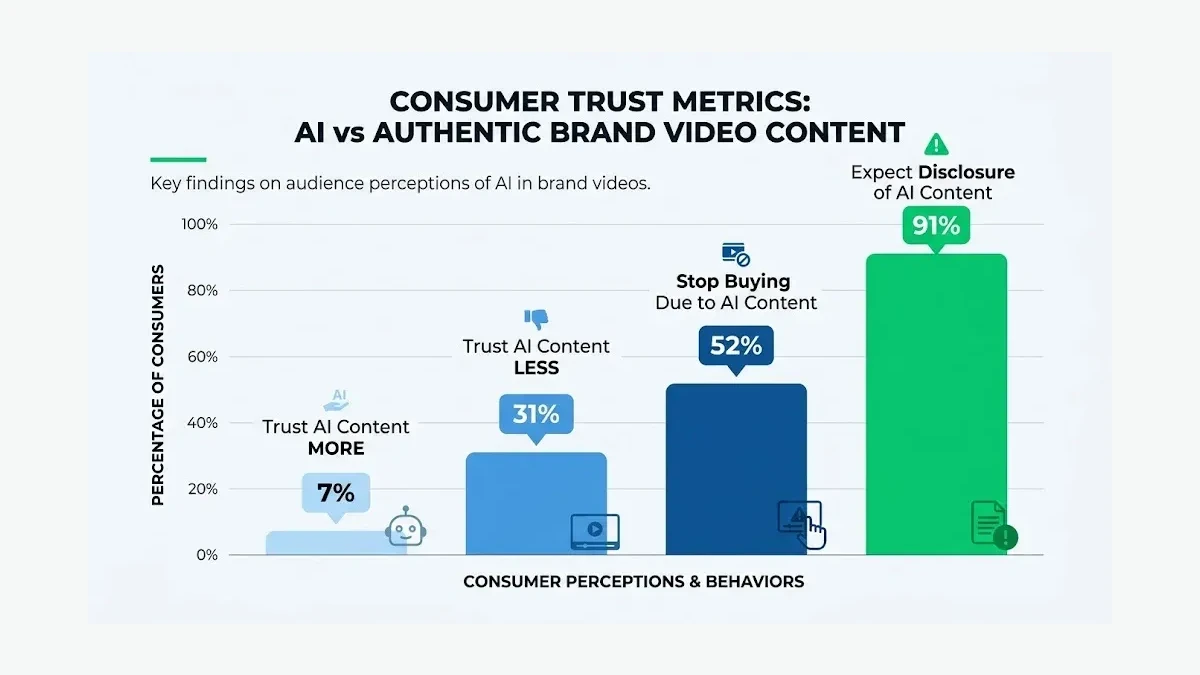
The research discussed above supports the trust comparison; the disclosure and customer-defection figures in this illustration are not substantiated by its cited source.
What Happens to Engagement When Every Pakistani Brand Uses the Same AI Video Tools?
Similar tools can produce similar-looking content, especially when teams reuse generic prompts and scripts. But shared software does not automatically cause falling engagement. The audience, offer, distribution, creative execution and measurement method all affect results. An original product demonstration can be useful even when its captions or background were generated with AI.
Post Everywhere’s benchmark compilation distinguishes overall Instagram engagement from Reels performance and reports differing results across datasets. The original article treated an overall Instagram decline as a Reels-specific finding. Its TikTok comparison also overlooked that comments can decline while other interactions grow. Neither comparison establishes that AI saturation caused the changes, or that Pakistani brands experienced the same pattern.
Content saturation is a useful description of a crowded feed, but it is not a diagnosis on its own. Imagine Lahore restaurants using similar food shots, trending audio and text overlays. The practical weakness is that viewers may learn little about portion size, ingredients, location or what makes each restaurant worth visiting. Better information can distinguish the content without expensive production.
Attention is limited, but its supply should not be treated as a fixed national figure. DataReportal’s Pakistan report provides useful market context; the available evidence does not substantiate the original claim about daily time online or a doubling of content supply. Neither claim is needed to justify making videos more relevant.
Audit your recent videos alongside competitors’ work. Compare the opening promise, visual treatment and information delivered. If the logos disappeared, could a viewer still recognise your business? Use that exercise to improve your social media strategy and content planning, then test whether the changes improve meaningful responses.
How Does Screen Fatigue Change the Rules for Pakistani Video Marketing?
Screen fatigue describes tiredness or a desire to reduce digital consumption. Deloitte’s Irish research identifies concern about device use, particularly among younger audiences. It is a useful warning against assuming unlimited appetite for content, but it does not establish a Pakistani fatigue rate. The original article’s precise exhaustion and physical-symptom figures are not supported by the cited material.
For Pakistani brands, posting frequency should follow audience response and production capacity. Daily posting can work when the content remains useful; a lighter schedule may work better when each video answers a distinct question. A viewer scrolling through Reels in Faisalabad may welcome a clear sizing demonstration while ignoring another generic brand announcement. Frequency alone cannot explain that difference.
Give each video a clear job: answer a question, demonstrate a product or show evidence that helps someone decide. Repetition needs a purpose beyond filling the calendar.
Search Engine Journal’s report on Google’s AI creative discussion describes advertiser guidance, creative variation and testing. Google’s position was that AI can help brands develop more variations when advertisers supply strong direction. The discussion does not announce an algorithmic penalty for repetitive AI video, nor does it establish how Instagram or TikTok will rank such content.
A declining account therefore needs diagnosis before a complete rebuild. Review distribution, audience fit, hooks, watch behaviour and the offer alongside production method. Content governance and editorial quality assurance can make those reviews consistent, particularly when different team members generate, edit and approve clips. Keep a record of recurring errors so faster production does not simply multiply them.
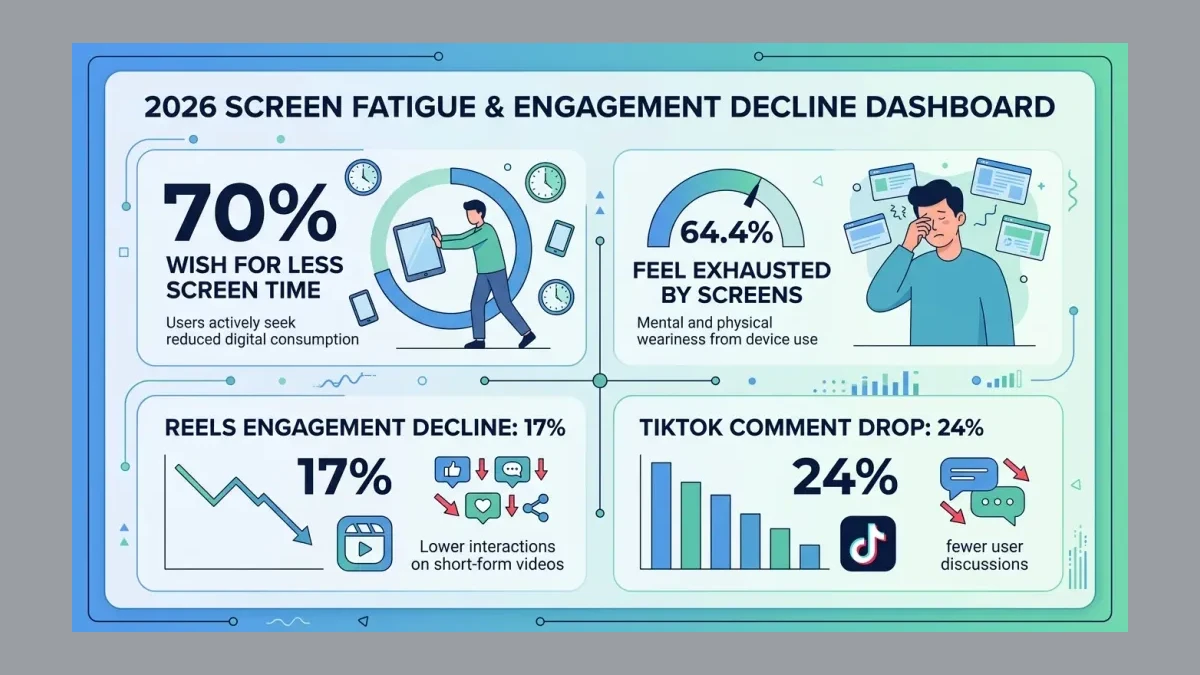
Read this illustration alongside the qualifications above: the fatigue research is from Ireland, and platform benchmarks do not establish that AI caused engagement changes.
Why Do Pakistani Consumers Detect AI Content Faster Than Brands Expect?
Pakistani audiences may notice pronunciation, clothing, settings or expressions that do not fit the context of an advertisement. An Urdu voiceover with misplaced stress, for example, can distract from an otherwise useful product explanation. These are sensible checks for a local creative team, but they do not prove that Pakistani viewers detect AI faster than audiences elsewhere.
Bottle Rocket Media’s analysis of AI and brand trust argues that synthetic presentation can weaken human connection. That is an industry perspective, not evidence of a measured Pakistani detection advantage. Nor should a multilingual audience be treated as uniform: familiarity with a language, regional expression or product category will differ between viewers.
Use reviewers who understand the language and market being targeted. Ask them whether the script sounds natural, whether the voice communicates the intended meaning and whether the visuals accurately represent the product. A technically smooth clip can still use awkward phrasing or show a garment behaving in ways the actual fabric would not.
Trust matters commercially, but it does not guarantee that a human-led video will generate more revenue than an AI-assisted alternative. Compare the complete production cost with qualified enquiries, purchases and customer feedback. An inexpensive clip that explains a feature accurately may be more useful than a polished founder video that never answers the buyer’s question.
Test a human-led alternative against a comparable generated concept. Keep the product, offer and distribution as similar as practical, and review audience comments alongside performance. Treat the result as evidence about that creative and audience, rather than a permanent verdict on the entire production method.
What Does Authentic Video Actually Cost for Pakistani Brands in 2026?
Authentic video production can begin with a smartphone and someone who knows the product. That lowers the equipment barrier, but it does not make the work free. Planning, filming, editing, approvals and responding to viewers all consume time. Existing equipment also needs to be considered differently from equipment bought specifically for a campaign.
AI production has its own overhead: subscriptions, usage limits, generated takes that cannot be used, revisions and quality checks. There is no reliable universal monthly price in Pakistani rupees for a workflow combining several tools. Compare current supplier quotes and your actual usage instead of assuming that a subscription replaces the whole production process.
| Cost Factor | AI-Generated Video | Authentic Smartphone Video |
|---|---|---|
| Tools and equipment | Subscriptions or usage charges depend on the workflow | Existing phone may suffice; audio and lighting may need investment |
| Production time | Scripting, generation, revisions and review | Planning, filming, editing and review |
| Trust considerations | Check synthetic identities, disclosure and product accuracy | Check claims, staging and whether experiences are represented honestly |
| Engagement impact | Depends on usefulness, execution and distribution | Depends on usefulness, execution and distribution |
| Scalability | Variations may be faster; review remains necessary | Batch filming and reusable formats can improve capacity |
For a Karachi D2C brand, the right comparison is a usable content pipeline. Include the time spent correcting product colours, fixing pronunciation, obtaining approvals and adapting videos for different placements. Compare those tasks with the work required to film the actual product. A generated workflow may save time on one format and create extra work on another.
Before commissioning short-form video production, define what the customer needs to see. A clothing buyer may need movement and close-up fabric detail. A food buyer may want packaging, preparation or serving context. The brief should specify those requirements before the team chooses whether to film, generate or combine assets.
Record the cost of approved, publishable work rather than every exported clip. A batch of unusable variations can look productive while creating no value. Conversely, footage from a well-planned shoot may support several useful edits. Include reuse in the comparison, but avoid counting nearly identical variations as separate strategic wins merely because they were easy to produce.
WeProms Digital helps Pakistani brands connect production choices with audience needs and commercial goals. A sensible brief can combine human demonstrations with AI-assisted editing or supporting visuals. The objective is a repeatable process that produces accurate, distinctive content and gives the team enough evidence to improve it.
Read next: Short-form video production · AI Video Production Cost for Pakistani Ecommerce
If your brand is struggling with engagement, trust or differentiation, WeProms Digital can review your content pipeline and identify where the message or production process needs work. Contact the social media marketing team at hello@weproms.com or on WhatsApp at +92 300 0133399.
Frequently Asked Questions
Is AI-generated video bad for Pakistani brands?
Not inherently. The risk depends on what the video represents and what viewers are being asked to believe. Supporting visuals and editing assistance raise different questions from a simulated customer endorsement. International research suggests visible AI marketing can reduce trust for some consumers, but it does not predict the outcome for every Pakistani campaign. Check accuracy, context and audience response.
How much does authentic video production cost for Pakistani SMEs?
Costs depend on the brief, equipment, talent, editing and approval requirements. Using an existing smartphone can reduce upfront spending, but staff time still has a cost. Ask suppliers to specify deliverables, revisions, usage rights and what the business must provide. Compare that quote with the full AI workflow, including subscriptions and review time, rather than assuming either approach is always cheaper.
What do Pakistani consumers think about AI-generated brand content?
The international sources cited here do not establish a representative Pakistani opinion. Local responses may vary by audience, language, product and whether the AI use is clear. Review Urdu and regional-language content with fluent speakers, then ask customers what they found useful or unconvincing. Do not confuse awkward pronunciation with proof that all synthetic content causes distrust.
Should Pakistani brands disclose when they use AI in video content?
Be transparent when synthetic people, voices or scenes could materially mislead viewers, and check the publishing platform’s applicable disclosure requirements. Explain the AI use in language the audience can understand. Disclosure is not a guarantee of stronger engagement, and it does not make an inaccurate product claim acceptable. The original article’s numerical claims about disclosure expectations and customer defection were not supported by its cited source.
Which Pakistani industries are most affected by AI video trust issues?
Risk is better assessed by the claim than by a fixed industry ranking. Fashion and food demonstrations need to represent appearance and product behaviour accurately. A software demonstration must also show capabilities the product actually has. Any business can damage credibility by inventing a customer experience or presenting a generated result as something buyers can reliably expect.
How can Pakistani brands verify if their AI video content is damaging trust?
Compare similar videos using saves, shares, qualified messages, conversions and direct feedback. Account for differences in reach, paid promotion, topic and audience before attributing a gap to AI. Lower engagement alone does not diagnose lost trust. Ask viewers what seemed unclear or implausible, and use the answers to guide the next test. WeProms Digital offers content audits to help structure that review.
What video content performs best for Pakistani ecommerce brands in 2026?
There is no universal winning format or duration established by the evidence cited here. Unboxings, founder explanations, production footage and customer demonstrations are useful candidates because they can answer buying questions. Choose the format around the question, obtain permission for customer contributions and test the result. Make the video long enough to deliver the promised information without padding the explanation.
Key Takeaways
- Visible AI marketing can carry a trust cost: international research found 31% trusted brands less and 7% more. These results are not specific to Pakistani video audiences.
- Platform benchmarks need context: overall Instagram results are not Reels results, and changes in comments do not describe every form of engagement.
- Screen-fatigue findings are market-specific: Deloitte’s finding that 70% wanted less device time came from Ireland, not a Pakistani survey.
- Transparency and accuracy deserve attention: avoid synthetic testimonials or product demonstrations that imply experiences or capabilities you cannot substantiate.
- Compare complete production workflows: subscriptions, staff time, revisions, equipment and reuse matter more than the cost of generating a clip.
- Test local audience response: language checks and comparable creative tests offer more useful evidence than assuming Pakistani viewers detect AI faster than everyone else.
About WeProms Digital
WeProms Digital is a social media and content marketing agency headquartered in Lahore, serving Pakistani SMEs, ecommerce brands and D2C companies across Lahore, Karachi, Islamabad, Rawalpindi, Faisalabad and Multan.
The team specialises in social media marketing and content strategy services, helping brands plan video content around audience questions and measurable business goals.
Get in touch: hello@weproms.com · WhatsApp +92 300 0133399
Sources & References
- eMarketer — Shoppers Aren’t Impressed by AI-Generated Marketing
- Martech Zone — As AI Floods the Video Feed, Be Prepared for People to Watch Less
- Search Engine Journal — Google Says AI Creative Should Help Brands Differentiate
- Bottle Rocket Media — Is AI Killing Your Brand Trust?
- Native Advertising Institute — Audience Trust and AI
- DataReportal — Digital 2025 Pakistan
- Post Everywhere — Social Media Engagement Rate Benchmarks
- Deloitte Ireland — Digital Consumer Trends
Additional reading from industry feeds: