TL;DR: AI video can reduce some production costs, but a generated clip is not the same as a finished product advert. Budget for subscriptions, rejected generations, editing and human review. Pakistani ecommerce brands should compare cost per approved video and completed order before scaling. WeProms Digital helps brands build workflows that connect production with measurable ecommerce outcomes.
A Karachi fashion brand commissioning a studio shoot pays for more than footage: planning, models, lighting, editing and the assurance that customers see the actual garment. An AI subscription covers a different set of tasks. Comparing its generation fee with an entire studio invoice makes the saving look larger than the evidence supports.
Here’s the thing. AI video generation creates moving content from images, text or existing footage. It can be useful for Pakistani brands selling through Daraz, Shopify and Instagram. But commercial usefulness depends on the product, the brief and the corrections needed before publication. The question is what an approved, accurate video costs your business.
Why Are Pakistani Ecommerce Brands Still Overpaying for Video Production?
Some brands commission bespoke shoots for content that could use existing photography, simple motion and reusable templates. Others buy AI subscriptions and discover that correcting the output takes longer than editing real footage. Either approach becomes expensive when the workflow does not match the job.
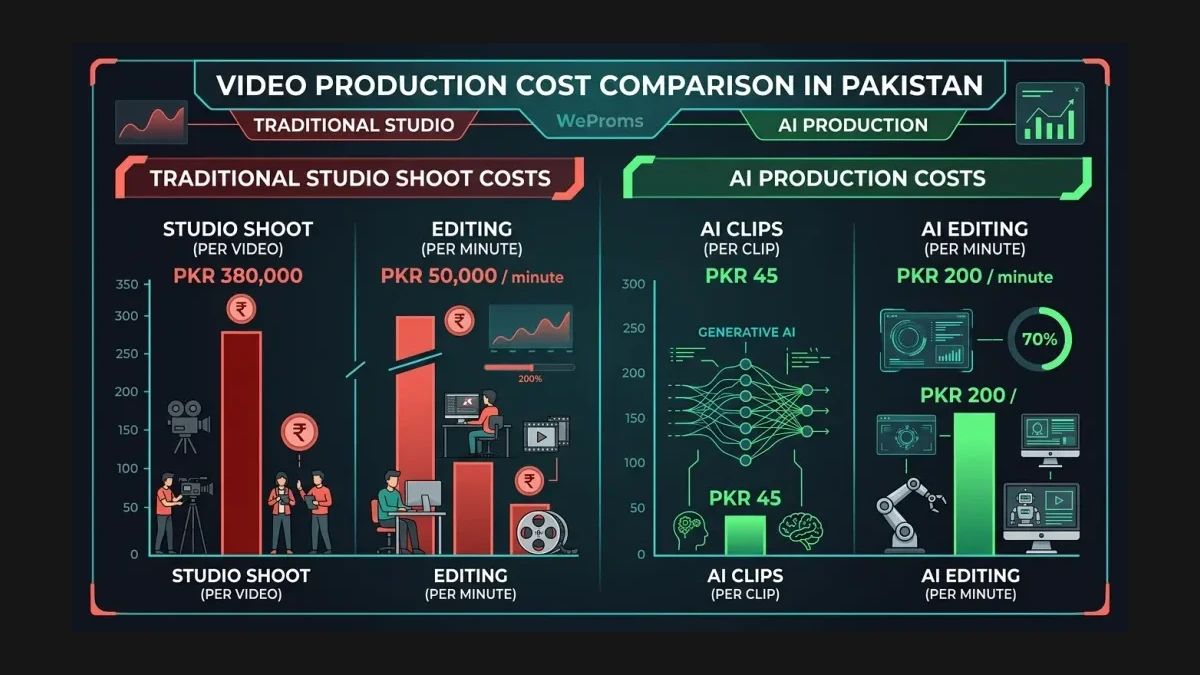
The infographic’s headline prices should not be treated as current quotes or evidence of equivalent quality. A studio campaign and a short generated clip have different deliverables. Ask suppliers to price the same brief, including usable exports, revisions and usage rights, before comparing them.
We see familiar barriers to testing alternatives: decision-makers expect AI output to look cheap, teams lack a repeatable workflow, and nobody owns the final quality check. Those are operational problems. Buying another tool will not resolve them on its own.
Start with products whose existing photography clearly shows shape, colour and packaging. Compare a generated treatment with a straightforward edit of the same images. Judge accuracy, production time and customer response. A clip that attracts attention but misrepresents the product has failed the brief.
Work on weak product pages where video could answer an identifiable question. Can buyers see the fastening, understand the scale or follow the setup? Pair the test with product page optimisation so unclear copy, missing specifications or checkout friction do not undermine useful creative.
What Does AI Video Production Actually Cost in PKR?
There is no reliable universal PKR price for a finished AI product video. Subscription allowances, exchange rates, generation settings and editing time all affect the result. Traditional production also varies by brief, location, talent and how many assets a shoot delivers.
| Cost Component | Traditional Production | AI-Assisted Production |
|---|---|---|
| Studio and location | Depends on shoot requirements | May still need source photography |
| Model or presenter | Talent and usage fees where applicable | Avatar or likeness rights may apply |
| Camera work | Filming and equipment | Existing footage or generated motion |
| Editing | Assembly, sound, captions and revisions | Assembly, corrections, captions and revisions |
| Software | Editing and production subscriptions | Generation credits and editing subscriptions |
| Finished video cost | Total project cost divided by approved assets | Total workflow cost divided by approved assets |
| Turnaround | Depends on scheduling and revisions | Depends on generation, review and corrections |
HeyGen’s pricing page lists Creator at $29 per month, or $24 per month billed annually, with 600 credits. Credit use varies with the model, duration and generation complexity. That allowance is not a promise of a fixed number of finished adverts.
Synthesia’s pricing page lists Starter at $19 per month after its introductory offer, or $14 per month billed annually. Its plans combine allowances and credits, so inspect the relevant generation limits before budgeting. Neither tool’s dollar subscription becomes a dependable PKR cost per video without your actual usage data.
Use your card provider’s billed exchange rate and applicable charges when recording costs in PKR. Include scriptwriting, photography, voiceover, music licensing, editing, rejected generations and review time. Divide the total by approved assets, rather than every file the tool produced.
A useful production budget measures the cost of an approved, publishable asset—not just the generation charge.
Shoppable video adds a purchasing route to video content, but availability depends on the platform and selling setup. Check how a Pakistani customer will reach checkout before commissioning the format. A clear product-page link may be more useful than an elaborate interaction your store cannot support.
Compare invoices and staff time from a recent production batch with an AI-assisted batch serving the same purpose. Keep the deliverables comparable: duration, product accuracy, sound, captions, revisions and usage rights. That gives you a defensible savings estimate instead of a headline built from incompatible prices.
How Do AI Product Videos Affect Conversion Rates for Pakistani Brands?
Product video can answer questions that photographs leave open. It can show how a lid opens, how a device connects or how clothing moves. Those are useful reasons to test video; they do not establish a universal conversion uplift for Pakistani ecommerce.
The previously cited conversion and email-performance figures are not reliable forecasts for your store. The DigitalApplied statistics review flags widely circulated video claims whose sourcing is weak or misleading. Use research to shape a hypothesis, then measure the outcome with your own customers.
Consider a Karachi electronics store selling wireless earbuds. Buyers may want to understand the charging case, controls and fit before ordering. Real demonstration footage can answer those questions. A generated animation that invents an indicator light or changes the connector creates uncertainty instead of reducing it.
Personalised video adapts content to customer information or behaviour. A relevant product recommendation may be useful, but adding a city name is not evidence that sales will improve. Test whether personalisation adds value beyond a clear, accurate demonstration, and include its additional production cost.
Cars.com offers a useful, limited example. In its company announcement, a 30-day campaign delivered a 47% increase in influenced vehicle sales, 45% increase in influenced dealership foot traffic, and 35% increase in dealership website visitors compared with the prior period. These are company-reported results for its advertising system, not a controlled estimate of what AI video alone delivers.
Pakistani dealerships could test inventory-specific videos using accurate listing data and real vehicle images. They should not assume the Cars.com results transfer to PakWheels or local campaigns. For any category, measure completed orders, cancellations and returns alongside initial conversion so misleading creative does not appear successful.
Which Platforms Drive the Most Video Commerce for Pakistani Brands?
Choose channels using your audience and sales data. Global engagement benchmarks can suggest formats to test, but they cannot rank platforms reliably for every Pakistani store. An existing audience, the product category and the quality of the creative all influence results.
| Platform | Useful Creative Test | Business Outcome to Check |
|---|---|---|
| Instagram Reels | Product demonstrations and styling ideas | Qualified visits and completed orders |
| YouTube Shorts | Clear answers to product questions | Relevant traffic and assisted purchases |
| TikTok | Creator-led demonstrations and native storytelling | Purchase intent and profitable orders |
| Daraz listings | Accurate product explanation where supported | Listing conversion and customer questions |
| Shopify or WooCommerce | Demonstrations beside product information | Add-to-cart, purchase and return behaviour |
The V9 Digital article cited below compares Reels with Stories in its headline reach finding, not with feed posts. It also discusses global brand data rather than a Pakistani ecommerce sample. Its longer-video findings are a test idea, not a reason to declare a universal platform winner.
For marketplace listings, check the video options available in your seller account. For your own store, check loading speed, mobile layout and whether the video helps answer a buying question. Do not assume that placing a clip on a collection page will improve every visitor’s journey.
The useful production multiplier is reusable source material. A clean product demonstration can become a concise social edit, a more detailed product-page explanation and a captioned version for sound-off viewing. Each output still needs an appropriate opening, framing and call to action.
Start where you already have relevant customers and reliable reporting. If that is Instagram, establish a repeatable Reels workflow before adding channels. A short-form video production workflow should adapt the creative to each placement while keeping product claims consistent.
What Is the Setup Checklist for AI Video Production?
The workflow between a product image and a published video needs clear inputs, ownership and approval. Write those requirements down before choosing a subscription. Otherwise, production volume can grow faster than your team’s ability to check what it publishes.
1. Choose your AI video platform. Test tools against a real brief. Presenter-led explainers, image animation and product demonstrations require different capabilities. Check commercial-use terms, export quality, credit consumption and voice options. Test Urdu pronunciation with your own product names rather than relying on a language-support label.
2. Standardise your product photography. Use clean, well-lit images that preserve the actual colour, proportions and packaging. Keep reference images available during review. If the source material hides important details, capture better photographs or real footage before asking a model to invent movement.
3. Build a template library. Cover recurring needs such as feature explanations, styling suggestions and size guidance. Separate illustrative scenes from claims about product performance. Never present an invented customer or generated testimonial as a real endorsement. Templates should simplify production without weakening evidence standards.
4. Set up your publishing pipeline. Confirm the export and scheduling options supported by each tool and destination. Do not assume a subscription includes direct publishing everywhere. Assign responsibility for captions, links, thumbnails and final approval, and leave room in the schedule for corrections.
5. Track performance in GA4. Google’s enhanced measurement guidance covers video engagement for embedded YouTube players with JavaScript API support enabled. Other players may require custom instrumentation. Use platform analytics for social viewing and tagged links for visits to your store; GA4 does not automatically observe every social-video interaction.
6. Run an A/B test before scaling. Where possible, compare versions of the same product page with traffic allocated fairly. Comparing unrelated products can confuse product demand with video impact. Keep pricing, promotions and traffic sources comparable, and allow enough purchases to assess the result meaningfully.
7. Scale based on data, not assumptions. Increase production for formats that improve useful outcomes at an acceptable cost. Track editing effort and rejected generations alongside engagement. A template that performs well but needs extensive repairs may be less economical than a simpler treatment using real footage.
How Does AI Video Affect Brand Trust for Pakistani Consumers?
Human review belongs in the workflow regardless of how quickly a tool generates footage. The reviewer needs the actual product, approved specifications and a clear brief. A visually polished clip can still show the wrong colour, change a label or imply a feature that does not exist.
Claims that disclosure eliminates any trust penalty are too broad. Customer reactions depend on the context and what the content represents. A stylised background is different from a simulated product test or an invented customer recommendation. Make those distinctions clear when planning the creative.
For fashion, inspect garment construction, fit and movement. For electronics, inspect ports, controls and accessories. For food or cosmetics, verify packaging and avoid generated results that imply unsupported benefits. If the video must prove how something works, real footage is often the stronger source material.
Keep colours, typography, captions and voice consistent with your brand, but do not confuse visual consistency with truthfulness. Review pronunciation and on-screen text as carefully as the moving image. The customer should receive a product that matches the expectations the video creates.
Our guide to AI video and brand trust in Pakistan explores that trade-off further. The practical rule here is simple: publish only what you can stand behind. If a generated scene cannot show the product accurately, change the treatment or use real footage.
If your ecommerce team still treats every product video as a bespoke shoot, there may be repeatable work worth automating. Start with editing, captions, versioning and carefully selected generation tasks. Preserve real demonstrations wherever the buying decision depends on seeing the actual product perform.
WeProms Digital helps Pakistani brands plan AI-assisted production, review creative and connect campaigns with reporting. Bring a sample brief, recent production costs and the product questions customers ask most often. Reach out via WhatsApp at +92 300 0133399 or email hello@weproms.com to discuss your setup.
Read next: Short-form video marketing strategy for Pakistani brands on TikTok and Reels | Ecommerce marketing strategies for Daraz and Shopify Pakistan
Frequently Asked Questions
How much does AI video production cost for Pakistani ecommerce brands?
Calculate the full workflow cost in PKR using your actual subscription bill, production time and approved output. Include photography, scripts, failed generations, editing and review. A low generation charge does not establish the cost of a finished advert, and local studio quotes need a comparable brief before you can estimate savings.
Does AI-generated video work for Pakistani fashion and apparel brands?
It can help with illustrative scenes, variants and edits based on approved photography. Check fabric movement, garment construction, colour and fit against the real item. Generated draping is not proof of how a garment behaves. Use real footage when the video needs to demonstrate fit, texture or movement accurately.
What platforms should Pakistani brands prioritise for video content?
Start with the platform where you already reach relevant buyers and can measure outcomes. Test Reels, Shorts or TikTok according to audience fit and creative capacity. Compare qualified traffic and completed orders alongside viewing metrics. Global engagement averages do not establish which platform will be most profitable for your store.
How does video affect conversion rates for Pakistani ecommerce?
Useful video can reduce uncertainty by showing size, assembly or product use. The effect depends on the category, page and audience; there is no dependable universal uplift. Test against an otherwise comparable experience and check cancellations and returns as well as purchases. A persuasive but inaccurate demonstration can create expensive downstream problems.
Can small Pakistani businesses afford AI video tools?
A limited trial may be affordable, but check the full workload before committing to an annual plan. Use existing photography and a narrow brief to establish whether the tool saves editing time. Technical setup, computing resources and licensing also matter when considering downloadable models. Recovering subscription costs depends on approved output and business results.
What is the best AI video tool for Pakistani ecommerce brands?
Choose by task rather than a general ranking. Test Synthesia or HeyGen against your requirements for presenters, voiceover and generated assets, and compare the results with a conventional edit. Inspect Urdu pronunciation, export restrictions and credit use. Contact WeProms Digital on WhatsApp for help defining a suitable production workflow.
How do I track AI video performance in Google Analytics?
Check whether your website player supports GA4’s built-in YouTube video engagement measurement; otherwise, implement and validate suitable custom events. Social-platform watch data belongs in those platforms’ reports. Use tagged campaign links and ecommerce events to connect visits with purchases. Marketing reporting automation can bring those sources together without implying every view caused a sale.
Key Takeaways
- Compare total cost per approved video, including editing and review, rather than generation fees alone.
- Check current subscription allowances and actual PKR billing costs before committing to a production target.
- Test conversion impact with comparable traffic and products; universal uplift claims are unreliable planning assumptions.
- Choose channels using your audience and sales data, supported by creative suited to each placement.
- Reusable templates can improve efficiency, but rejected generations and corrections still consume time and budget.
- Human review should verify product accuracy, rights, captions and claims before publication.
About WeProms Digital
WeProms Digital is a Lahore-based agency serving Pakistani SMEs, ecommerce brands and D2C businesses across Lahore, Karachi, Islamabad, Rawalpindi, Faisalabad and Multan.
The team works on AI-assisted video workflows, GA4 conversion tracking and ecommerce marketing automation. Engagements connect production planning with creative review and measurement so brands can assess costs and outcomes using their own operating data.
Get in touch: hello@weproms.com · WhatsApp +92 300 0133399
Sources & References
- DigitalApplied — Video Marketing Statistics 2026 — includes checks on commonly repeated statistics.
- Atlas Cloud — Cheapest AI Video Generation API 2026 — vendor reading on generation pricing, not a finished-production quote.
- PR Newswire — Cars.com AI Video Solution — company-reported campaign results.
- V9 Digital — Instagram Reels Outperform TikTok and Facebook — global brand comparisons, not Pakistani ecommerce benchmarks.
- WhiteHat SEO — AI in Marketing Research Report — additional industry reading.
- MarTech Series — V4b.AI AI-Powered Video Production Launch — vendor announcement.
- Wistia — Video Marketing Statistics — broader video research.
- Ryze AI — How to Optimise Video Ads with AI — vendor guidance.
Additional reading from industry feeds: