
TL;DR: Generative AI can shorten email production, but faster drafting is not a reason to increase sending frequency. For Pakistani businesses, the risk is allowing volume to outpace subscriber interest, quality control and deliverability monitoring. Use the time saved for editing, segmentation and testing. Watch complaints and conversions alongside campaign output, and investigate declining engagement before increasing volume again.
The attraction is obvious: an email that once waited for a copywriter can now reach the review stage much sooner. Platforms and standalone writing tools give small teams more production capacity. That can be useful when a campaign needs a clearer product explanation or a better welcome message.
The trouble starts when a team treats spare production capacity as permission to send more. A polished draft does not establish that subscribers want another promotion. This article focuses on that operational risk: how AI can accelerate a weak email strategy, and how Pakistani businesses can keep production speed from dictating their sending decisions.
Why does faster email production hurt Pakistani sender reputation?
Sender reputation reflects how mailbox providers assess a sender’s mail. Complaints, authentication problems and poor address quality deserve attention, particularly when sending patterns change. AI use alone does not explain a deliverability problem, and a campaign’s wording cannot tell you everything about why it reached a particular folder.
Faster production becomes a problem when it removes the pause in which someone would normally ask whether a campaign is useful. The team finishes another draft, schedules another send and measures success by output. Meanwhile, subscribers may be receiving messages that repeat an offer they already ignored.
Avoid treating a complaint-rate figure as a universal switch between inbox folders. The original article’s claims that a particular rate automatically sends mail to Promotions, or another guarantees spam placement, were too categorical. Use the Google email sender guidelines when reviewing Gmail requirements, and investigate actual delivery evidence before drawing conclusions.
The practical question is whether recipients recognise the sender and want the message. Similar AI drafts can make competing brands sound interchangeable to readers. That is a reason to improve relevance and voice; it is not evidence of a published penalty for using the same prompt as another business.
Think of the promotional messages that arrive around Eid. A relevant offer can be welcome, but repeated reminders from several brands can become tiring. Your team controls the promise made at signup, the usefulness of each message and the pressure placed on each subscriber. Start there before blaming the writing tool.
How does the AI email speed trap unfold for Pakistani businesses?
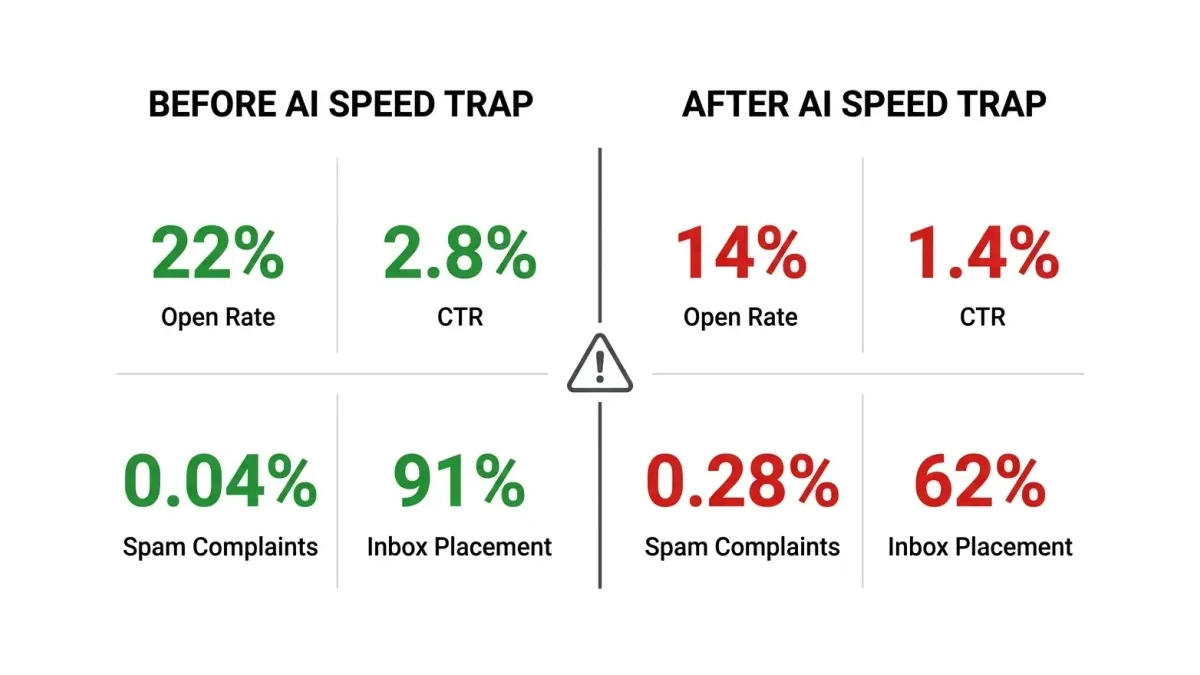
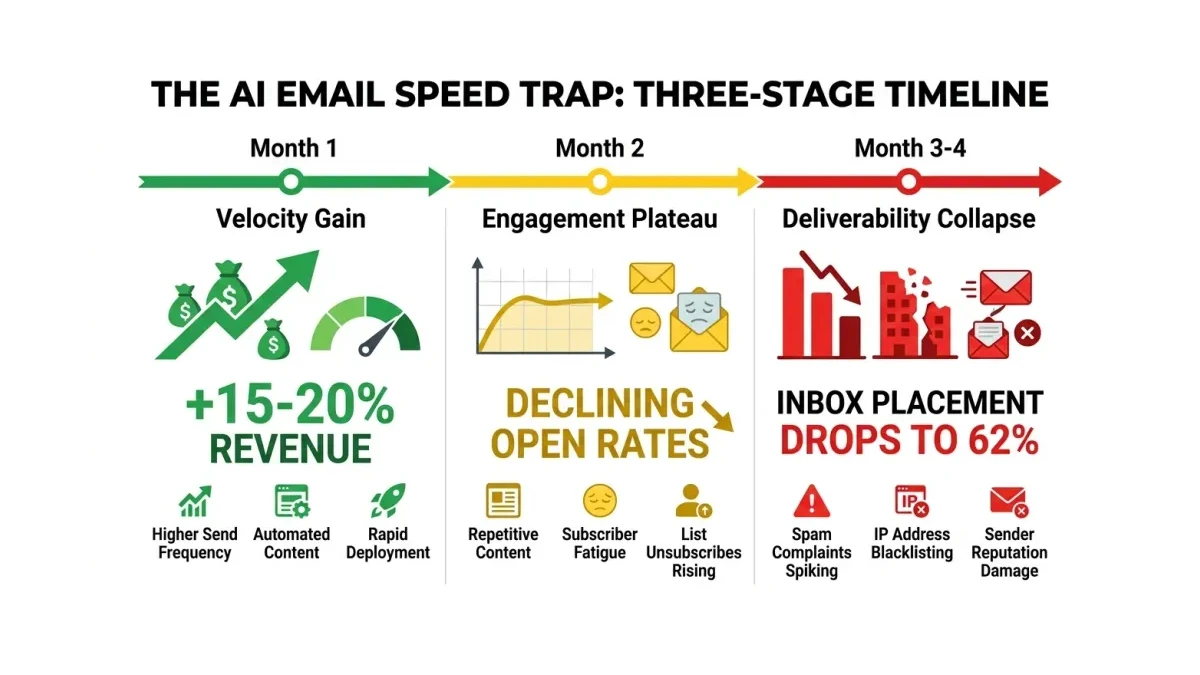
The following stages illustrate a possible failure pattern. They are not a measured Pakistani benchmark or a prediction of when any particular account will deteriorate.
Stage one: The velocity gain. An ecommerce team introduces AI drafting and clears its production backlog. More campaigns become possible, so the calendar fills up. Early sales look encouraging, and the team credits the workflow without checking whether results reflect the offer, seasonality or additional sending.
Stage two: The engagement plateau. Clicks and purchases stop improving, while unsubscribes or complaints attract attention. The team responds with more subject-line variants. That may improve the wording, but it leaves the underlying question unanswered: does this audience want another message about this offer?
Stage three: The delivery problem. Campaign results weaken further, and the team suspects inbox placement. At this point, it needs to separate delivery failures from poor targeting, unattractive offers and measurement changes. More AI-generated variants cannot resolve every cause, and increasing volume makes the diagnosis harder.
| Metric | Before AI | Early adoption | Warning pattern |
|---|---|---|---|
| Campaign frequency | Set by the existing plan | Increased as drafts become available | Remains high despite weaker response |
| Production time | Constrained by drafting and review | Drafting becomes quicker | Review receives less attention |
| Open rate | Recorded as a baseline | May appear encouraging | Needs interpretation alongside other measures |
| Click-through rate | Compared across similar campaigns | May improve with a strong offer | Weakens across comparable audiences |
| Spam complaints | Monitored routinely | Checked during sending changes | Rise and require investigation |
| Inbox placement | Assessed separately from engagement | Not assumed from campaign revenue | Investigated when delivery concerns emerge |
| Revenue per email | Used alongside total revenue | May benefit from extra sends | Falls despite sustained production |
Use this table as a discussion aid, not a forecast. Compare campaigns with similar audiences and purposes, and record what changed. Without that context, a revenue increase can conceal declining efficiency, while an ordinary seasonal slowdown can be mistaken for a deliverability collapse.
What makes Pakistani senders particularly vulnerable to AI email penalties?
For a Pakistani business, the useful starting point is an account audit, not an assumption that its location creates a special penalty. Look for operational weaknesses that higher sending volume could expose.
First, authentication gaps. Before expanding campaigns, confirm that the sending domain and email platform are configured against the relevant provider requirements. Do not assume that choosing an established platform completes every domain-level task. Ask whoever manages DNS and email operations to document the setup and resolve unexplained authentication failures.
Second, list quality issues. Review where addresses came from and what people agreed to receive. Checkout collection, discount forms and imported contacts need separate scrutiny; they do not establish identical expectations. Check whether subscribers can recognise the brand and understand why they are receiving its promotions. Avoid using an unsupported national estimate of inactive addresses as a substitute for inspecting your own list.
Third, content that could come from any competitor. A skincare brand in Karachi and another in Lahore may ask AI for similar sale emails. The editorial problem is clear: neither draft necessarily explains why its products or offer deserve attention. Add accurate product details, a recognisable voice and a reason to act that matches the audience’s needs.
These issues deserve attention wherever a business operates. Local language preferences, seasonal campaigns and customer expectations should inform the review, but they do not justify a fixed Pakistani risk multiplier or a guaranteed collapse timeline. Our guide to email marketing for Urdu audiences explores the audience side of that work.
Can Pakistani brands use AI for email marketing without destroying deliverability?
Yes, provided the team gives someone responsibility for both the message and the decision to send it. AI can help draft and revise copy; the review process should still establish whether that copy is accurate, relevant and worth sending.
Human editing gate. Review every draft for product accuracy, offer terms, tone and audience fit. Replace generic claims with details the business can substantiate. Check links, preview text and the final rendered email. There is no useful reason to prescribe an arbitrary percentage of words that must change: a rewritten sentence can still make the same unsupported promise.
Audience-led sending frequency. Keep the campaign calendar tied to subscriber expectations and observed response. A quicker drafting process should not automatically increase frequency. Review the total messages a person may receive from campaigns and automated flows, then decide whether the next send adds value. Give subscribers meaningful choices through email preference centre management.
Authentication and list oversight. Assign ownership of domain authentication, unsubscribe handling and contact suppression. Check the platform’s guidance and relevant mailbox-provider requirements before scaling. Define how the team handles failed addresses and disengaged contacts, with an approach suited to its buying cycle and available engagement evidence.
The principle is straightforward: use saved drafting time for better decisions. That may mean a more useful product explanation, a clearer segment or a properly reviewed experiment. None requires filling every available space in the campaign calendar.
WeProms Digital builds email marketing automation and lifecycle flows with attention to campaign relevance, operational oversight and delivery requirements. The aim is a workflow that the team can understand and monitor as it grows.
What should Pakistani businesses do right now?
If AI has changed your email workflow, review what changed alongside it. Separate faster drafting from changes in audience size, campaign frequency, offers and automation rules. That gives you a more useful starting point than assuming AI caused every movement in performance.
Check spam complaints and sending trends in your available reporting. Investigate increases, especially after changes to frequency or acquisition sources. Review the reporting definitions before comparing dashboards, and do not invent a universal internal alarm threshold from an unrelated benchmark.
Verify authentication and unsubscribe handling with whoever manages the domain and platform. Inspect authentication results from test messages and consult the provider documentation where results are unclear. A successful test should sit alongside a review of the actual campaign configuration and sending domains.
Audit your recent subject lines and offers for repetition. Ask whether each message gives its audience a distinct reason to open and act. Repeated wording is an editorial warning, but it does not establish a particular filtering penalty. Check the content and targeting together.
Assess the commercial impact using your own results. Compare attributable revenue, clicks, purchases and sending costs across comparable periods. Avoid attaching a national loss estimate to a hypothetical subscriber list: the outcome depends on actual reach, buying behaviour, attribution and campaign frequency.
If the evidence points to delivery problems, an email deliverability and inbox placement review can help organise the investigation. Contact WeProms Digital at hello@weproms.com or via WhatsApp at +92 300 0133399 to discuss the account and its sending history.
Read next: SCRIBE Framework: An AI Email Marketing Roadmap for Pakistani Teams
Frequently Asked Questions
Is using AI to write marketing emails bad for deliverability?
Using AI is not enough information to diagnose a delivery problem. Review what the workflow changed: frequency, audience selection, factual accuracy and quality control. If a team sends more repetitive promotions to people who are not responding, investigate those decisions. Keep human review focused on relevance and accuracy, rather than trying to make every draft appear less machine-written.
What spam complaint rate should Pakistani senders target?
Aim to minimise complaints and follow each mailbox provider’s current guidance. Do not treat a single rate as a universal guarantee of safe delivery or an automatic penalty. Investigate rising complaints even when other metrics look healthy, and check which recipients and messages the reporting covers. The Google guidelines linked above are a starting point for reviewing Gmail requirements.
How do I set up DMARC for my Pakistani business domain?
Use your email platform’s domain-authentication instructions and involve the person responsible for DNS. Document every legitimate service sending on behalf of the domain before changing enforcement settings. Have the configuration and reports reviewed, and base policy changes on the findings. Avoid moving to stricter enforcement simply because an arbitrary waiting period has passed.
How many emails per week is too many for a Pakistani ecommerce brand?
There is no account-specific answer without looking at audience expectations and results. Review campaigns and triggered messages together so that overlapping flows do not disappear from the discussion. Test frequency changes cautiously, compare similar subscriber groups and watch purchases, clicks, unsubscribes and complaints. A list-size rule or open-rate cutoff cannot replace that assessment.
What email authentication standards should Pakistani senders review?
Review SPF, DKIM and DMARC configuration, alongside the unsubscribe requirements relevant to your mail. Check Gmail and Yahoo documentation directly for their current scope and implementation details. Do not assume that every provider defines bulk sending identically, or that using a particular email platform automatically resolves domain configuration. Keep a named owner responsible for those checks.
Should I hire an email deliverability specialist or an email marketing agency?
Choose based on the problem and the skills available internally. Authentication failures or unexplained delivery problems call for technical diagnosis; weak offers and targeting need campaign expertise. Some accounts need both. Ask a prospective partner what evidence it will inspect, how it will separate causes and how progress will be measured before agreeing to a recovery plan.
Key Takeaways
- Faster AI drafting creates production capacity. Whether to send more remains a separate decision based on audience needs and campaign results.
- Investigate complaints and delivery concerns using provider guidance and account evidence. Avoid universal claims about rates that automatically determine inbox folders.
- Review authentication, list acquisition and message relevance before expanding sending. Pakistani businesses need an account-level diagnosis rather than unsupported national benchmarks.
- Give every draft a human review, and assess the combined pressure from campaigns and automated flows. Use saved time to improve segmentation and testing.
- Measure commercial impact with your own revenue and engagement data. Hypothetical losses and fixed collapse timelines can distract from the issues the account actually shows.
About WeProms Digital
WeProms Digital serves Pakistani SMEs, ecommerce brands and B2B teams across Lahore, Karachi, Islamabad, Rawalpindi, Faisalabad and Multan.
The team specialises in email marketing automation, lifecycle flows and email deliverability optimisation. Its work brings campaign planning and technical review into the same conversation, helping businesses examine how their messages are produced, targeted and delivered. For teams introducing AI, that means keeping clear ownership of quality and sending decisions.
Get in touch: hello@weproms.com · WhatsApp +92 300 0133399
Sources & References
- Litmus — The Dangers of Generative AI in Email Marketing
- Validity — The True Story of Email Authentication and How to Untangle the Acronyms
- Shopify Pakistan — AI Marketing Statistics
- Litmus — Inbox Decoded: How Mailbox Providers Really Think About Email
- Shopify Pakistan — Common Email Marketing Mistakes
- SEO Strategists — Email Marketing in Pakistan
- Google — Email Sender Guidelines for Bulk Senders
Additional reading from industry feeds: