
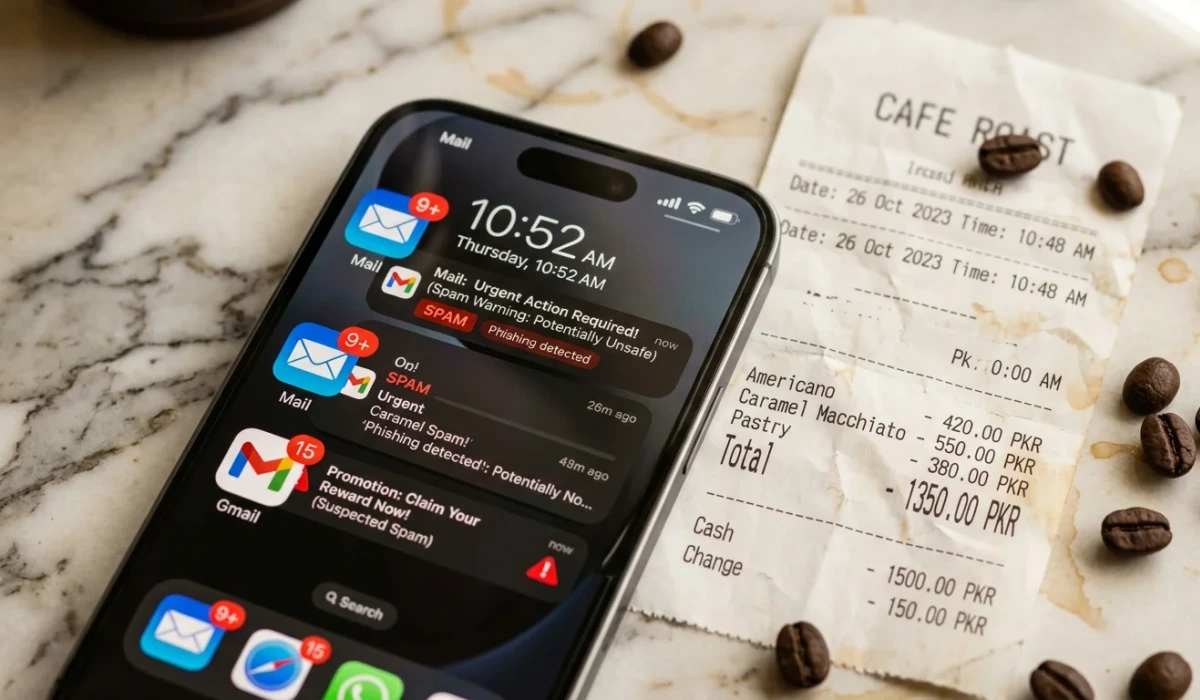
TL;DR: AI can help attackers write convincing phishing emails, but it does not automatically make legitimate AI-written campaigns spam. Pakistani senders should prioritise authentication, permission, complaint monitoring and reliable sending infrastructure. WeProms Digital provides email deliverability and inbox placement optimisation to help teams investigate delivery problems and strengthen their sending setup. Authentication helps establish domain identity; it does not guarantee inbox placement.
Picture a Karachi fashion ecommerce brand whose campaign engagement suddenly falls. Email revenue declines too, even though the team has kept its usual content and sending schedule. A shared-IP problem is possible, but so are authentication failures, an ageing list, changes in tracking or an offer that no longer resonates.
The useful response is investigation. Compare delivery errors, complaints, authentication results and recipient activity before blaming a neighbouring sender or an AI phishing campaign. A falling open rate alone cannot establish the cause.
Here’s the thing. The same tools that help marketers draft emails can help criminals write plausible messages. That makes trust more important, but the practical defence remains clear: send expected messages from an authenticated domain, monitor delivery evidence and act on problems early.
How does AI phishing destroy email deliverability for Pakistani senders?
Sender reputation describes how mailbox providers assess sending domains and IP addresses. Authentication, complaints and sending practices can affect whether messages are accepted, filtered or rejected. Each provider makes its own decisions; there is no universal reputation score shared across the industry.
Shared infrastructure can create exposure to other senders’ behaviour. However, an attack from a nearby IP address does not prove that Gmail penalised an entire IP range. Establish which IP actually sent your messages and ask your email service provider whether its pool experienced a reputation problem.
AI-assisted phishing adds pressure because attackers can produce polished, personalised messages quickly. Grammatical correctness is no longer a useful reason to trust an email. Equally, polished marketing copy is not evidence that a sender is malicious.
Widely circulated phishing statistics often combine different reporting periods and definitions. Estimates of AI-assisted messages should not be presented as measurements of all phishing worldwide, and historical growth figures should not become current annual growth rates. None establishes a baseline failure rate for Pakistani marketing emails.
For your business, the relevant evidence is closer to home: delivery logs, authentication results, complaints and changes by mailbox provider. Our guide to diagnosing email deliverability problems in Pakistan explains how to approach that investigation.
Fix this week: Review Google Postmaster Tools alongside your platform’s delivery logs. Look for changes that coincide with the decline. Treat reputation information as a diagnostic signal, not proof that every message was filtered or that phishing caused the problem.
Why do AI phishing emails bypass spam filters so easily?
Generative AI can produce convincing text from prompts, including messages tailored to a recipient’s job or company. This helps attackers avoid obvious writing mistakes. It does not eliminate every detection signal: authentication failures, malicious destinations and suspicious sending behaviour still matter.
Research findings also need context. A phishing simulation measures responses to particular messages and participants. It does not establish a universal click rate or show that AI consistently outperforms skilled human attackers. Avoid using dramatic comparisons as forecasts for your own audience.
In IBM X-Force’s October 2023 experiment, researchers generated a phishing email in five minutes, compared with about 16 hours for their team’s manual process. This measured message creation, not the time required for a novice to build an entire attack infrastructure. Human-written phishing performed slightly better in that test.
For marketers, the lesson is to maintain editorial control as production accelerates. There is no verified basis here for claiming that Gmail automatically flags legitimate emails because their sentence structure resembles AI-generated phishing.
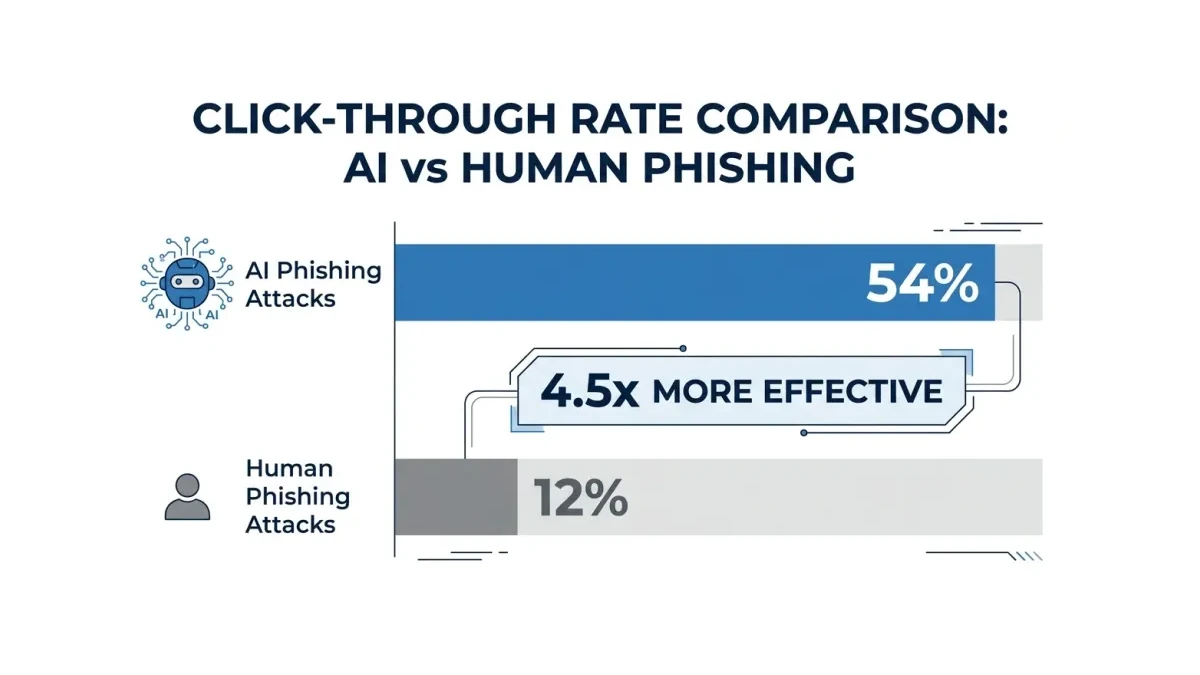
Treat the graphic as illustrative: phishing-test results depend on the messages, participants and comparison group, and do not establish a universal AI-versus-human advantage.
Litmus’s discussion of its State of Email Report 2026 reports that 76% of marketers produce and send emails within three days. Faster production makes review and campaign coordination more important; it does not prove that mailbox providers tightened filtering because of that speed.
Run this check: Send to test accounts and inspect placement and authentication results. Gmail’s Promotions tab is an inbox category, not the Spam folder. Promotions placement alone does not demonstrate an authentication fault. A personal test account is useful, but cannot represent every subscriber’s experience.
What makes Pakistani businesses vulnerable to email deliverability failure?
A Pakistani business can face the same operational weaknesses as senders elsewhere: poorly managed infrastructure, incomplete authentication and mailing practices that no longer meet provider requirements. Assess these weaknesses directly rather than assuming a national adoption rate.
First, shared IPs require a dependable email service provider. Shared IP pools allow several customers to send through common infrastructure. Ask how your provider monitors abuse, handles complaints and investigates delivery incidents. A well-managed shared pool can suit a smaller sender better than an inadequately maintained dedicated IP.
Second, authentication can be incomplete even when DNS records exist. Marketing platforms, order systems, support tools and staff mail may use different sending arrangements. Check each legitimate source rather than assuming that configuring the main newsletter platform covers everything.
Third, sender requirements need ongoing attention. Google’s sender guidelines require bulk senders reaching approximately 5,000 or more personal Gmail recipients daily to use SPF, DKIM and DMARC. Relevant marketing and subscription messages must support one-click unsubscribe and include a visible unsubscribe link.
Google recommends keeping user-reported spam below 0.1% and preventing it from reaching 0.3% or higher. These are a recommended operating target and a higher-risk ceiling, not interchangeable thresholds. Its sender FAQ describes increased enforcement from November 2025, rather than announcing a general content-ranking algorithm update.
| Authentication Protocol | What It Does | What to Check |
|---|---|---|
| SPF | Authorises servers for the envelope-sender domain | Every legitimate sending service is covered |
| DKIM | Signs messages so receivers can verify the signing domain and message integrity | Signing works on actual outgoing messages |
| DMARC | Evaluates authentication alignment with the visible From domain | Legitimate sources pass before enforcement increases |
Include automated receipts and account messages in this audit. Teams managing email marketing automation should document which system owns each sending domain.
Do this today: Check your DMARC record and inspect a real message’s authentication results. A missing record means DMARC is absent; a published record alone does not prove the setup works.
How much does poor email deliverability cost Pakistani ecommerce businesses?
Poor inbox placement can reduce the audience that sees an offer and therefore reduce sales opportunities. The size of that loss depends on the affected subscribers, campaign, product margin and buying cycle. There is no defensible standard monthly loss for Pakistani stores.
Start with comparable campaigns. Review audience size, accepted messages, clicks, orders and revenue using consistent attribution settings. Separate results by mailbox provider where possible. A decline concentrated among Gmail recipients calls for a different investigation from a decline across every audience segment.
Keep acceptance and inbox placement separate. Your email platform may report a message as delivered when the receiving server accepts it, even if it subsequently goes to spam. Equally, lower opens do not by themselves establish a placement problem. Our guide to email open-rate inflation explains why opens need supporting evidence.
Do not respond to falling engagement by immediately increasing frequency. Review consent, suppress invalid addresses and investigate complaints first. More campaigns can compound the problem when subscribers already find the messages unwanted.
Klaviyo and Datalily research reported by eMarketer found that visible AI-generated marketing content made 31% of surveyed consumers trust a brand less and 7% trust it more. This was broader marketing research, not a Pakistan-specific email finding. It supports thoughtful review, not a prediction about your subscribers.
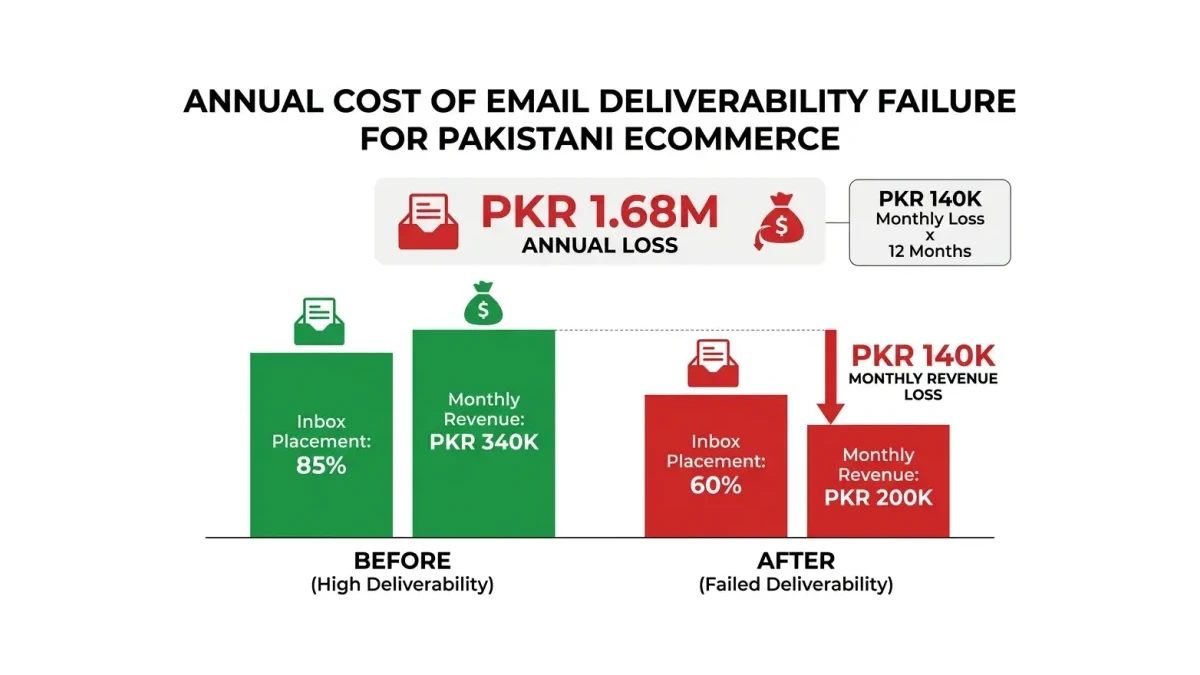
The graphic’s scenario is illustrative, not a verified business result or a forecast. Use your own campaign and order records to assess commercial impact.
Calculate your loss: Compare revenue from similar audiences before and during the delivery problem, accounting for promotions and seasonality. Do not multiply revenue by Postmaster Tools’ spam rate: that measures user complaints, not the proportion of messages placed in spam.
What is the SPF-DKIM-DMARC fix for Pakistani sender reputation?
SPF (Sender Policy Framework) authorises sending servers for the envelope-sender domain used during delivery. Follow your provider’s DNS instructions and account for every legitimate sending service. Check the existing record before changing it so that fixing marketing mail does not disrupt another system.
DKIM (DomainKeys Identified Mail) adds a cryptographic signature that lets receiving servers verify the signing domain and message integrity. Your provider supplies the relevant DNS configuration. Publishing it is only part of the job: send a message and confirm that DKIM passes.
DMARC (Domain-based Message Authentication, Reporting, and Conformance) connects authentication to the domain recipients see in the From address. Under Google’s DMARC guidance, a message passes when SPF or DKIM passes with the required domain alignment. Failure of either mechanism alone does not necessarily mean DMARC fails.
Policies range from monitoring with p=none to requesting quarantine with p=quarantine or rejection with p=reject. Start by identifying legitimate senders and reviewing reports. Increase enforcement when you have resolved legitimate failures, rather than following an arbitrary calendar deadline.
Authentication is a foundation, not an inbox guarantee. It cannot compensate for unwanted campaigns or establish that the content of an authenticated message is safe. Continue reviewing complaints, audience quality and delivery errors after the records are configured.
Setup timeline: Inventory sending systems, configure authentication, test real messages, review reports and then increase enforcement. Allow enough observation to include occasional business mail. The work depends on your systems and DNS access; there is no reliable universal completion time.
When should Pakistani businesses switch to a dedicated sending IP?
A dedicated IP is used by a single sender, giving that sender control over the IP’s reputation. It removes dependence on other customers using that exact IP. It does not remove domain reputation problems, complaints, compromised accounts or poor list practices.
The trade-off is responsibility. You need consistent sending, a suitable warm-up plan and the ability to monitor delivery. A dedicated IP with little activity is not automatically an improvement over an established, well-managed shared pool.
Provider criteria vary. Brevo’s guidance on shared and dedicated IPs recommends a dedicated IP for senders exceeding 100,000 emails monthly, or meeting its alternative campaign-frequency and audience criteria. This is provider-specific advice, not a universal migration threshold.
Ask your provider about eligibility, current charges, warm-up support and whether your sending pattern is suitable. Avoid generic PKR price comparisons without checking the plan, billing currency and included services. A migration should address an evidenced infrastructure problem, not serve as a shortcut around complaints.
| Sending Pattern | Setup to Consider | Cost Check | Main Responsibility |
|---|---|---|---|
| Small or occasional campaigns | Managed shared IP | Confirm plan inclusions | Authentication and audience quality |
| Regular campaigns with stable results | Retain current infrastructure | Review support options | Monitor complaints and delivery |
| Sustained volume with documented shared-pool issues | Evaluate dedicated IP | Request a provider quote | Warm-up and consistent sending |
| Complex sending across message types | Provider-led infrastructure review | Request a scoped proposal | Traffic separation and monitoring |
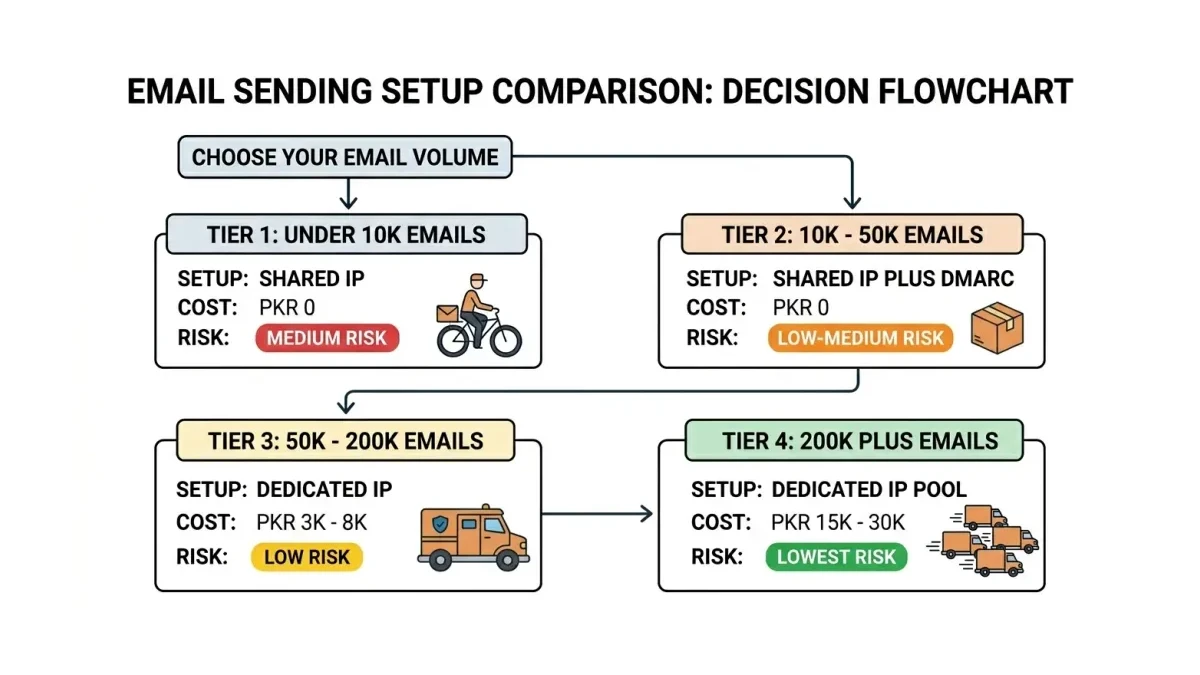
Use the table and your provider’s current guidance for decisions; the graphic’s volume and price comparisons are not verified current recommendations.
Decision point: Investigate high complaints before changing IPs. A new address does not make unwanted mail welcome. Migrate only when the evidence, sending pattern and provider support justify it.
Deliverability Survival Checklist for Pakistani Senders
- Verify SPF covers legitimate sending services
- Enable DKIM and test signatures on outgoing messages
- Publish DMARC and check alignment
- Review reports across all legitimate sending systems
- Resolve legitimate failures before increasing DMARC enforcement
- Register the domain with Google Postmaster Tools
- Aim for Gmail complaints below 0.1%; avoid reaching 0.3%
- Verify one-click unsubscribe and visible unsubscribe links where required
- Review AI drafts for accuracy, relevance and trustworthy links
- Check placement across test accounts and review delivery logs
- Evaluate dedicated IPs against provider criteria and sending consistency
- Record ownership of DNS, complaint monitoring and incident response
Read next: How Pakistani SMEs build AI marketing automation stacks | The SCRIBE Framework for email teams using AI
If your business is losing email engagement or revenue, request a scoped deliverability audit. Bring recent campaign reports, delivery errors and a list of sending systems so the investigation can start with evidence. WeProms Digital can help review authentication and sending practices. Contact WhatsApp at +92 300 0133399 or hello@weproms.com to discuss your setup.
Frequently Asked Questions
How do I check if my Pakistani business emails are going to spam?
Use test accounts across relevant mailbox providers, inspect authentication results and compare placement with delivery logs. Promotions is an inbox category, so record it separately from Spam. Google Postmaster Tools can add complaint and compliance information where data is available. No single test account proves placement across your entire list.
What is DMARC and does my Pakistani business domain need it?
DMARC lets a domain publish handling preferences for messages that fail authentication alignment and receive reports about sending activity. It is required for Gmail bulk senders and useful for other business domains too. Implement it alongside SPF and DKIM. Start with visibility into legitimate sources, then increase enforcement once those sources authenticate correctly.
How much does email deliverability cost to fix for Pakistani SMEs?
Costs depend on the number of sending systems, DNS access, reporting needs and the cause of the problem. Authentication uses DNS records, but technical work and monitoring services may carry charges. Ask for an itemised quote covering diagnosis, configuration, testing and follow-up. Confirm dedicated-IP eligibility and pricing directly with the provider.
Why did my Gmail open rate suddenly drop in 2026?
Possible causes include audience changes, tracking changes, authentication failures, complaints or delivery restrictions. Google describes increased sender-requirement enforcement from November 2025, but that does not establish the cause of your decline. Compare clicks, orders and delivery errors, then check whether the change is specific to Gmail or appears across other providers.
Can AI-written marketing emails trigger spam filters?
Any marketing email can be filtered. AI authorship alone does not establish why a message was flagged, and the cited guidance does not identify generic AI sentence patterns as a standalone trigger. Review the message’s claims, links and relevance alongside authentication, consent and complaints. Human editing improves quality but cannot guarantee inbox placement.
Should Pakistani businesses stop using AI for email marketing?
No. Use AI to assist drafting, then assign a person to approve accuracy, tone, offers and links. Keep campaign frequency tied to subscriber expectations rather than how quickly the team can generate copy. Litmus’s production-speed findings describe workflow changes; they do not promise better engagement or delivery for every business using AI.
Which email service providers work best for Pakistani senders?
Compare Klaviyo, Brevo, Mailchimp and other providers against your integrations, sending pattern, support needs and reporting requirements. There is no verified Pakistan-specific ranking in the evidence reviewed here. Ask about authentication support and abuse handling. Our Klaviyo email marketing team can help assess whether that platform fits your ecommerce operation.
Key Takeaways
- AI can accelerate convincing phishing messages, but global statistics do not diagnose your business’s delivery problems.
- Investigate authentication, complaints, delivery errors and audience changes before blaming shared infrastructure.
- Configure SPF, DKIM and DMARC, then verify alignment using real messages and reports.
- Assess commercial impact through comparable campaign and order data; complaint rates are not spam-placement rates.
- Choose dedicated infrastructure only when your sending pattern and evidence support it. Keep human review in the email workflow.
About WeProms Digital
WeProms Digital is a Lahore-based digital marketing agency serving Pakistani SMEs, ecommerce brands and B2B teams across Lahore, Karachi, Islamabad, Rawalpindi, Faisalabad and Multan.
The team specialises in authentication setup, sender reputation investigations and email marketing automation. An audit should establish the cause of delivery problems, prioritise corrective work and agree how progress will be measured. Recovery depends on the underlying issue and mailbox-provider responses.
Get in touch: hello@weproms.com | WhatsApp +92 300 0133399
Sources & References
- Google — Email sender guidelines
- Google — Email sender guidelines FAQ
- Google — Set up DMARC
- IBM X-Force — AI vs. human deceit
- Litmus — The Dangers of Generative AI in Email Marketing
- Klaviyo/Datalily via eMarketer — Consumer Trust in AI-Generated Marketing
- Brevo — Differences between a shared IP and a dedicated IP
Additional reading from industry feeds: