

TL;DR: Buying AI software does not guarantee better marketing. The human-AI research cited below raises questions about how teams combine judgement and automation; it does not establish a failure rate for Pakistani campaigns. Before adding subscriptions, check whether your team can evaluate outputs, remove unnecessary work and connect tool use to business results. WeProms Digital helps businesses build workflows with clear responsibilities for strategy, production and review.
Most Pakistani business owners buy AI marketing tools with a reasonable expectation: their team should produce better work, faster. ChatGPT, Jasper, Canva and other platforms promise assistance with work that already consumes staff time. The subscription may look affordable compared with hiring, and a convincing demonstration makes the purchase easy to approve.
The harder question comes after access is granted. Are campaigns improving, or is the team simply producing more drafts, reports and variations? A busy dashboard cannot answer that. If nobody checks the relationship between tool use and outcomes, a subscription can become a recurring expense without a clear purpose.
The Nature Human Behaviour paper by Vaccaro, Almaatouq and Malone offers a useful starting point for this discussion. It examines human-AI collaboration across experimental studies. Its findings should prompt closer examination of workflows, rather than a blanket verdict on Pakistani marketers. A business still needs evidence from its own tasks, customers and campaigns before deciding whether a tool helps.
What does the research actually say about human-AI collaboration?
The distinction that matters is the comparison being made. A combined human-AI result can fall short of the stronger solo performer without being worse than both participants. Those statements are not interchangeable. Likewise, an average across different experiments does not describe the outcome of every individual task or every business using similar technology.
The cited Nature Human Behaviour meta-analysis is relevant to the design of human-AI workflows. It should not be treated as a direct audit of advertising accounts in Lahore or ecommerce teams in Karachi. Moving from experimental findings to a claim about local revenue requires evidence that the original article did not establish.
The MIT NANDA report discussed in the references also needs careful handling. Findings about enterprise AI projects do not supply a probability that a Pakistani SME’s marketing subscription will fail. Pilot completion, deployment, profitability and revenue acceleration are different outcomes. A reported result for one cannot automatically stand in for the others.
Healthy usage figures answer whether people use a tool. They do not answer whether the work is better, whether customers respond, or whether the business earns more from it.
For an owner, the practical response is to define the comparison before evaluating performance. Compare the existing workflow with the proposed AI-assisted workflow on equivalent work. Record output quality, staff time, corrections and business outcomes. If the new process only improves speed while increasing errors or review effort, that trade-off should be visible.
Research can inform the questions you ask. It cannot replace that evaluation, establish that human oversight always harms automation, or prove that hiring an agency will resolve a weak implementation.
Why do Pakistani marketing teams get worse when they add AI tools?
A plausible failure point is the gap between producing an answer and knowing whether it is usable. Imagine a content writer in Faisalabad asking a tool to explain a client’s product. The draft sounds polished, but the writer lacks the approved specifications needed to check it. Publishing the draft transfers an unresolved information problem onto the customer’s screen.
That is a workflow problem, not proof that junior staff cannot use AI. Experienced employees can also accept convincing errors. The useful safeguard is access to source material, clear instructions about unsupported claims and a reviewer who understands the product. Seniority alone does not provide those protections.
Another failure point is duplicated work. Someone writes a draft, asks AI to rewrite it, restores the original meaning, then sends it through another editing tool. Each step may feel productive while the overall process becomes slower. The question is whether the tool replaces work or creates another version that someone must reconcile.
Inconsistent instructions create a related problem. Colleagues may use different product descriptions, audience assumptions and tone preferences. Their individual outputs look acceptable, but the campaign as a whole loses coherence. A shared brief and approved examples make disagreements easier to identify before publication.
Ordering food during monsoon season offers a useful analogy: the app can accept the order while the delivery still breaks down. A functioning tool is only part of a functioning service. In marketing, the missing connection may be the handover between a draft, its approval and the person responsible for publishing it.
These are risks to investigate in your team, rather than established traits of Pakistani SMEs. Review actual work before diagnosing the cause. Poor briefs, missing customer information and unclear ownership can undermine a campaign whether AI is involved or not.
How much are Pakistani SMEs spending on AI marketing tools?
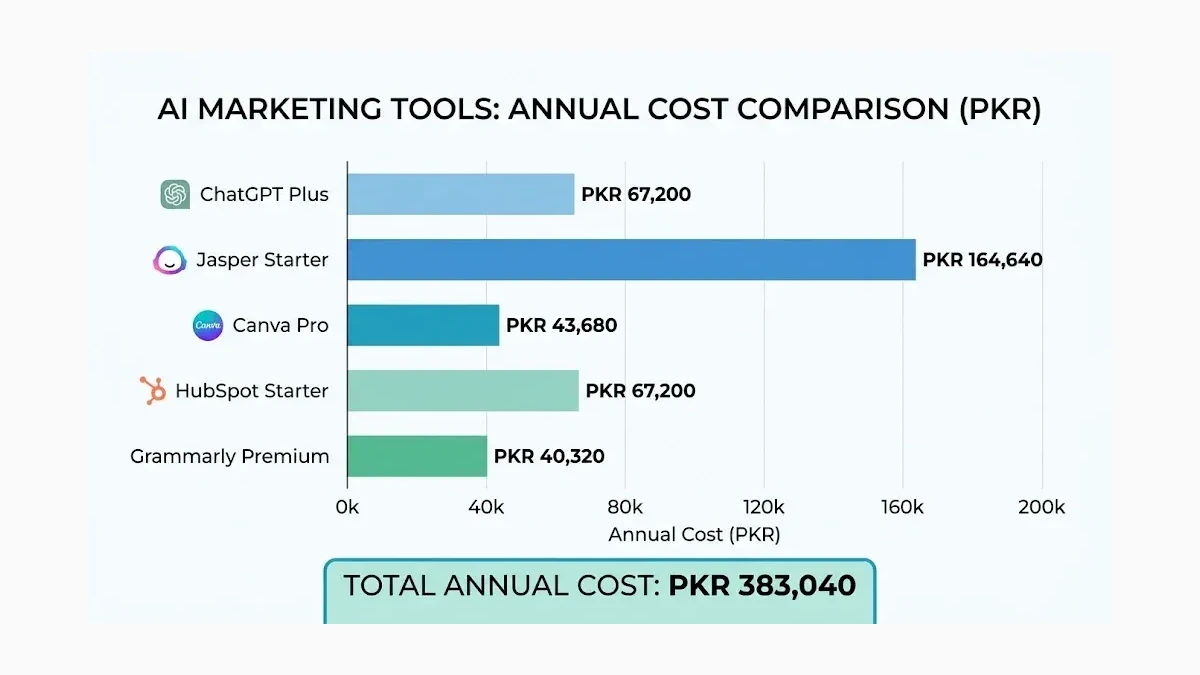
There is no dependable universal price for a Pakistani SME’s AI marketing stack. The bill depends on the products selected, billing cycle, seats, usage allowances and additional features. A list of headline subscriptions also misses the time employees spend configuring tools and correcting their outputs.
Treat the tools below as purchasing categories to examine, rather than a recommended bundle. Product names, packaging and local charges should be checked at purchase. The cost infographics illustrate the original comparison, but their displayed amounts should not be used as current quotations.
| Tool or category | What to verify before buying | What to include in the cost review |
|---|---|---|
| ChatGPT subscription | Suitable plan, access arrangements and usage limits | Actual billed cost and review time |
| Jasper subscription | Current package and overlap with existing writing tools | Seats, billing commitment and editing effort |
| Canva subscription | Required design features and team access | Licence costs and asset approval time |
| HubSpot subscription | Required product, included features and additional charges | Setup, administration and ongoing usage |
| Grammarly subscription | Current package and overlap with existing editing tools | Seats and whether editing time falls |
| Whole stack | Whether each tool has a distinct job | Subscription costs plus staff effort |
For a local budget, use the amount that reaches your account rather than assuming an old exchange rate will hold. Record currency conversion charges and applicable taxes alongside the subscription. If colleagues share a budget across departments, establish who owns renewals and who can approve additional seats.
An agency retainer is a different purchase. It may include planning, delivery and reporting, but the scope must be explicit. Comparing a software bill with a service fee tells you little unless you also compare responsibilities, outputs and the work your staff still need to do.
Our guide to email marketing tool costs in Pakistan explores the same budgeting problem in a specific channel. For a broader review, list each tool beside its owner, purpose and evidence of value. Overlapping subscriptions deserve attention before the next purchase request.
Banking-sector adoption figures would not establish SME marketing expenditure, even if current. The relevant evidence for your business is its own invoices, staff workload and results. The guide to choosing a digital marketing agency in Pakistan can help when comparing external support with improving the internal process.
Which marketing tasks suffer most from human-AI collaboration?
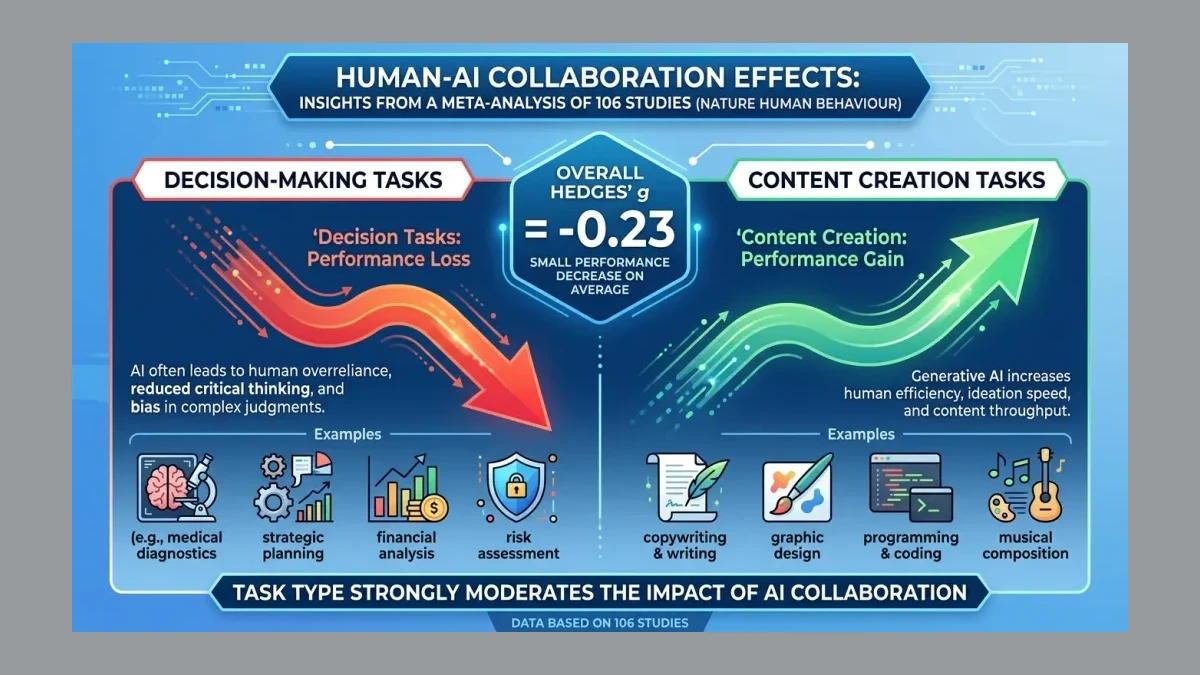
Start with decisions where a plausible mistake has a meaningful cost: allocating advertising spend, choosing an audience, assessing lead quality or interpreting campaign performance. These tasks require more than a fluent explanation. They require reliable inputs, a defined objective and a way to check whether the recommendation worked.
Suppose a tool recommends moving budget after observing a change in reported conversions. Before acting, establish whether tracking changed, leads were duplicated or the sales team altered how it records outcomes. The recommendation may be reasonable given its inputs while those inputs fail to describe the business accurately.
Human intervention can also be poorly informed. Reversing an automated recommendation because it feels unfamiliar is not a reliable safeguard. A reviewer should explain the evidence behind an override and record what happened afterwards. Otherwise, the team cannot distinguish useful judgement from interference.
Content production offers a different testing environment. A team can inspect draft copy, compare variations and reject unsuitable material before publication. That makes review more direct, but it does not make the output automatically useful. Relevance, factual accuracy and suitability for the audience still need checking.
The distinction between decision support and production support is a way to organise evaluation, not a ranking of every tool. A writing assistant can generate a costly false product claim; a well-configured automated process can complete a bounded task reliably. Inspect the actual work and the consequences of an error.
The guide to AI marketing tools for Pakistani SMEs provides a starting point for reviewing tool categories. For each proposed use, ask what information the system receives, what it is allowed to change and how the result will be assessed. Those questions are more useful than assuming every automated decision is harmful.
When does combining humans and AI actually work?
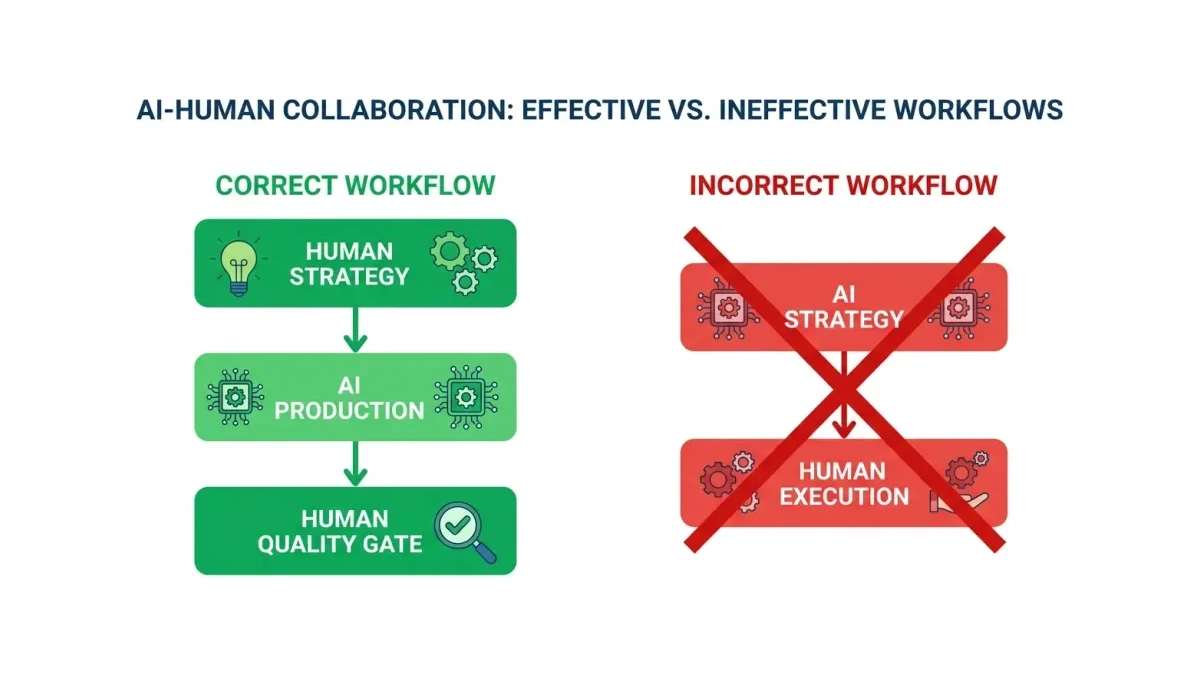
A useful collaboration starts with a well-defined task and a credible standard for judging the result. The team should know what the tool contributes and what remains someone’s responsibility. “Help with marketing” is too broad to evaluate; drafting copy from an approved offer gives reviewers something concrete to assess.
Consider a Lahore retailer planning an Eid campaign. The brief can include confirmed stock, delivery commitments, approved payment options and customer objections gathered by the sales team. AI assistance may be useful for developing variations from that material. The reviewer then checks whether each variation preserves the offer and fits the channel.
Local knowledge should be documented rather than assumed. An experienced marketer may recognise a delivery concern that a generic brief misses, but the insight becomes more useful when it is written down and supported by customer evidence. Otherwise, colleagues cannot apply it consistently or challenge it when circumstances change.
Experience also does not make every human decision correct. A strong workflow allows a reviewer to reject the tool’s output while requiring a reason for consequential changes. It should also allow the team to keep a useful automated result when there is no evidence that manual intervention improves it.
A digital marketing strategy can connect these task decisions to commercial priorities. The aim is a repeatable process in which people understand the objective, the information is adequate and results are checked. Neither the cited research nor a vendor demonstration establishes that this arrangement will work for every campaign.
What should Pakistani businesses do instead of buying more tools?
Begin with a workflow that already matters to the business. Choose work the team understands well enough to evaluate, and document how it currently happens. Identify delays, repeated edits and missing information before deciding which part a tool should assist. Automating an unclear process can make the confusion harder to trace.
Next, define the input and the acceptance criteria. A content task needs an approved brief and supporting material. A reporting task needs agreed definitions and a reliable data source. A campaign recommendation needs a stated objective and constraints. Without those foundations, the team is judging answers against expectations that nobody has written down.
Assign ownership of the result. A quality gate is simply a checkpoint where work is reviewed against a standard before proceeding. Specify who checks factual claims, who approves commercial promises and who can authorise consequential account changes. The checks should match the task rather than adding the same approval burden to everything.
Test the proposed process against comparable work. Include the time spent prompting, correcting, reviewing and transferring material between systems. Faster drafting is useful, but it is not a saving if the approval process absorbs the time gained. Equally, a worthwhile improvement in quality may justify extra review effort.
Connect the assessment to outcomes the business values. For a lead campaign, that might mean checking sales feedback alongside the marketing report. For content, assess whether the piece answers customer questions and supports its intended purpose. Our guide to measuring content marketing ROI in Pakistan develops that connection between activity and value.
At WeProms Digital, the practical starting point is the relationship between strategy, execution and measurement. Tools belong inside that relationship. Before renewing a subscription, ask whether its owner can explain what it contributes, what can go wrong and how the team knows the result is acceptable.
Read next: Choosing a Digital Marketing Agency in Pakistan: How to Evaluate and Hire and AI Marketing Tools for Pakistani SMEs: The Complete Automation Stack
If your business cannot connect its AI subscriptions to useful outcomes, WeProms Digital can help review the stack and the workflows around it. Contact us at hello@weproms.com or via WhatsApp at +92 300 0133399 to discuss the work your team needs to improve.
Frequently Asked Questions
Are AI marketing tools bad for Pakistani businesses?
No blanket judgement is useful. Evaluate a tool against the task, the quality of its inputs and the team’s ability to check its output. The cited research is a reason to question automatic performance gains, not evidence that every Pakistani business will lose money using AI. Keep a useful process when it demonstrably improves work, and change or stop one that creates more effort or errors than it resolves.
How much should a Pakistani SME spend on AI marketing tools?
Set the budget around a defined need and an affordable test, rather than a universal spending cap. Include subscriptions, implementation, training and review time. Establish what evidence would justify renewal before making a commitment. A small stack can still be wasteful if nobody uses it effectively, while a more expensive tool may be justified by a valuable, measurable improvement. The decision should come from your operating costs and results.
What is the Hedges’ g effect size discussed in the research?
Hedges’ g expresses a difference between groups on a standardised scale. Its interpretation depends on the comparison and the uncertainty around the estimate. It is not a percentage change in revenue, campaign effectiveness or productivity. In particular, an average result comparing collaboration with the stronger solo performer cannot be translated directly into a forecast for your advertising account. Consult the original paper for its estimates, methods and limitations.
Should Pakistani businesses hire a digital marketing agency instead of using AI tools?
Compare the capability you need with what your team can provide. An agency may help with strategy, implementation or measurement, but external support does not guarantee success. Ask who will perform the work, how outputs are reviewed and how results will be reported. Compare the proposed scope with the cost of improving internal delivery. WeProms Digital offers digital marketing support for businesses assessing that choice.
Which AI marketing tools actually help Pakistani marketing teams?
Start with a task rather than a brand recommendation. Drafting from approved material, exploring design variations or checking copy are possible uses to test. Judge the result against an agreed standard and include review effort. Decision support needs equally clear boundaries and reliable inputs. A positive finding about a broad task category would not prove that a particular subscription, feature or configuration will improve your team’s work.
How do JazzCash and Easypaisa payment behaviours affect AI marketing tool accuracy?
Payment information matters when a recommendation depends on how customers complete an order. Give the team and its tools accurate information about the methods your store accepts, checkout problems and reasons customers abandon purchases. Do not assume that a system knows current wallet conditions or that every Pakistani customer behaves alike. Use your checkout records and customer feedback to test recommendations, and verify payment-provider details before including them in customer-facing content.
Is AI-written content ranking well in Google search for Pakistani websites?
The original article’s ranking claim does not provide a reliable basis for predicting a Pakistani website’s results. Assess content on its accuracy, usefulness and fit with the searcher’s needs, then monitor its performance. A polished draft still needs verified claims, relevant local detail and a clear purpose. Avoid promising rankings from either AI production or human editing alone. Your own search and conversion evidence is more useful than a blanket label attached to the writing method.
Key Takeaways
- Human-AI research deserves careful interpretation. Comparing a combined result with the stronger solo performer is different from claiming the combination is worse than both participants.
- Enterprise AI findings do not establish a failure probability or expected financial return for a Pakistani SME’s marketing tools.
- Build a stack budget from current quotations, actual billed charges and staff effort. Historical price comparisons should not determine purchasing decisions.
- Evaluate decision support and content production separately, with checks suited to the consequences of an error. Neither category guarantees success or failure.
- Give each tool a defined task, suitable inputs, an accountable owner and acceptance criteria. Measure whether the complete workflow improves.
- Compare agency support with internal capability on scope, expertise and evidence of delivery. Buying services is not itself proof of better outcomes.
About WeProms Digital
WeProms Digital is a digital marketing agency headquartered in Lahore, serving Pakistani SMEs, ecommerce brands and B2B teams across Lahore, Karachi, Islamabad, Rawalpindi, Faisalabad and Multan.
The team specialises in AI-integrated marketing strategy and structured workflow implementation. Its focus is on connecting marketing decisions, production and measurement so that businesses can assess what their tools and teams contribute. Research can inform this work, but it does not certify an agency’s operating model or guarantee client results.
Get in touch: hello@weproms.com · WhatsApp +92 300 0133399
Sources & References
The research and industry reading below provide context. They should not be treated as current software quotations or evidence of guaranteed outcomes for Pakistani SMEs.
- Vaccaro, Almaatouq, Malone — “When Combinations of Humans and AI Are Useful” — Nature Human Behaviour
- MIT NANDA — “The GenAI Divide: State of AI in Business 2025” — Fortune coverage
- KPMG Pakistan — Pakistan Banking Perspective 2026
- Martech Zone — “Human-AI Teams Perform Worse Than Either Alone”
- MarketingProfs — “How Well Does AI-Written Content Rank in Search?”
- Brainlabs — “The Organic Media Mix: The Strategy Document Every CMO Should Be Building Right Now”
- Search Engine Journal — “How To Build Local Pages That Win In AI-Powered Search”
- PASHA — Federal Budget 2026-27 Policy Recommendations
Additional reading from industry feeds: