

TL;DR: Support conversations contain churn warnings, product feedback and purchase intent that ticket closure reports can miss. The ATLAS framework — Analyze, Tag, Link, Act, Scale — gives Pakistani marketing and operations teams a repeatable method for turning those conversations into useful business intelligence. Start with accessible support data, check AI classifications against human judgement, connect findings to purchase history, and measure whether the resulting actions improve customer outcomes.
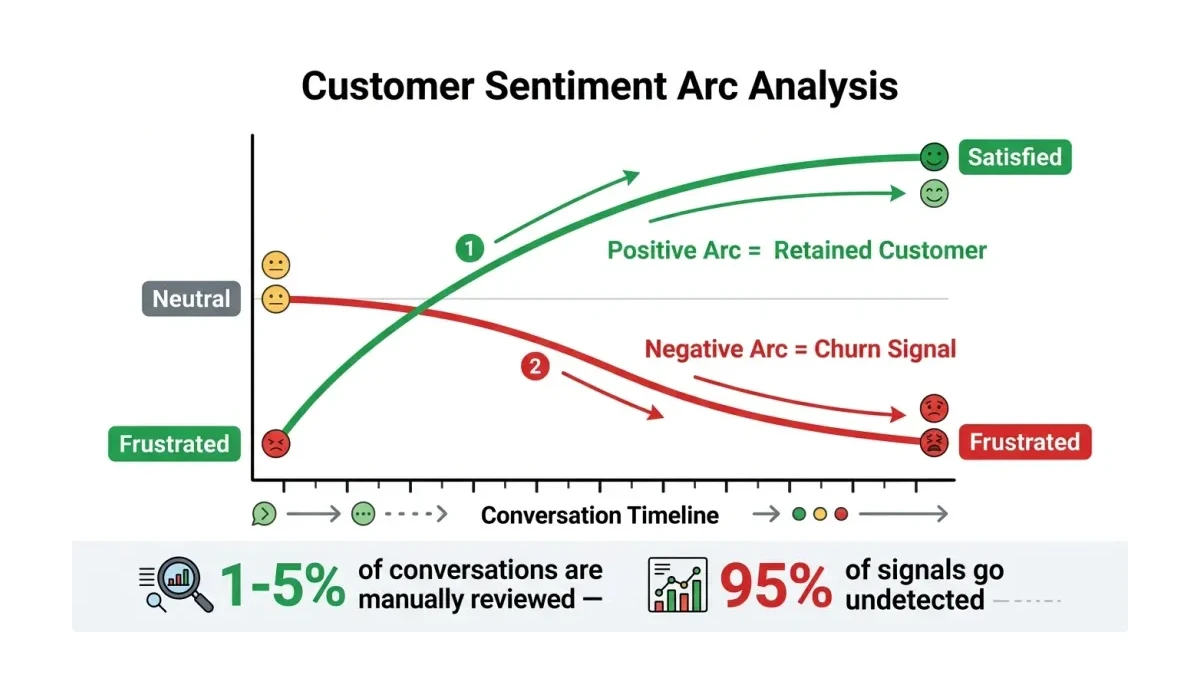
Pakistani ecommerce teams handle customer questions across marketplaces, messaging apps and independent stores. Yet answering those questions does not automatically produce a useful record of why customers needed help. In its product announcement published by MarTech Series, Revelir AI says manual quality assurance programmes typically review only 1 to 5 percent of interactions. That is a vendor-reported observation about support operations, not a measured benchmark for Pakistan.
For a Faisalabad textile exporter, Lahore fashion brand or Islamabad SaaS business, the practical question is the same: what happens to customer feedback after a ticket closes? Product complaints, pricing objections, delivery frustrations and feature requests remain useful after resolution. ATLAS provides a way to collect that evidence and assign responsibility for acting on it.
What Is the ATLAS Framework for Customer Support Analytics?
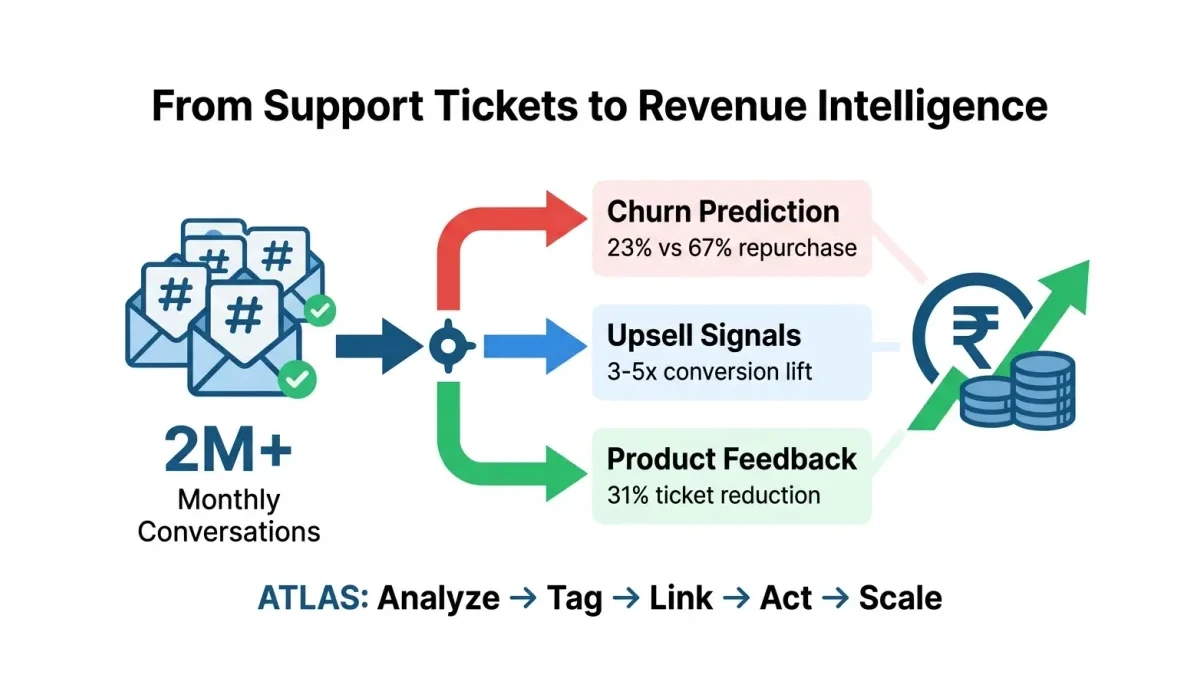
ATLAS — Analyze, Tag, Link, Act, Scale — is a five-stage framework for turning raw customer support conversations into structured revenue intelligence. Each stage builds on the previous one, connecting customer language to decisions your team can evaluate.
| Stage | Purpose | Output |
|---|---|---|
| Analyze | Process available conversations through AI | Sentiment and topic analysis for review |
| Tag | Classify by intent, emotion, and risk | Structured labels with supporting evidence |
| Link | Connect support signals to revenue data | Retention risks and purchase opportunities |
| Act | Trigger appropriate responses and alerts | Assigned interventions with tracked outcomes |
| Scale | Expand coverage across channels and teams | Shared CX intelligence with quality controls |
The framework treats support data as an ongoing source of customer research. A buyer asking about a delayed TCS delivery, a failed JazzCash payment or a restocking date provides evidence about friction and demand. Support contacts are not a representative survey of every customer, however. Compare their findings with purchase behaviour and other feedback before treating a recurring complaint as a market-wide preference.
How Does the Analyze Stage Work for Pakistani Support Teams?
The Analyze stage uses sentiment analysis — the automated interpretation of emotional tone in text — to look for patterns across available conversations. Its output should help reviewers find relevant evidence, with links back to the messages behind each conclusion.
Consider an illustrative Lahore fashion brand handling WhatsApp messages and email tickets. Agents read and answer individual questions, but nobody compares the conversations. Analysis can identify sentiment arcs: how a customer’s expressed feelings change between their opening message and the eventual resolution. Frustration followed by thanks suggests a different outcome from a neutral enquiry that ends in repeated complaints. Neither pattern proves whether the customer will buy again.
Revelir’s announcement provides a concrete deployment example. It reports that RevelirQA evaluates every support ticket at Xendit against a compliance-led scorecard, with an audit trail for each score. The company says this shifted the QA team’s work from manual sample grading towards AI calibration and pattern-based coaching. This supports the feasibility of broader analysis, without establishing equivalent results for a Pakistani SME.
For your own pilot, select a manageable export covering different agents, languages and outcomes. Remove unnecessary personal details, retain ticket identifiers, and define the fields you want returned: contact reason, sentiment arc, resolution status and supporting text. Ask reviewers to check the output before drawing conclusions. Include Urdu, Roman Urdu and English examples where relevant, and keep ambiguous conversations marked for review instead of forcing a confident label.
What Does the Tag Stage Reveal About Pakistani Customer Behavior?
The Tag stage applies consistent labels to analyzed conversations. Start with categories that help your team make decisions, then revise them when real tickets expose gaps or overlap.
Contact reason classification describes why the customer reached out. Useful starting categories include delivery delays, payment failures, product quality, returns and exchanges, and order status enquiries. These are suggested labels, not a verified ranking for Pakistani ecommerce. Measure their share in your own dataset. Separate the customer’s initial question from the underlying cause: an order-status enquiry might ultimately reveal a dispatch failure or an unclear tracking message.
Customer effort indicators capture repeated explanations, transfers and unresolved follow-ups. A straightforward replacement suggests less effort than a conversation that moves between agents without progress. Keep inferred effort separate from Customer Effort Score (CES), which measures customers’ reported experience through a survey. Qualtrics distinguishes survey measures from effort inferred from unstructured feedback. Both can inform investigation, but an AI label should not be presented as a customer’s survey response.
Product feedback signals identify mentions of features, pricing and availability. As an illustrative example, a kitchen appliance brand could group complaints about a blender component, check whether they concern the same model, and send the evidence to its product team. After a change, compare complaint rates against units sold. Falling ticket counts alone may reflect lower sales rather than a better product.
A structured classification prompt can provide a starting point, but there is no verified universal accuracy range for this workflow. Create a human-reviewed reference set and inspect errors by category and language. Check missed complaints as well as incorrect labels. Keep an “unclear” category, document label definitions, and review disagreements before using tags to trigger customer-facing actions.
How Does the Link Stage Connect Support Data to Revenue?
The Link stage connects support signals to commercial outcomes. Use reliable customer or order identifiers where available, document unmatched records, and avoid treating a guessed identity match as a confirmed relationship.
Churn prediction. Repeated unresolved complaints and competitor mentions are candidates for investigation, not universal churn rules. Link them to subsequent purchasing behaviour and test whether they identify risk in your business. For example, a skincare brand could compare repurchase patterns across customers with different complaint histories. Account for purchase frequency and customer tenure: frequent buyers may naturally generate more tickets. Your customer retention programme should use that evidence to prioritise helpful follow-up.
Upsell identification. Support conversations contain direct and indirect purchase intent. A customer asking about larger sizes signals possible demand; someone asking about a collection launch may welcome an availability update. Connect those enquiries to the product catalogue and existing customer preferences. Keep unresolved complaints out of promotional flows until the service issue has been addressed. An expression of interest is a useful lead, not a completed sale.
Product-market fit validation. Feature requests, compatibility questions and unsolicited feedback help teams understand customer needs. Group them by product and customer segment, then compare them with returns and purchase data. A request repeated by the same customer across channels should not count as independent demand each time. Keep the original wording available so product teams can distinguish a clear request from an analyst’s interpretation.
What Does the Act Stage Look Like for Pakistani Businesses?
The Act stage turns findings into assigned actions. Every trigger needs an owner, a suitable response and a way to check whether it helped. Begin with workflows your team can supervise before automating sensitive decisions.
For churn-risk signals, prioritise unresolved problems and send a relevant service follow-up through an appropriate channel. A WhatsApp message acknowledging a delayed delivery and giving a confirmed next step is more useful than an automatic discount that ignores the complaint. Use compensation according to your service policy. The original article’s claimed retention uplift could not be independently substantiated; evaluate your own results by comparing eligible customers who receive follow-up with a comparable group who do not.
For product feedback, route tagged evidence to a shared marketing analytics dashboard accessible to support, marketing and product teams. Review recurring complaints alongside their source tickets and assign an owner to each accepted issue. For example, a food delivery team could investigate whether inaccurate arrival estimates drive complaints, revise the customer updates, and track whether the relevant complaint rate improves. This is an illustrative workflow, not a documented local case study.
For purchase-intent signals, consider a relevant availability message when the requested variant returns to stock, where the customer has agreed to receive it. Check that inventory is current and that the customer has not already purchased. Track purchases, unsubscribes and contribution margin rather than assuming triggered messages deliver a fixed conversion uplift. Stop or revise a flow when it creates unwanted contact or discounts orders that would have happened anyway.
How Does the Scale Stage Expand Across Pakistani Organizations?
The Scale stage extends a tested pipeline across channels and teams. Start with the channel that contains useful, accessible conversations for your business. That may be WhatsApp, but the original article’s claimed national channel share has no independent support in the sources checked.
Multichannel integration connects conversations from email, messaging, social media and call transcripts. Its value depends on reliable matching and consistent definitions. A complaint repeated on Instagram after an unanswered WhatsApp message should retain its channel history while remaining part of the same customer issue. Record missing conversations so dashboard readers understand the limits of coverage.
A Customer Data Platform (CDP) can help unify and activate customer information, but do not make it a prerequisite for a pilot. Start with a controlled export, clear identifiers and a documented tagging process. Consider customer data platform implementation when fragmented identities and disconnected systems prevent useful action. Compare integration, processing and maintenance costs against the value of the decisions the system supports.
WeProms Digital can help scope the data pipelines and automation workflows connecting support channels with marketing systems. Agree ownership for source access, classification checks and intervention results before expanding. More processed conversations only help when teams can trust the labels and respond to the findings.
“Most CX leaders can tell you their CSAT score. Very few can tell you why it moved.” — Rasmus Chow, Founder of Revelir AI
Treat support evidence with the same discipline as other business data: consistent collection, documented definitions and regular review. Wider coverage does not guarantee accurate interpretation. Keep human checks in place as product ranges, customer language and support policies change.
If your team closes tickets without reviewing recurring causes, begin with a focused pilot around a business question such as unresolved delivery complaints or restocking demand. Contact hello@weproms.com or WhatsApp +92 300 0133399 to discuss a CX analytics implementation.
Read next: Customer Retention Framework for Pakistani Ecommerce · Marketing Dashboards Don’t Decide — Data Pipelines Do
Frequently Asked Questions
How much does a CX analytics setup cost for a Pakistani SME?
Costs depend on conversation volume, export access, model usage, integrations and human review. Separate recurring subscriptions and processing charges from implementation and maintenance. A manually reviewed pilot has a different scope from a live system that sends customer messages. Request a current, itemised quote; the previous PKR estimates and WeProms starting fee could not be verified as current pricing.
Can Pakistani businesses use ChatGPT for support ticket analysis?
A useful pilot starts with an approved AI tool and a carefully prepared export. If using ChatGPT, check the account’s current upload capabilities and data settings before sharing customer records. Define categories, require supporting excerpts and compare the output with human-reviewed examples. Do not assume a fixed accuracy percentage or completion time. Validate Urdu and Roman Urdu conversations separately where they appear in your data.
What support channels should Pakistani businesses analyze first?
Start where you have meaningful conversation volume, usable exports and a team able to act on findings. WhatsApp may be suitable for your business; email or helpdesk tickets may be easier to structure. Choose based on your own channel records. Expand once ticket identifiers, labels and review responsibilities work consistently, then check whether customers repeat issues across channels.
How does CX analytics reduce churn for Pakistani ecommerce brands?
It can help teams spot unresolved complaints and reach customers with useful assistance before another purchase decision. Link those signals to purchase history and measure subsequent outcomes. Complaint frequency alone does not establish churn risk, and an intervention does not guarantee retention. Compare similar customer groups and consider the cost of incentives when assessing whether follow-up produces incremental value.
What is the difference between CSAT scoring and CX analytics?
CSAT, or Customer Satisfaction Score, captures reported satisfaction, commonly through a survey after an interaction. CX analytics examines conversation content for topics, sentiment, effort and recurring issues. Survey responses and inferred signals complement each other. Neither automatically explains causation: read the underlying conversations and test proposed fixes before claiming to know why satisfaction changed or what will improve it.
Does ATLAS work for B2B companies in Pakistan?
Yes, with adjustments to the unit of analysis and buying cycle. A Faisalabad textile exporter might group conversations by client account, shipment or contract rather than by individual shopper. Keep account managers involved when interpreting complaints and commercial intent. Prioritise using actual contract value and renewal context instead of applying an assumed revenue multiplier to every B2B support interaction.
How does WeProms Digital help Pakistani businesses implement CX analytics?
WeProms Digital helps scope support data pipelines, classification workflows, revenue connections and follow-up processes. A useful brief identifies the source channels, accessible customer identifiers, business questions and team responsible for acting on findings. Contact hello@weproms.com or WhatsApp +92 300 0133399 to discuss the integration requirements and agree how a pilot’s results will be assessed.
Key Takeaways
- Manual QA sampling can leave useful evidence unexplored, but the cited sampling estimate is not a Pakistan-specific benchmark or a measure of missed revenue.
- ATLAS connects Analyze, Tag, Link, Act and Scale into a repeatable support intelligence workflow with human review.
- Measure contact reasons and classification quality in your own dataset rather than borrowing unsupported national percentages.
- Link complaints to purchasing behaviour before treating them as churn predictors, and distinguish correlation from causation.
- Evaluate follow-up through incremental customer outcomes and margin, without assuming a guaranteed retention or conversion uplift.
About WeProms Digital
WeProms Digital serves Pakistani SMEs, ecommerce brands and B2B teams across Lahore, Karachi, Islamabad, Rawalpindi, Faisalabad and Multan.
The team specialises in customer journey automation, marketing analytics dashboard setup and marketing attribution modeling. For CX analytics projects, the practical goal is to connect support evidence with decisions that marketing, service and product teams can act on and measure.
Get in touch: hello@weproms.com · WhatsApp +92 300 0133399
Sources & References
The Revelir announcement supports the attributed sampling observation, deployment description and quotation. Qualtrics supports the distinction between survey metrics and inferred signals. The remaining links provide broader industry context, not evidence for Pakistan-specific performance benchmarks.
- MarTech Series — Revelir AI Launches AI Analyst for Customer Experience
- MarTech Series — Breaking Down Agency Silos in the Age of Outcomes
- Digiday — Marketers’ AI Use Rises, But Tech Skills Stall
- Braze — Cross-Channel Marketing Platform for Customer Engagement
- Salesforce — SMB Takeaways from the State of Marketing
- ATNRCO — Choose the Right Digital Marketing Agency in Pakistan
- MarTech Series — Invoca First to Integrate With ChatGPT Ads
- Qualtrics — What Is Customer Satisfaction?
Additional reading from industry feeds: