

TL;DR: Product markup is not take-home profit. Pakistani ecommerce merchants need to account for platform fees, marketplace commissions, payment processing, COD returns, app subscriptions and courier charges. The size of each cost depends on the store’s contracts, payment mix and delivery performance. WeProms Digital helps merchants review these expenses alongside Shopify conversion rate optimisation so that better sales performance translates into healthier margins.
A Pakistani ecommerce merchant calculates product cost, adds a markup and lists the price. The problem starts when that markup becomes the assumed profit. Between checkout and settlement, payment charges, shipping, discounts and failed deliveries can change what the store actually earns.
Picture a Karachi clothing brand celebrating a busy sales month while its bank balance barely improves. The useful question is not simply how much it sold, but how much remained after fulfilling those sales. Like bargaining at a Karachi market, the sticker price is only the starting point.
Start with a consistent definition of revenue. Placed orders, dispatched orders and delivered, paid orders are different measures. Use settled sales after refunds when assessing realised margin, and record failed-order costs separately. Otherwise, a growing order dashboard can hide a worsening cash position.
What does the platform fee structure look like for Pakistani ecommerce stores?
Platform fees are the recurring costs of operating your store. The advertised subscription is a starting point for comparison, but it cannot tell you the full cost of running a particular business.
For a Pakistani merchant considering Shopify, the budget should cover the selected plan, paid apps, implementation and ongoing support. Check payment-provider eligibility and the applicable third-party transaction-fee rules directly before committing. Do not assume that a fee quoted for a particular plan or payment method applies to every order, especially when comparing online payments with COD.
For WooCommerce, separate the core software from the infrastructure and work needed to operate it. Hosting, extensions, backups, security, updates and developer support belong in the comparison. A low software bill does not automatically mean a low operating cost.
The APPWRK migration analysis provides background for comparing the platforms, but its estimates should not become a Pakistani store’s budget without checking the assumptions. Revenue alone cannot determine the app stack, support workload or payment costs.
| Cost Component | Shopify budget check | WooCommerce budget check |
|---|---|---|
| Platform Subscription | Confirm the selected plan and billing cycle | Separate core software from paid services |
| Hosting | Check what the plan includes | Obtain a hosting quote suited to the store |
| Essential Apps/Plugins | Record subscriptions and usage charges | Record licences, renewals and paid services |
| Developer Maintenance | Include theme, integration and support work | Include updates, compatibility checks and support |
| Transaction Fees | Check platform rules and gateway charges separately | Check gateway and integration charges |
| Total Operating Cost | Combine actual bills and support requirements | Combine actual bills and support requirements |
A Faisalabad apparel merchant without technical support should compare maintenance proposals before choosing either platform. Ask what happens when checkout breaks, an integration fails or a promotion needs urgent changes. The cheapest proposal may exclude the work the business needs most.
For foreign-currency subscriptions, record the rupee amount actually charged, including applicable conversion costs and taxes. Avoid mixing exchange rates across a comparison. Our platform choice guide for Pakistani sellers offers a broader framework for matching the platform to the business.
How much do marketplace commissions like Daraz really cost Pakistani sellers?
Daraz commission should be checked against the current seller terms and the category assigned to each product. A marketplace-wide average is a weak pricing tool: your actual product mix and deductions determine what reaches your account.
Before listing an item, review the applicable commission, any relevant taxes or deductions, logistics arrangements and settlement terms. Keep a copy of the terms used in the calculation. When a settlement differs from your forecast, trace the difference rather than treating it as miscellaneous marketplace expense.
Seller commission and affiliate earnings are different arrangements. An affiliate marketing video cannot establish what a merchant will pay to sell a product. Use the seller’s current fee information and transaction statements as the working evidence.
Promotions need a separate calculation. Advertising, seller-funded discounts and campaign conditions can affect the contribution from an order. Confirm which expenses apply to the campaign you join; do not assume every sponsored listing or sale event follows the same charging model.
Build a product-level worksheet that starts with the selling price and deducts product cost, marketplace charges, seller-funded discounts and fulfilment expenses. Add the costs of failed deliveries or returns where the seller bears them. Compare the result with settled orders to catch missing deductions.
This is where Daraz store management should connect merchandising with margin control. A product that wins visibility but leaves little contribution may need different pricing, campaign participation or stock allocation.
Understanding the Daraz versus own-store tradeoff also means comparing customer acquisition costs. Marketplace deductions and the advertising needed to bring shoppers to an independent store belong in the same decision, even though they appear on different bills.
What are the payment gateway fees Pakistani stores never calculate?
A payment gateway’s headline rate is only part of its commercial terms. Ask each provider for a written quotation covering the payment methods you intend to accept, applicable taxes, setup or recurring charges, settlement timing and refund treatment.
The XStak payment gateway comparison can help identify providers to investigate. It should not replace a merchant-specific quotation. Avoid assuming that every bank gateway is more expensive than every fintech provider, or that a published introductory offer will apply to your account.
For JazzCash and Easypaisa, check the terms of the actual merchant integration. A wallet payment accepted through an intermediary may have different commercial terms from a direct arrangement. Ask who collects the fee, which statement shows it and how refunds are handled.
Calculate your effective processing cost from the fees charged and the relevant successfully processed value. Keep refunds and settlement adjustments visible. If the platform also charges an applicable transaction fee, record it separately so that neither charge disappears from the margin calculation.
Review the checkout experience alongside the price. A cheaper quoted rate offers little benefit if the integration creates payment failures or extra support work. Test the payment journey and reconciliation process before directing substantial traffic to it.
The cost of digital payments versus COD deserves a comparison based on completed orders. COD can involve collection, remittance and failed-delivery expenses; prepaid orders can involve processing fees, refunds and returns. Neither method is cost-free.
Prepaid incentives may help, but their value must be measured. Compare the discount offered with changes in delivery success, refunds and contribution. Do not assume switching a particular share of customers to prepaid will produce a guaranteed saving.
How do COD return shipping costs destroy Pakistani ecommerce margins?
COD return costs become easy to miss when sales reporting stops at dispatch. A refused parcel does not produce a completed sale, yet it may still leave the merchant with shipping, packaging and handling expenses.
Check your courier agreement before assuming every failed delivery attracts the same outbound and return charges. Billing can depend on the service, route and commercial arrangement. Match courier invoices to shipment records so that the cost of a failed delivery is visible rather than buried in a monthly total.
Consider a Multan cosmetics brand reviewing its returned parcels. The useful calculation starts with what it actually paid: outbound delivery, any return charge, packaging that cannot be reused and staff time spent inspecting stock. Damaged goods and stock that needs discounting require separate treatment.
Keep lost sales opportunity distinct from an expense. A refused order is revenue that did not materialise; its full selling price is not automatically an additional cash loss. If the product returns in saleable condition, the stock still has value. Counting both the full order value and the returned stock as lost would exaggerate the damage.
Inventory delay matters too. Returned seasonal clothing may arrive too late for the original promotion, while fragile products may need inspection before resale. Record when goods become available again so that stock planning reflects what can actually ship.
Use clear return reasons: unreachable customer, incorrect address, late delivery, product mismatch or refusal. Review them by courier, destination, product and acquisition source. This shows whether the problem begins before dispatch or during delivery.
Our WhatsApp messaging guide for Pakistani stores can help structure confirmation and delivery communication. Measure the result rather than promising a standard reduction. Track outbound courier costs on successful deliveries as well: they remain part of fulfilment even when no parcel comes back.
What hidden app and plugin costs inflate Shopify expenses for Pakistani merchants?
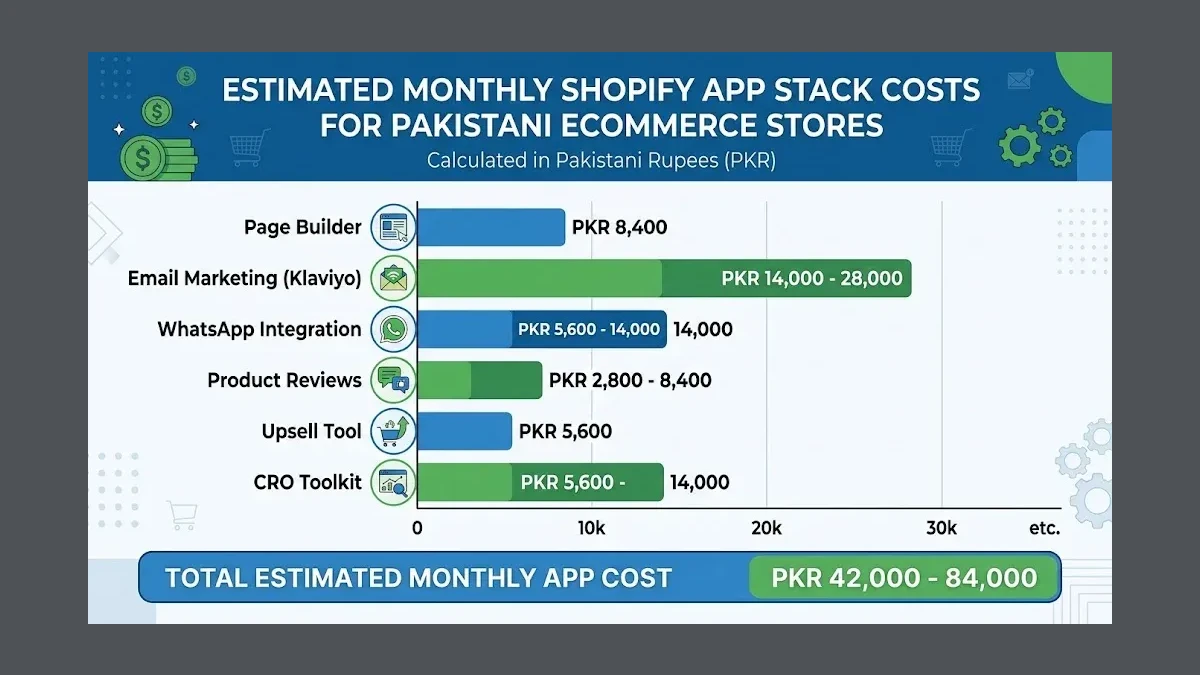
App costs accumulate when each operational problem leads to another subscription. Reviews, email, WhatsApp, upselling, inventory, analytics and page building may all have a purpose, but the store needs a clear reason to pay for each tool.
There is no reliable universal app budget based only on revenue. Charges may depend on the plan, contacts, messages, orders or other usage. A tool that looks affordable during setup can cost more as the store grows, even without adding features.
Create an app register with the owner, purpose, billing cycle and cancellation terms for every subscription. Include usage charges and annual renewals. Check whether similar functionality already exists in the platform, theme or another paid tool before buying an additional app.
For email software such as Klaviyo, price the audience and sending requirements you actually have. For WhatsApp integrations, separate the software subscription from any applicable messaging charges. For conversion rate optimisation, identify what the tool helps you test or improve rather than treating installation as a result.
WooCommerce needs the same discipline. A plugin licence, installation work and ongoing compatibility support are different expenses. Compare the complete proposal instead of assuming that an annual licence makes the setup cheaper than a monthly subscription.
Before removing an app, check its dependencies. It may support a checkout function, customer message or reporting process that is not obvious from its dashboard. Export necessary data, confirm the replacement and test the affected customer journey.
The existing illustration below shows categories to review; its displayed estimates should not be treated as current supplier quotations. Build your budget from actual bills and the features the store needs.
Which ecommerce platform delivers the lowest total cost for Pakistani businesses?
The lowest-cost platform depends on how the business sells, who maintains it and what it takes to win a completed order. A comparison based only on revenue misses those differences.
| Business Situation | Shopify cost considerations | WooCommerce cost considerations | Daraz marketplace considerations |
|---|---|---|---|
| Testing demand | Subscription, setup and customer acquisition | Hosting, setup and technical support | Applicable seller charges and campaign spending |
| Building repeat sales | Apps, payments and retention activity | Extensions, maintenance and retention activity | Marketplace tools, terms and repeat-order economics |
| Growing order volume | Usage charges, support and fulfilment | Hosting capacity, maintenance and fulfilment | Product-level deductions, logistics and promotions |
Compare the platforms using the same product mix, delivered sales and fulfilment assumptions. Include advertising and the merchant’s support workload. A commission-only marketplace estimate cannot fairly be compared with a fully staffed independent-store budget.
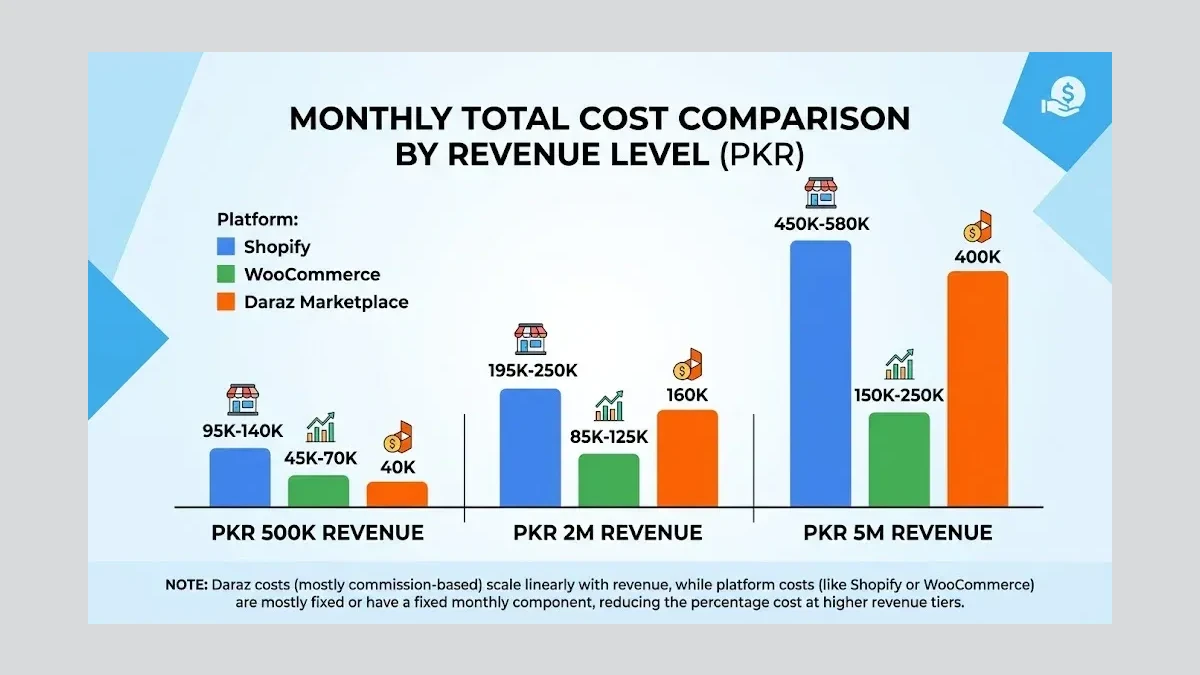
Fixed and variable costs also need separating. A subscription may stay stable while gateway charges, fulfilment and usage-based software bills grow. An independent store therefore does not become almost cost-free simply because its revenue rises.
Daraz can be a useful route to testing demand, but it should not be described as having no upfront business costs. Inventory, packaging, content and operational work still need funding. Equally, launching an independent store does not guarantee cheap traffic or repeat customers.
There is no universal revenue threshold for moving away from a marketplace. Consider the strength of demand, repeat purchases, customer acquisition costs and the team’s ability to manage another channel. Testing an own-store channel alongside marketplace sales may provide better evidence than an abrupt migration.
Building a successful Shopify store in Pakistan requires planning for these operating demands. Use the illustration below as a prompt to examine cost behaviour, rather than a current price list or forecast.
Read next: Daraz vs Shopify vs Custom: Ecommerce Marketing Pakistan and COD vs Digital Payments: Ecommerce Costs in Pakistan
If sales are growing but profit is not, WeProms Digital can review platform bills, payment settlements, courier invoices and app subscriptions together. Contact hello@weproms.com or WhatsApp +92 300 0133399 to discuss a cost audit.
Frequently Asked Questions
How much does it really cost to run an ecommerce store in Pakistan?
There is no dependable total based on monthly revenue alone. Budget for the platform, maintenance, apps, payment processing, fulfilment, returns and customer acquisition. Separate launch spending from recurring costs, and compare your forecast with actual settled sales. Keep product costs and overheads visible too; the expenses discussed here are only part of the full profit calculation.
Should Pakistani merchants choose Shopify, WooCommerce, or Daraz?
Choose according to your operating capacity and route to customers. Assess Shopify’s plan and integration costs, WooCommerce’s hosting and maintenance requirements, and Daraz’s applicable seller charges and terms. Obtain comparable quotes and include the work your team must perform. A platform decision should account for reliability, customer experience and margin, as well as the headline bill.
How can Pakistani stores reduce COD return costs?
Improve product information, confirm uncertain orders, validate addresses and communicate delivery expectations. Review failed-delivery reasons with the courier and test prepaid incentives where appropriate. Compare delivered-order contribution before and after each change. Confirmation work and discounts also cost money, so a lower return rate is useful only when it improves the overall economics.
What is the average payment gateway fee in Pakistan?
A general average is not a safe pricing assumption for an individual store. Request current terms for your payment methods, volume and integration, including taxes and any additional charges. Use payment gateway comparisons to shortlist providers, then compare written quotations. Review actual deductions after launch to confirm that the effective cost matches your expectations.
How much should a Pakistani ecommerce store budget for apps and plugins?
Build the budget from required functions and expected usage. Include subscriptions, renewals, implementation and maintenance, then remove overlaps where the replacement has been tested. Review tools that nobody owns or uses. WeProms Digital can assess app costs alongside Shopify conversion rate optimisation to identify expenses that do not support the customer journey or business operations.
Key Takeaways
- Product markup is not realised profit. Reconcile settled sales with product costs, fulfilment, platform bills, marketplace deductions and overheads.
- Use current Daraz seller terms and product categories to price listings; affiliate earnings are not evidence of seller commission.
- Compare Shopify and WooCommerce using equivalent operational requirements, including maintenance, integrations and customer acquisition.
- Obtain merchant-specific payment quotations and check actual deductions. Keep gateway and applicable platform transaction charges separate.
- Calculate COD failure costs from courier bills, handling and stock outcomes. Do not treat every refused order’s full value as a cash expense.
- Test prepaid incentives, delivery communication and app reductions against contribution. Avoid assuming that a standard saving applies to every store.
About WeProms Digital
WeProms Digital works with Pakistani ecommerce brands on cost auditing and conversion rate optimisation. Its approach connects marketing performance with the operational expenses that determine what remains after a sale.
A useful audit brings order records, platform bills, payment statements and courier invoices into the same discussion. The aim is to identify avoidable expense and improve customer journeys without assuming that more traffic will solve every margin problem.
Get in touch: hello@weproms.com · WhatsApp +92 300 0133399
Sources & References
These existing references provide background reading. Use current supplier terms, written quotations and your own settlement records for pricing decisions; the links below are not substitutes for those documents.
- APPWRK — WooCommerce to Shopify Migration: Real Cost Analysis
- XStak — Online Payment Gateways in Pakistan
- Buzz Interactive — Payment Gateways in Pakistan
- Mustajab Hub — Shopify vs WooCommerce
- Martech Zone — How Custom Software Unlocks Advanced eCommerce Functionality
- Adex360 — How to Run Profitable Ads with Google and Facebook
- Oscar PK — Best Shopify Alternatives in Pakistan
Additional reading from industry feeds: