

TL;DR: FAQ schema implementation should not be sold as a promise of extra visibility in Google. Search Engine Roundtable reports that Google dropped FAQ rich results, making it essential to review any deliverables built around that feature. Pakistani businesses should ask what their agency’s markup work achieves, retain useful answers for customers, and prioritise content, technical accessibility and relevant structured data. Measure results through qualified enquiries and sales as well as search traffic.
Picture a Karachi ecommerce brand opening its agency report and finding “FAQ schema added to product pages” presented as the main achievement. The report shows completed work, but no evidence that customers found those pages more easily or bought more products. That distinction matters: implementing code is an activity; improving search performance is an outcome.
If your SEO plan depends on expandable FAQ panels appearing beneath Google listings, ask your agency to explain the current eligibility rules and demonstrate the benefit. The aim is to stop paying for an assumed result and put that effort towards work your business can evaluate.
What exactly are FAQ rich results and why did Google remove them?
FAQ rich results were expandable question-and-answer sections beneath eligible Google search listings. They gave users a way to read answers without opening the page. Their appearance depended on Google’s eligibility and display decisions, rather than simply on a website adding FAQ markup.
Search Engine Roundtable reports that Google dropped FAQ rich results and associated Search Console support. That report is the basis for the retirement discussed here. The practical lesson for a business owner is to distinguish the search feature from the answers on the page and the code describing them.
Those are separate assets. Your answers may still help customers understand delivery, returns or service availability. Your markup may remain in the website’s templates. Neither proves that Google will display a particular search enhancement.
A completed schema task is not evidence of additional search visibility. Ask which supported feature it targets and how success will be measured.
It is also a mistake to describe every rich-result change as proof that Google has replaced that feature with AI Overviews. That explanation needs evidence. Your investment decision can be simpler: does the proposed work address a current opportunity, and is it more valuable than other unresolved problems?
The export deadlines previously associated with this change are historical, not an actionable checklist. Check what your Search Console account currently provides, retain existing exports and record gaps in your baseline. Do not assume a missing FAQ-specific report means all performance information for those pages has disappeared.
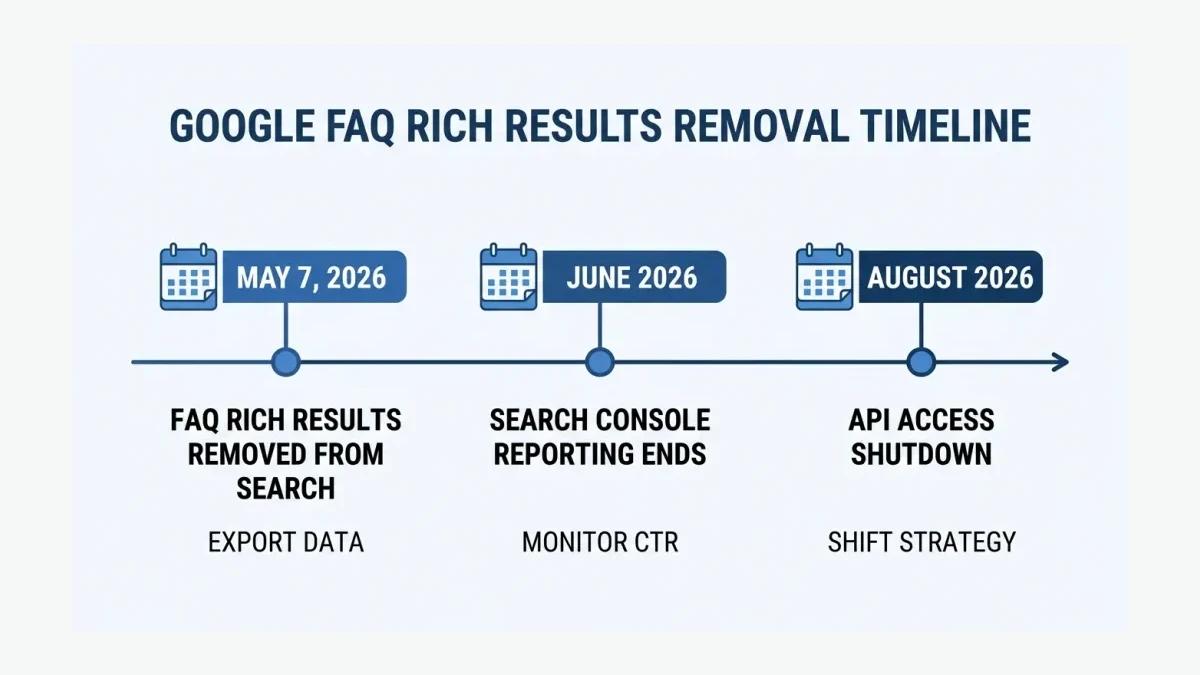
The timeline graphic is a historical illustration; confirm current reporting availability before planning an export.
How does this change affect Pakistani businesses specifically?
For Pakistani businesses, the main issue is accountability for SEO spend. A Lahore retailer, Karachi clinic or Faisalabad exporter needs to understand which tasks support customer acquisition. A report full of schema additions can obscure the more useful questions: which pages improved, which enquiries came through, and what prevented other pages from performing?
There is no reliable basis here for assigning a standard share of Pakistani SEO budgets to FAQ work. Your own contract and activity logs provide a better starting point than a national estimate. Ask whether the implementation was a template change, an automated plugin setting or substantial manual work. These involve different levels of effort and should not be valued as equivalent deliverables.
Then examine opportunity cost. If the agency spent time maintaining markup while product descriptions remained incomplete or enquiry forms failed on mobile, those unresolved problems deserve attention. The concern is the choice of priorities, not the existence of an FAQ section.
Local context still matters. Customers may need clear delivery coverage, payment options, stock information or service-area boundaries before they contact you. An exporter may need specifications and ordering requirements that a domestic retailer does not. These details should come from the business, rather than from generic SEO copy.
Review the mobile experience directly instead of relying on an unsupported national traffic percentage. Open important landing pages on a phone, read the answers, and complete the purchase or enquiry journey. Problems you can reproduce provide a stronger brief than claims about how much traffic every Pakistani business receives from mobile.
Which Google schema types still work for Pakistani websites?
Do not use a fixed shortlist as a complete inventory of Google’s supported search features. A schema vocabulary, a valid implementation and eligibility for a Google enhancement are different things. Before commissioning work, ask your agency to identify the relevant Google documentation and explain how the page meets its requirements.
The table below is an audit guide, not a certification of current feature availability. It replaces the assumption that every listed type automatically produces a rich result.
| Schema Type | What to verify | Pakistani Business Use | Practical Check |
|---|---|---|---|
| Product | Current product-feature eligibility | Ecommerce stores | Match markup to visible product details |
| Article | Applicable article guidance | Publishers and business blogs | Check authorship and article information |
| LocalBusiness | Appropriate business details and eligibility | Clinics, restaurants, retail and services | Check names, addresses and opening hours |
| HowTo | Whether the intended Google feature is supported | Tutorial and process content | Do not promise an enhancement from the type name |
| Breadcrumb | Current breadcrumb requirements | Websites with a clear hierarchy | Match markup to meaningful navigation |
| Offer | Its role within the relevant implementation | Pages presenting genuine offers | Match prices and availability to the page |
| FAQ markup | A documented purpose beyond promised FAQ panels | Pages answering customer questions | Keep the visible answers useful and accurate |
For existing FAQ markup, avoid a blanket instruction either to preserve it forever or remove it urgently. Check whether it is accurate, inexpensive to maintain and used elsewhere. Incorrect or duplicate markup deserves attention; harmless legacy code may be a lower priority than substantive website problems. Do not justify retention with an unverified claim that removal disrupts indexing.
For ecommerce, start with product information customers can actually see and trust. For physical businesses, review location details and the customer journey alongside the markup. Marketplace sellers should also establish which technical elements they control before paying an agency to change them.
Our schema markup and structured data guide for Pakistani businesses provides further context for discussing these implementation choices.
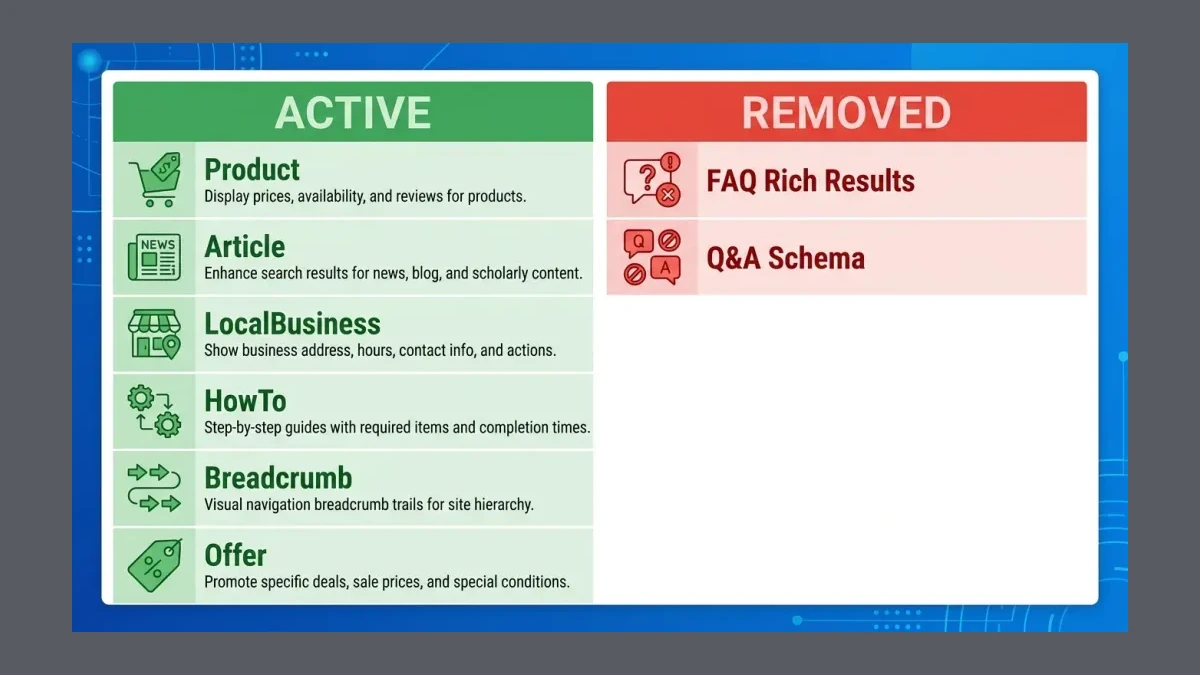
Do not use the graphic’s original active-type labels as a current support list. Validate each proposed implementation against current documentation.
What should you demand from your SEO agency after May 2026?
Start with direct questions: “Which recent tasks targeted FAQ rich results?”, “What evidence supports the benefit claimed for that work?”, and “Which current opportunities should take priority instead?” Ask for answers tied to your website, not a generic presentation about algorithm changes.
A useful agency response distinguishes implementation, eligibility, appearance and business results. It should also acknowledge uncertainty. If a report counts markup additions as success without explaining their purpose, ask for a revised scope before renewing the same deliverables.
An independent SEO audit and strategy review can help turn those answers into a practical work plan. The review should cover the following areas in sequence.
First, the schema audit. Inventory the markup generated by your theme, plugins and custom code. Identify which pages it affects, whether it matches visible content and what each implementation is intended to achieve. Flag unsupported promises and conflicting outputs. Avoid paying separately for repeated tasks that a shared template already handles.
Then, the content assessment. Review the questions customers actually ask before buying. Keep useful FAQ sections, but remove repetition and update inaccurate answers. Put essential purchase information where readers can find it easily. Do not rebuild every accordion simply because somebody claims AI systems only read ordinary body paragraphs; ask for evidence of a specific accessibility or rendering problem.
Next, the reporting review. Save available performance data and locate earlier exports. Compare affected landing pages over comparable periods, noting changes to demand, rankings, content and promotions. Record what the data can and cannot establish. A fall in clicks around a reported feature change does not, by itself, establish the cause.
After that, the budget review. Prioritise work using the likely customer benefit, implementation effort and evidence available. Improvements might include clearer product information, crawlability fixes, better internal navigation or relevant structured data. Set an observable outcome for each task and agree when it will be reviewed.
Finally, ask the agency to explain what it will stop doing. A revised strategy should change the work schedule, not simply rename existing schema tasks as “AI optimisation”. Keep a short decision log so the next report can show whether the new priorities were completed and what happened afterwards.
How does AI search change the SEO game for Pakistani businesses?
AI search adds another visibility question: can your business provide useful information that an answer service might reference? That deserves attention, but it does not establish that AI optimisation delivers a higher return than every other SEO activity. The right balance depends on your audience, current performance and commercial goals.
Treat clear writing as a useful editorial standard, rather than a guaranteed citation formula. A paragraph should explain its subject, answer the relevant question and preserve necessary qualifications. Avoid forcing statistics into every answer or assuming that each paragraph functions as an independent citation unit across all systems.
Local detail is valuable when it helps a customer make a decision. A restaurant can publish its actual menu, delivery area and ordering arrangements. A service business can explain where its team travels and which work requires an on-site visit. A supplier can describe specifications, payment terms and fulfilment constraints.
Use verified details from the business. Do not invent example prices or insert city names merely to make a page appear locally relevant. Accuracy matters more than the appearance of specificity, particularly when another service may quote the information without the surrounding context.
If you commission answer engine optimisation services, agree how visibility will be assessed. Record the questions checked, the answers observed and the referral or enquiry evidence available. Treat isolated mentions as observations, not a complete measure of market coverage.
Content planning can also support social channels, but each channel needs its own presentation and measurement. A clear website answer may inform a video, post or customer-support response. That does not prove the same format automatically earns distribution across search engines, social platforms and chatbots.
What does a modern SEO strategy look like for Pakistani SMEs?
A practical strategy connects useful content, technical accessibility, relevant markup and local discovery to business goals. These areas overlap, so use the sequence below as a planning framework rather than a universal ranking of returns. A broken checkout may deserve attention before a content project; an incomplete service page may be the more urgent issue elsewhere.
First comes content quality and usefulness. Review your most commercially important pages before expanding the blog. Explain what you sell, whom it suits, where it is available and what a customer should do next. Include prices when you can publish them accurately; otherwise explain the factors that determine a quote. Give each page a clear purpose and remove unsupported promises.
Then comes answer-focused content planning. Use customer questions to organise information, with direct answers followed by relevant detail. Keep related pages connected through useful internal links. Avoid creating near-duplicate pages for every wording of the same question. Readers should be able to understand the subject without moving through a chain of thin articles.
Next comes the technical foundation. Check that important pages can be reached, rendered and considered for indexing. Review mobile usability, page performance, navigation and forms as separate concerns. Do not treat a performance score as proof that Google will index a page, or a poor score as proof that it cannot. Investigate the actual symptoms and prioritise fixes that affect important journeys.
After that comes relevant structured data. Select implementations according to the page’s content and the search feature being targeted. Require documentation, validation and a maintenance owner. A structured data implementation review should explain these choices rather than promise blanket coverage of an arbitrary list of schema types.
Finally comes local discovery. Keep business information accurate and give customers useful location or service-area details. Build city pages only where there is a meaningful local offer to describe. A business serving Lahore and Islamabad should explain any genuine differences in availability, fulfilment or contact arrangements. Review local SEO and Google Business Profile optimisation alongside the website experience.
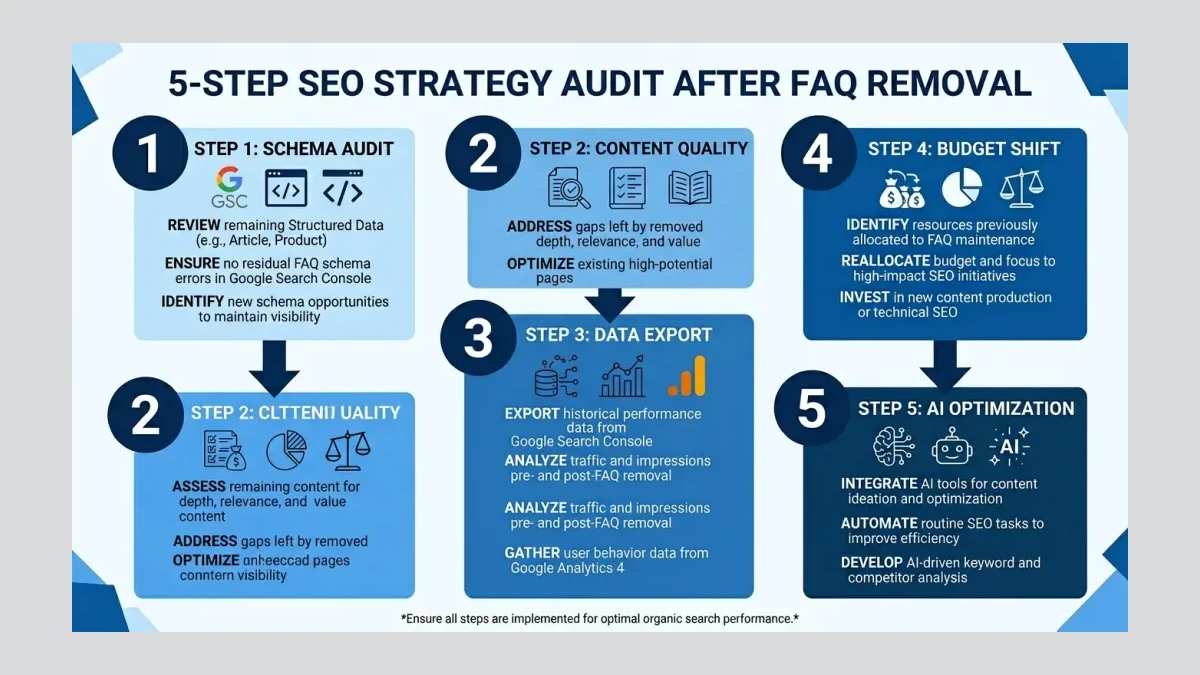
Assign an owner and an outcome to each priority. Review progress against enquiries, sales and useful search indicators, with enough context to explain seasonal or operational changes. Avoid attributing every improvement to the most recent SEO task.
WeProms Digital can help Pakistani businesses review existing deliverables and build an evidence-based work plan. Bring your agency reports, available search data and commercial priorities so the discussion starts with your business. Contact hello@weproms.com or message WhatsApp at +92 300 0133399 to discuss an audit.
Read next: Schema markup and structured data guide for Pakistani businesses
Frequently Asked Questions
Should I remove FAQ schema from my Pakistani website?
Do not make removal an emergency task without identifying a problem. Review whether the markup is accurate, how it is generated and whether another system uses it. Keep useful customer-facing answers regardless of the markup decision. If maintenance creates unnecessary work or the code describes content that is no longer present, include it in the technical review. Ask your agency to explain the purpose of any proposed new FAQ implementation instead of accepting a promise of search visibility.
How do I know if my SEO agency is using outdated tactics?
Request a recent deliverables breakdown and ask which current opportunity each task addresses. FAQ markup in a report is a reason to ask questions, not sufficient evidence on its own that the agency’s entire strategy is outdated. Warning signs include guaranteed search enhancements, unsupported traffic forecasts and repeated implementation counts without outcomes. A useful report explains what changed, why it mattered and what evidence is available. It also distinguishes observations from assumptions and acknowledges work that did not deliver the expected result.
How much does a modern SEO strategy cost for Pakistani SMEs?
There is no verified Pakistan-wide price range established here. Request quotes against a defined scope covering your website’s size, technical problems, content needs and reporting expectations. Compare the proposed effort and responsibilities, including any work your own team must supply. Ask what is included, what requires a separate project and how priorities can change. A smaller retainer is not automatically better value, and a larger one does not guarantee results. Judge whether the work addresses your actual constraints and whether its progress is visible.
What is the deadline for exporting Google Search Console FAQ data?
Treat the deadlines in the original retirement reporting as historical. Check which FAQ-specific information remains available in your account or existing exports before making a data request. Preserve the records you already hold and document any missing periods. Continue reviewing available page and query performance, while recognising that a general landing-page report does not necessarily isolate the contribution of a particular search appearance. Do not promise to recover unavailable historical data, or assume that losing a feature-specific report removes all evidence about the affected pages.
How does the FAQ removal affect local SEO for Pakistani businesses?
Do not assume a change to FAQ search appearances changes your local visibility in the same way. Assess local performance separately, using available profile interactions, website visits and enquiries. Keep location information, opening hours and service details accurate, and make it easy for customers to contact you. For businesses in Lahore, Karachi, Islamabad or other cities, these remain sensible priorities without claiming that local SEO has become universally more profitable. The appropriate investment depends on how customers find and choose your business.
Key Takeaways
- Search Engine Roundtable reports the retirement of FAQ rich results. Ask your agency to substantiate any deliverable that still promises those search appearances.
- Audit your actual SEO activity logs instead of assuming a fixed share of the budget has been wasted. Separate automated template changes from substantial manual work.
- Do not treat a short schema list as Google’s complete support catalogue. Check the intended feature, current requirements and accuracy of each implementation.
- Keep useful answers and improve the customer journey. Clear content supports understanding, but neither schema nor a particular paragraph format guarantees rankings or AI citations.
- Replace expired export reminders with a review of available data and saved reports. Record limitations before drawing conclusions about traffic changes.
- Reallocate effort according to business needs and measurable outcomes. Avoid unsupported promises about universal traffic gains, market growth or the return from a particular tactic.
About WeProms Digital
WeProms Digital works with Pakistani SMEs, ecommerce brands and B2B teams on SEO strategy and implementation. Its work includes technical audits, content planning and structured data reviews, with priorities shaped around the website and the business it serves.
An audit should give your team a practical explanation of what needs attention, what evidence supports that recommendation and how progress will be reviewed. Bring questions about existing deliverables as well as plans for future growth.
Get in touch: hello@weproms.com · WhatsApp +92 300 0133399
Sources & References
The retirement reports below provide the attributed background to this article. They should not substitute for checking current product documentation when commissioning implementation work.
- Search Engine Roundtable — Google Drops FAQ Rich Results In Search & Search Console
- Search Engine Land — Google to No Longer Support FAQ Rich Results
- The Prompt Insider — Google Drops FAQ Rich Results: What It Means for AEO
Additional reading from industry feeds: