
TL;DR: LinkedIn deserves a place in a Pakistani B2B company’s visibility strategy, but publishing there does not guarantee recommendations from ChatGPT, Perplexity or Google AI Overviews. Use expert profiles and company content to answer specific buyer questions, support claims with evidence and connect readers to useful website resources. WeProms Digital builds generative engine optimization and AI discoverability strategies that connect these activities. Measure citations and qualified enquiries separately from posting volume and engagement.
A company page links to a website but offers little explanation of the business. A founder’s profile lists a job title without showing how they solve customer problems. These are useful starting points for a LinkedIn review, whether the business is a software house in Islamabad, a Karachi trading firm or a Faisalabad textile exporter.
The question is not simply whether the company posts often enough. It is whether a buyer can find a clear account of its expertise, services and evidence. The original article presented a profile audit as a national benchmark without providing its methodology. That comparison cannot establish how Pakistani businesses perform overall. The useful question remains: what would a prospective customer learn from your public content today?
What happens when a Karachi importer asks ChatGPT for a logistics partner?
Consider a procurement manager asking, “best logistics companies for imports in Karachi”. Treat the resulting answer as a research starting point. Check whether it provides sources, whether those sources are current and whether they support the actual recommendation. An answer without citations cannot tell you which publication influenced the brand selection.
Do not assume that a missing recommendation proves ChatGPT has never encountered your LinkedIn content. Equally, a LinkedIn citation does not establish that a post was part of a model’s training data. For a practical audit, record the question, the answer, the cited pages and the services attributed to each business. This gives your team something concrete to investigate instead of a theory about an inaccessible training process.
Generative engine optimization (GEO) is a useful label for work aimed at improving visibility in generated answers. It should sit alongside search optimisation, website content and buyer education. A readable LinkedIn article cannot compensate for an unclear service offering, and an attractive website cannot answer a question it never addresses.
Think of asking a wholesale dealer at Lahore’s Azam Cloth Market for a fabric supplier recommendation. A supplier with a clear specialism and credible references is easier to discuss than one whose catalogue says only “quality products”. That is a useful communication analogy, not a description of how an AI model works. Your content should make the business understandable and its claims easy to check.
Why does LinkedIn feature in discussions of AI citations for B2B answers?
The Meltwater report listed below places LinkedIn prominently in its analysis of AI citations. However, its precise ranking, source shares and methodology could not be independently checked for this article. Those figures should not be treated as a universal distribution of B2B recommendations across ChatGPT, Perplexity and Google AI Overviews.
Even with a verified study, ask what was measured: which prompts, products, markets and collection period? A domain appearing as a source is different from a vendor receiving an endorsement. Neither automatically tells a Pakistani business where its next qualified lead will originate. Use citation research to inform testing, then compare it with the questions your customers actually ask.
| Source Type | What to Examine | Example Platforms |
|---|---|---|
| Social platforms | Whether the cited content answers the buyer’s question | LinkedIn, YouTube, Reddit |
| Company websites | Whether service details and evidence are clear | Brand-owned blogs, product pages |
| Peer review sites | Whether reviews are relevant and current | G2, Capterra, Gartner Peer Insights |
| Other sources | Whether coverage supports the recommendation | News outlets, analyst reports, forums |
The Nobori article on off-site AI visibility offers another perspective on external sources. Its headline percentage should not become a budget rule without checking the underlying sample. A founder’s post is still a company-connected claim; publishing it on LinkedIn does not turn it into independent validation.
Build a public explanation of your expertise that a buyer can understand, investigate and compare with alternatives.
Before funding a redesign or a LinkedIn programme, identify the actual gap. Is your website missing service details? Are executives making claims without examples? Are third-party descriptions inaccurate? Allocate work around those problems. Avoid treating website investment and expert publishing as interchangeable activities with a predetermined winner.
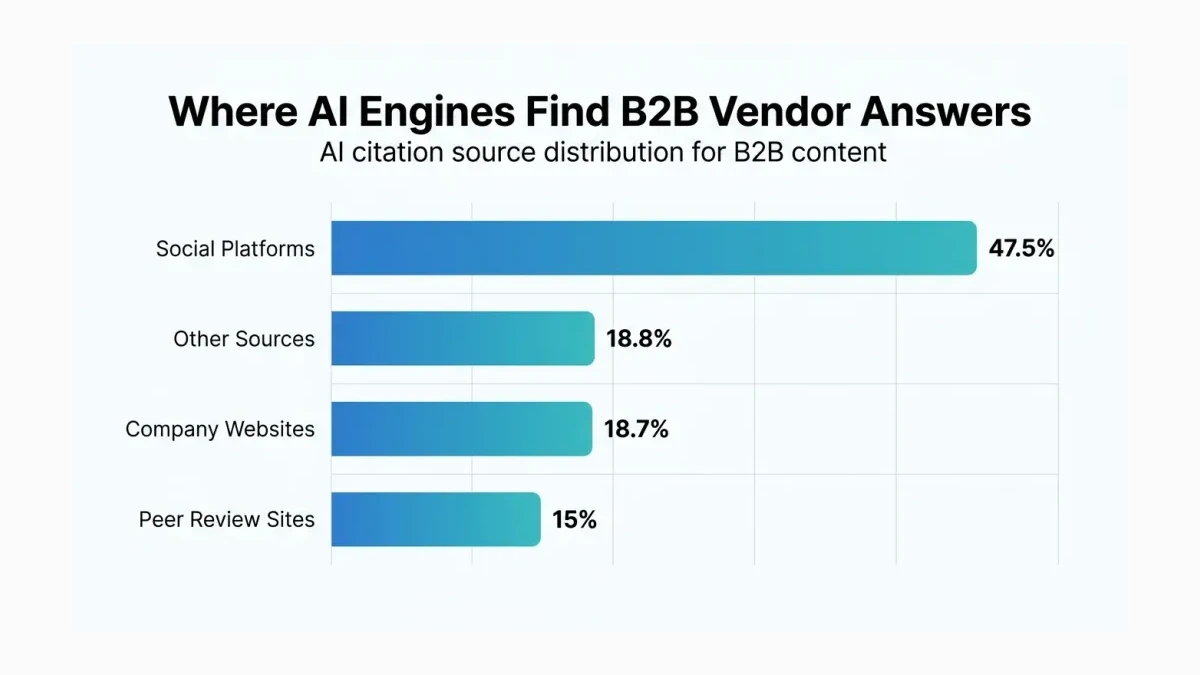
The percentages in this existing illustration have not been independently verified. Do not use them as market benchmarks or budget guidance.
Which LinkedIn profiles actually get cited by ChatGPT and Perplexity?
The original article assigned precise citation shares to individual profiles and company pages, then used follower counts to predict which author would be cited. Without a verified dataset and clear definitions, those comparisons are too strong. There is no defensible basis here for promising that an engineer’s post will outperform a large company’s page in an AI answer.
Individual experts and company pages can serve different editorial purposes. Ask an engineer to explain implementation choices, a logistics lead to discuss documentation problems and a company page to maintain a consistent description of the business. Choose the author who can substantiate the advice. Do not create an executive publishing programme merely because a profile supposedly receives preferential treatment.
For each article, review the question it answers, the evidence behind its claims and the context a reader needs. Descriptive headings, useful lists and explicit company or product names can make that review easier. Quantitative claims need sources and scope; adding a percentage to an otherwise vague post does not make it trustworthy.
A post explaining KYC compliance challenges should identify the relevant requirement and link to authoritative guidance where appropriate. A partnership announcement should explain what changes for customers. Both can be useful when they contain substantive information. The editorial aim is to answer something meaningful, rather than divide all content into supposedly citable advice and worthless announcements.
How much B2B purchase influence has shifted to AI search in 2026?
The G2 and 6sense reports in the references address AI use during B2B buying. Their headline findings warrant attention, but the precise figures and survey wording could not be independently verified here. They should not be extended into claims about all Pakistani procurement teams or the proportion of revenue a particular company has already lost.
Different research questions also measure different behaviour. Trying an assistant during a purchase is not the same as starting research there, changing a shortlist because of its answer or buying from an unfamiliar supplier. Keep those distinctions visible when discussing research with leadership. A striking percentage is not useful if the team applies it to the wrong decision.
| B2B AI Search Metric | Question to Check | Research Mentioned in the Original Article |
|---|---|---|
| Buyers using LLMs in a purchase journey | What counted as use? | 6sense Buyer Experience Report |
| Buyers starting research with AI chatbots | Who was surveyed, and for which purchases? | G2 Answer Economy Report |
| Buyers changing vendor choice after AI advice | Was this influence or a completed purchase? | G2 Answer Economy Report |
| CMOs using assistants for vendor discovery | Does the sample match your target market? | Wynter buyer research |
Imagine an Islamabad SaaS firm targeting enterprises in Dubai. If an assistant’s shortlist omits it, that is a useful observation to investigate. It does not prove a lost deal or establish why the brand was absent. Check whether the question matched the firm’s offering and whether the cited sources described suitable alternatives.
For a practical starting point, the SIGNAL approach to answer engine optimisation connects buyer questions with content planning. Pair that work with sales conversations: ask prospects how they researched suppliers and what information helped them decide. This gives your team business context that a citation count alone cannot provide.
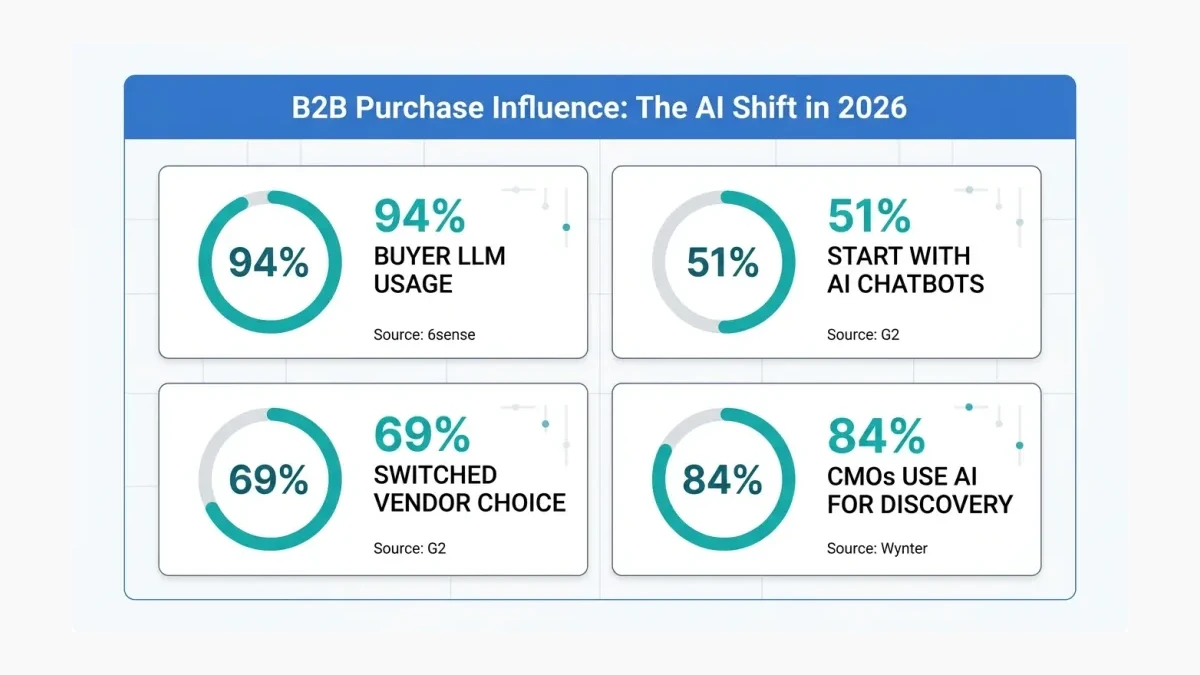
The survey figures in this existing illustration need verification against their original reports before reuse.
What separates a LinkedIn profile that appears in AI answers from one that doesn’t?
There is no verified formula here that separates cited profiles from uncited ones. However, you can improve the quality and usefulness of a profile’s content through a straightforward editorial review. Treat the following elements as publishing standards, then test visibility separately.
Self-contained, understandable paragraphs. A reader arriving at a passage should understand who it concerns and what problem it addresses. “We just launched our new feature” leaves important questions unanswered. “Our inventory software now lets textile exporters reconcile warehouse stock with customer orders” provides a clearer subject and benefit. Explain the limitations too, especially when the feature applies only to particular customers or workflows.
Relevant names and supported evidence. Name a regulator, product, city or integration when it helps explain the point. Do not insert JazzCash, Easypaisa, Daraz, PTA or SECP into unrelated posts to create the appearance of authority. For regulatory advice, verify the current requirement and distinguish an official rule from your team’s interpretation. For commercial claims, state the conditions behind the result and obtain permission before identifying a customer.
Formatting that follows the explanation. Use descriptive headings to separate questions and lists to organise genuinely parallel points. There is no supported word-count or heading-count formula in this article that guarantees citations. The human-experience content approach for AI search offers a useful related perspective: start with something the author has observed, tested or learned, and explain it clearly.
Before publication, ask a colleague unfamiliar with the project to read the draft. Can they identify the intended buyer, the problem and the evidence? Can they distinguish a recommendation from a demonstrated result? Fix those gaps before polishing the opening line. A clearly scoped article is also easier for a sales colleague to share during a real customer conversation.
Why do Pakistani B2B companies lag behind regional competitors on LinkedIn?
A regional comparison needs comparable samples, sectors and reporting periods. The original posting-frequency figures for Pakistan, India and the UAE were not supported by a disclosed method. They cannot establish a national performance gap. Compare your business with relevant competitors individually, and examine the substance of their publishing alongside its frequency.
For your own team, start with operational questions. Is LinkedIn owned only by recruitment? Do subject-matter experts have time to contribute? Does marketing have access to customer questions and approved project evidence? These questions reveal fixable constraints without assuming that Pakistani professionals lack writing skills or that neighbouring markets follow a uniform playbook.
A common planning mistake is to assign publishing responsibility without providing source material. Give the writer access to approved demonstrations, implementation notes and recurring sales objections. Ask experts to review accuracy rather than invent polished posts from a blank page. Define who approves regulatory statements, customer references and commercial claims before the content calendar fills up.
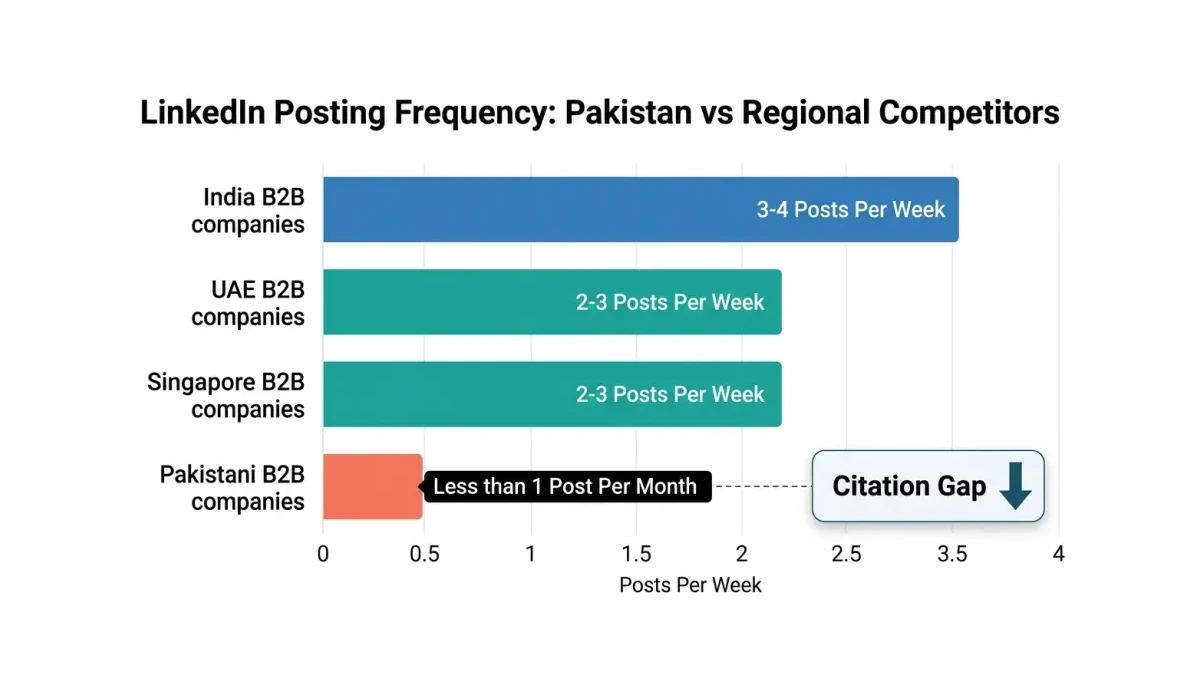
The regional frequencies in this existing illustration are unverified and should not be used to compare national markets.
WeProms Digital’s LinkedIn content strategy services focus on turning subject-matter expertise into a manageable publishing programme. The scope should connect profile positioning, buyer questions, evidence gathering and editorial review. Agree how results will be assessed before deciding how much content to produce.
Avoid promising that publication will trigger model training or establish permanent citation patterns. This article cannot substantiate a fixed timeline for appearing in generated shortlists. Instead, establish a baseline, publish useful material and revisit a consistent set of relevant questions. Record the sources shown and any changes in how the business is described. Treat each observation as a result to examine, not proof of causation.
Read next: How to Make Pakistani Brands Visible in AI Search — The SIGNAL Method · LinkedIn Lead Generation for Pakistani B2B: LINK Method Setup
If your business is missing from the answers you monitor, investigate its broader public information before attributing the problem solely to LinkedIn. Review website content, profile consistency and supporting evidence together. WeProms Digital can help scope that work through a generative engine optimization strategy. Contact WhatsApp at +92 300 0133399 or hello@weproms.com to discuss a LinkedIn visibility audit.
Frequently Asked Questions
How do I get my Pakistani B2B company to appear in ChatGPT answers?
Start by identifying the questions your customers ask and checking whether your public content answers them accurately. Publish useful explanations from appropriate experts, keep company information consistent and provide evidence for commercial claims. Review the sources shown in relevant answers to understand what is being referenced. LinkedIn can be part of this work, but neither a publishing schedule nor a particular post format guarantees inclusion. Track whether the business is cited, mentioned accurately or recommended; these are different outcomes.
Does my company website help with AI search visibility?
Your website should provide a clear, maintainable account of your services, customer fit and supporting evidence. Do not dismiss it on the basis of an unverified citation-share statistic. When reviewing AI answers, check whether your website appears among the sources and whether the information attributed to your business is correct. Use LinkedIn to explain expertise and guide interested readers towards relevant detail. Make the same service understandable across both channels, with a clear route for a buyer to enquire.
How often should Pakistani B2B teams post on LinkedIn for AI visibility?
Choose a cadence your experts can sustain without weakening accuracy or repeating themselves. There is no verified minimum posting frequency in this article that makes a company eligible for citations. Plan around customer questions and available evidence, then review what the published content contributes. A smaller collection of useful explanations is a better editorial objective than a calendar filled with unsupported claims. Increase output when you have more substantive material and the capacity to review it properly.
What does a LinkedIn AI optimization service cost in Pakistan?
Request a current written quote based on the work required. Relevant scope includes profile management, expert interviews, writing, editorial approval, reporting and any website work included in the engagement. The earlier market range and WeProms starting price could not be verified, so they should not be used for budgeting. Ask what deliverables are included and how success will be assessed. Contact hello@weproms.com or WhatsApp +92 300 0133399 for a proposed scope and pricing.
Does follower count on LinkedIn matter for AI search citations?
Do not use follower count alone to predict whether content will be cited. The earlier claim that it is irrelevant went beyond what could be established here. Review whether the author has relevant experience, whether the content answers the question and whether its claims are supported. Assess audience engagement separately: a useful discussion with potential buyers may matter commercially even when the post does not appear in the AI answers you monitor.
Why does LinkedIn matter alongside Google for B2B vendor recommendations?
Treat LinkedIn, search results and generated answers as places to investigate during your customers’ research process. This article cannot establish that LinkedIn matters more than Google for every B2B purchase. Ask customers where they discovered suppliers, what they checked next and which sources they trusted. Use those findings to decide how LinkedIn publishing should connect with website content and other marketing activity. Avoid replacing a working channel solely because an industry report describes a broader shift.
Can a small Pakistani B2B startup compete with large companies in AI search?
A small team can publish a precise, useful explanation of a problem it understands well. That is a practical opportunity, but it does not establish equal visibility or guarantee recommendations alongside larger competitors. Focus on a defensible specialism, document relevant experience and explain who your service suits. Measure the questions where your company appears and the enquiries that follow. Use competitor observations to improve your information, rather than assuming that company size or reputation has no influence.
Key Takeaways
- Treat LinkedIn as part of a broader visibility strategy, supported by a useful website and credible evidence.
- Check citation research for its sample, questions and methodology before applying it to Pakistani B2B buyers.
- Give subject-matter experts a clear editorial role without assuming individual profiles automatically outperform company pages.
- Use relevant names, readable structure and supported claims; avoid invented statistics or formulaic posting targets.
- Compare relevant competitors directly instead of relying on unverified national posting-frequency benchmarks.
- Measure citations, accurate mentions, recommendations and qualified enquiries separately, without promising a fixed timeline.
About WeProms Digital
WeProms Digital works with Pakistani B2B companies, SaaS firms and professional services teams on content and search visibility. Its work includes helping businesses explain their services and turn internal expertise into useful public content.
The team specialises in generative engine optimization and LinkedIn content strategy. An engagement should define the content scope, expert involvement and reporting process, with expectations grounded in observed results rather than guaranteed AI citations.
Get in touch: hello@weproms.com · WhatsApp +92 300 0133399
Sources & References
These references are retained for further reading. The numerical claims discussed above could not be independently verified during the source check; their inclusion here does not validate the original article’s percentages or conclusions.
- Meltwater — LinkedIn Is the #2 Most-Cited Source in AI Answers, New Report Finds
- G2 — The Answer Economy Report
- 6sense — 2025 Buyer Experience Report
- Nobori — 85% of AI Visibility Does Not Come from Your Website
- Signal Inc. — The B2B Guide to AI Visibility
- Search Engine Journal — Condé Nast CEO: Plan As If Search Traffic Will Be Zero
- Search Engine Journal — How to Build Local Pages That Win in AI-Powered Search
- Search Engine Journal — The 90-Day AI Search Sprint: How to Rebuild Your Marketing for 2026 Visibility
Additional reading from industry feeds: