

TL;DR: AI makes common information easier to reproduce, increasing the value of first-hand observations and useful judgement. Research suggests AI Overviews can reduce organic clicks, but international benchmarks do not establish the effect on Pakistani businesses. The practical response is experience-first content: document what your team tested, explain what happened, and help readers make better decisions. WeProms Digital’s content strategy services build around that evidence rather than publishing volume alone.
Publishing more content with AI writing tools can feel like progress. For Pakistani marketing teams, the harder question is whether those pages give customers a reason to read, trust or contact the business.
Consider familiar scenarios: a SaaS company fills its blog with automated explainers, a Karachi ecommerce store generates product descriptions, or an Islamabad consultancy automates its LinkedIn calendar. These are illustrative examples, not documented client results. The output may be grammatically clean yet offer little beyond what competing businesses already publish.
The problem is not the tool. It is the lack of an editorial contribution. Similar prompts can produce similar recommendations, especially when nobody supplies original evidence or challenges the draft. Adding Daraz or JazzCash references does not automatically make an article useful to a Pakistani buyer.
Search Engine Journal’s reporting describes Google’s Martin Splitt discussing why experience and opinions matter when chatbots can repackage basic information. That is a useful editorial principle, not a promise that personal anecdotes automatically earn rankings.
Why Does Generic AI Content Fail to Rank in Pakistani Search Results?
Generic content can struggle because it gives readers little reason to choose it over existing answers. Someone searching for ways to reduce cart abandonment in Pakistan needs practical guidance: which checkout problems to investigate, what evidence to collect, and which changes suit their customers. Repeating familiar advice leaves those decisions unresolved.
Google’s AI answers are not simply summaries of a fixed set of top-ranking pages. Its guidance for generative AI search describes retrieving relevant indexed content and using related queries to find supporting information. Clear, useful content remains important, but originality alone does not guarantee inclusion.
Conductor’s benchmark report found AI Overviews on 25.11% of the US queries it analysed during September–October 2025. That is a historical sample, not a current global prevalence rate. A separate field experiment reported by Search Engine Journal found 38% fewer organic clicks on queries displaying AI Overviews among US desktop Chrome participants. The reported paper was a non-peer-reviewed draft; its findings do not establish an equivalent loss in Pakistan.
For a Pakistani business, these findings justify investigation rather than panic. Review which pages attract relevant enquiries, which merely repeat public information, and which need better evidence. Generic content can still answer a customer’s question; the issue is whether it earns its place in your content budget.
What Does Google Actually Mean by “Human Experience” in Content?
Experience adds context that a specification or definition cannot supply. An explanation of conversion rate optimisation describes the discipline. A documented account of a Lahore bridal wear boutique testing checkout language explains the practical decisions, customer reactions and limitations behind a particular change.
“I think we have to increase the level of our content to be useful and interesting for humans, from humans to humans.” — Martin Splitt, quoted by Search Engine Journal
Google’s people-first content guidance asks whether content demonstrates first-hand expertise and offers original information or analysis. It also explains that E-E-A-T is not a specific ranking factor. An author biography can provide useful context, but it cannot substitute for accurate, well-supported content.
Think of bargaining at Liberty Market in Lahore. A shopkeeper who explains that a fabric may lose colour in the first wash gives you information that could prevent a disappointing purchase. Reading the product label aloud offers less help. The distinction is the value of the advice, not a guaranteed search-ranking advantage.
AI can summarise a published account of that experience. It cannot establish that an unrecorded event happened. Your editorial advantage comes from gathering reliable evidence, interpreting it honestly and keeping the account useful after publication.
How Can Pakistani Businesses Inject Real Experience Into Their Content?
Start with material your team already encounters: customer questions, campaign decisions, checkout problems, support conversations, product returns and implementation notes. These become useful content when you explain the circumstances, show the evidence and identify what another business could reasonably learn.
For example, an ecommerce brand might compare JazzCash and Easypaisa checkout journeys. The publishable insight would include what was tested, how failures were identified and whether customer groups behaved differently. A statement that a payment method “converts better” is incomplete without context about the store, traffic and measurement.
Likewise, a Lahore agency comparing advertising costs across neighbourhoods should explain differences in audiences, creative, objectives and competition. A restaurant campaign and a clinic campaign cannot establish a neighbourhood effect on their own. Specificity makes a claim easier to inspect; it does not automatically make the conclusion valid.
An illustrative account might read: “We moved enquiries to WhatsApp after customer interviews revealed confusion at checkout. We then compared completed orders and support workload.” Publish that only if it happened, and add verified results where available. Do not invent a national preference statistic to explain a client outcome.
Keep the underlying screenshots, exports and interview notes, and agree what can be shared. A first-party data strategy helps turn routine operational records into evidence your editorial team can use responsibly.
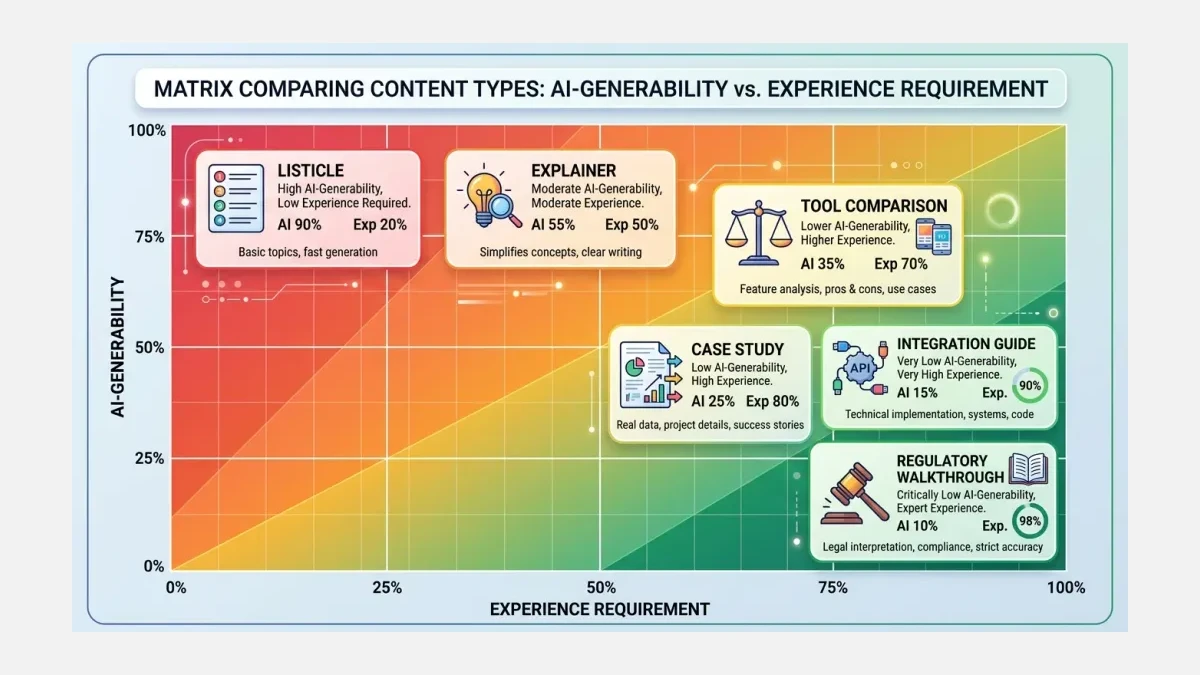
What Types of Content Should Pakistani Businesses Stop Publishing?
Stop approving pages whose only purpose is to restate what already exists. An outline covering social media, SEO and email marketing may be useful for beginners, but the headings alone do not create value. Ask what decision the reader can make after reading your version that competing guides leave unresolved.
Gartner’s widely repeated forecast was a prediction, not evidence of a permanent traffic decline. Its original announcement predicted a 25% decline in traditional search engine volume by 2026. That forecast does not prove the decline occurred, or describe the outcome for Pakistani informational queries.
| Content Type | AI Can Generate | AI Overviews Replace | Experience Required |
|---|---|---|---|
| “What is SEO” explainer | A basic draft | May answer the basic question | Helpful for examples |
| Tool comparison with PKR pricing | A draft requiring checks | May summarise comparisons | Hands-on testing adds value |
| Campaign case study with results | A draft from supplied evidence | May summarise published results | Essential for authentic evidence |
| Marketing tips listicle | A generic draft | May answer similar questions | Needed for distinctive advice |
| Platform integration guide (SBP Raast) | A draft requiring technical review | May summarise published guidance | Valuable for tested implementation details |
| Regulatory compliance walkthrough | A draft requiring expert review | May summarise available guidance | Expertise and current sources essential |
These are editorial distinctions, not guarantees about search appearance. AI can draft or summarise each format, including case studies and compliance guidance. The question is whether the underlying claims are true and useful.
Review dictionary-style posts, untested tool round-ups and unsupported how-to guides. Improve, consolidate or retire them according to their usefulness and performance. Do not remove a helpful customer resource simply because its format looks easy to automate.
What Should Pakistani Businesses Publish Instead?
Publish resources built around questions your team can answer with evidence. Useful formats include campaign analyses with verified PKR costs, tool reviews based on actual use, implementation walkthroughs and explanations of decisions that did not work as expected. Readers need the trade-offs as well as the outcome.
Consider a SaaS company documenting a Raast-related billing integration. A credible account would identify its integration route and provider, explain the errors encountered, distinguish provider requirements from regulatory requirements, and report outcomes from actual records. Approval timelines and transaction improvements should come from that project’s evidence, not an illustrative success story presented as fact.
A strong case study also explains what changed alongside the intervention. If pricing, traffic sources and checkout design changed together, avoid attributing the entire result to payment integration. That restraint makes the account more useful to another team deciding what to test.
Industry discussion about AI tools, including Digiday’s coverage of Meta’s advertising ecosystem, can prompt useful questions. It should not replace evidence about your own content or customers.
Choose topics where access to your people and records improves the answer. A focused case study writing process can turn those materials into a readable account with a clear problem, decision, outcome and limitation.
Where Does AI Fit in an Experience-First Content Strategy?
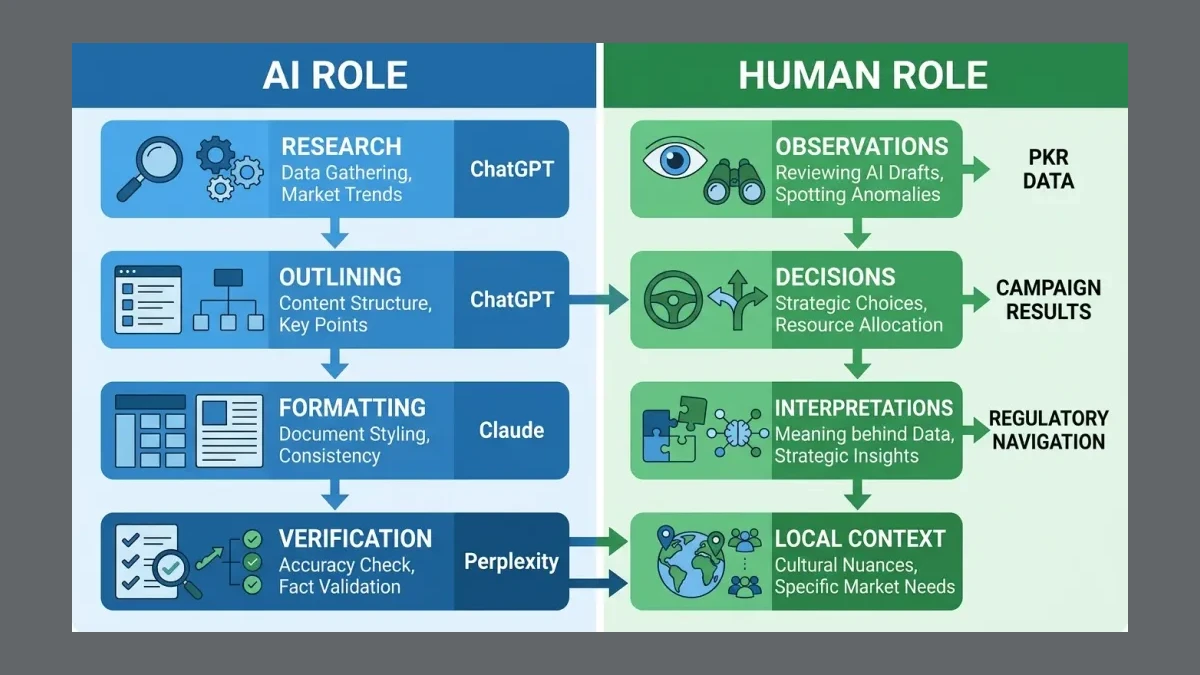
AI tools can help with research, outlining, drafting and formatting. Give them source material: an approved interview transcript, a campaign report or implementation notes. Ask for a structure or summary, then check the output against the original material. A fluent draft still needs someone accountable for its claims.
Google’s guidance on generative AI content recognises its usefulness for research and structure. It also warns that generating many pages without adding value may violate its scaled content abuse policy. The editorial test is usefulness and reliability, not whether a tool touched the document.
Assign a subject expert to check interpretations and an editor to check evidence, language and reader value. Research tools can help locate sources, but the reviewer should open the source and confirm that it supports the precise claim being published.
Make this division of work part of your editorial quality assurance. It is easier to maintain quality when verification happens during production, rather than after a customer challenges an unsupported statement.
How Do You Measure Whether Your Content Has Enough Experience Signals?
Ask whether a competitor could produce essentially the same page without access to your team or records. If so, look for missing decisions, observations and explanations. This is an editorial prompt, not a numerical test of ranking potential.
You can use unique assertion density as an internal review concept: identify statements grounded in your own evidence and ask whether they materially help the reader. There is no verified threshold that guarantees rankings or AI citations. A short, well-supported observation can be more valuable than a page crowded with personal anecdotes.
For each important assertion, record its source, scope and limitations. Can the author explain where it came from? Does a screenshot or report support it? Is a customer quotation approved? Does the conclusion go beyond what the evidence shows?
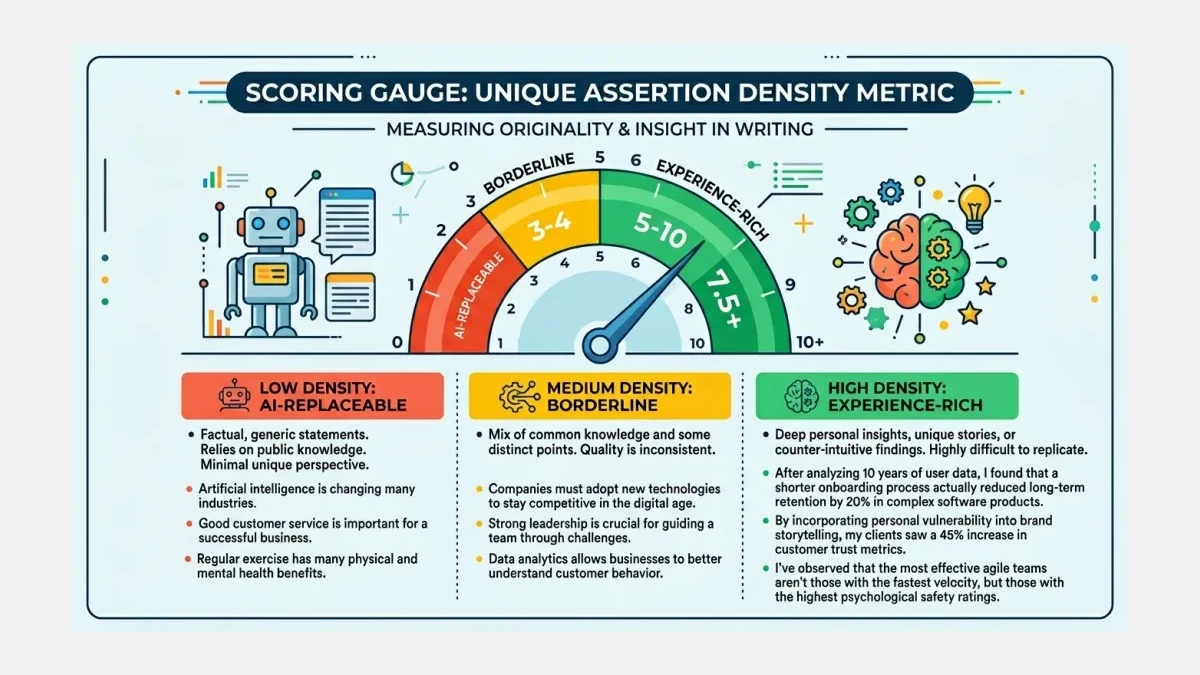
Treat the scoring illustration as an editorial aid, not a Google scoring system. Evaluate the resulting pages through relevant enquiries, engagement and search performance, alongside qualitative feedback from customers and sales teams. More unique statements do not necessarily mean more useful content.
Read next: AI Content Quality for Pakistan Business Blogs · The CITE Framework for Google AI Citations in Pakistan
WeProms Digital helps Pakistani businesses turn campaign records, customer knowledge and operational lessons into content. If your team has useful experience but struggles to publish it clearly, contact hello@weproms.com or message WhatsApp at +92 300 0133399 to discuss the work.
Frequently Asked Questions
Does Google penalise AI-generated content?
AI involvement alone is not the issue. Google’s guidance focuses on accuracy, relevance and value, and warns against scaled content created without added value for users. An AI-assisted article still needs appropriate review. Original evidence helps, but neither human authorship nor a personal anecdote excuses misleading claims or poor advice.
How is experience-based content different from E-E-A-T?
E-E-A-T means Experience, Expertise, Authoritativeness and Trustworthiness. Google uses these concepts in its quality guidance; E-E-A-T itself is not a specific ranking factor. Experience-based content supplies evidence of what an author actually did or observed. It supports trust when the account is accurate, relevant and clear about its limits.
What if my Pakistani business does not have original data to share?
Begin with customer questions, support notes and conversations with the people delivering your service. Document how they diagnose problems and choose solutions. Publish useful qualitative insights where quantitative evidence is unavailable. Build measurement into future work, but do not promise a dataset or persuasive case study after a fixed documentation period.
How do AI Overviews affect Pakistani blog traffic specifically?
The cited US research suggests a risk to organic clicks when AI Overviews appear, but it does not quantify Pakistani blog traffic losses. Review your own search performance, relevant query results and lead generation. Separate changes in demand, rankings and conversion from assumptions about AI Overviews before deciding which pages to revise.
Should Pakistani businesses stop using AI writing tools entirely?
No. Use them where they help your team research, organise and communicate reliably. Decide the workflow according to the material and the risk of errors, rather than assigning a fixed share of production to automation. The responsible author or reviewer should understand and stand behind the published claims.
What does experience-first content strategy cost for Pakistani businesses?
Pricing depends on research access, interviews, technical complexity, production scope and channels. Request a scoped proposal from WeProms Digital or another provider rather than relying on an unsupported market-wide price range. Compare what the fee includes: evidence collection, subject review, writing, revisions and measurement. Low production costs are not useful if the resulting content cannot support business goals.
How long does it take for experience-based content to rank?
There is no reliable universal timetable. Discovery, indexing, competition, site quality and relevance all affect performance. Agree review points and monitor progress without promising rankings within a fixed period. Specific content may answer an underserved question, but that does not guarantee demand, visibility or citations. Its usefulness to existing customers can still justify publishing it.
Key Takeaways
- Google’s guidance supports useful, original content, and Martin Splitt has discussed the value of human experience. Neither establishes an automatic ranking advantage for anecdotes.
- AI Overview benchmarks need geographic, device and sampling context. The cited studies do not measure Pakistani businesses’ traffic losses.
- Use unique assertions as an editorial review aid, with evidence behind each claim. Avoid treating a density target as a search ranking formula.
- Publish tested workflows, honest campaign analyses and reviews that explain practical decisions. Identify illustrative scenarios and distinguish observations from causal conclusions.
- Use AI to support production, with human review of evidence and interpretation. Measure reader and business outcomes instead of assuming more publishing creates more value.
About WeProms Digital
WeProms Digital works with Pakistani SMEs, ecommerce brands and B2B teams on content strategy, SEO content and conversion-focused copywriting. Its focus is helping businesses communicate what they know in ways prospective customers can understand and use.
Experience-first content starts with access to the people doing the work. Campaign records, customer conversations and operational knowledge give the editorial process something substantive to communicate. Search visibility remains a goal, but rankings and AI citations cannot be promised for individual pages.
Get in touch: hello@weproms.com · WhatsApp +92 300 0133399
Sources & References
- Search Engine Journal — Google: AI Makes Human Experience More Important For Content
- Search Engine Journal — AI Overviews Cut Organic Clicks 38%, Field Study Finds
- Conductor — AEO / GEO Benchmarks Report
- Google Search Central — Creating Helpful, Reliable, People-First Content
- Google Search Central — Guidance on Generative AI Content
- Google Search Central — Optimising for Generative AI Features
- Gartner — Search Engine Volume Forecast
Additional reading from industry feeds:
- Omnibound — AI Search Statistics
- WordStream — Google AI Overviews Statistics
- BriefGlance — Beyond Google: Agencies Pivot to AI
- Digital Applied — AI Search Engine Statistics
- Search Engine Journal — Google Says a New Wave of AI Users Is Transforming Search
- HubSpot — Product SEO: 8 Strategies That Drive Demand for B2B & SaaS
- MarTech Series — Kaltura Open-Sources Suite of AI Agent Skills