TL;DR: If essential product information appears only after JavaScript runs, check whether search crawlers can retrieve it. A technical SEO audit for AI visibility examines rendering, crawler access, internal links and readable content. These checks help identify barriers to discovery; they cannot guarantee a recommendation in ChatGPT, Perplexity or Claude. WeProms Digital’s technical SEO audit service helps Pakistani businesses investigate those barriers before committing to a rebuild.
A customer in Faisalabad asks an AI assistant for product recommendations, but your store does not appear. Before blaming your keywords, ask a more basic question: can the systems researching that answer retrieve your product information?
A polished page in your browser does not settle that question. Prices, descriptions or stock information may arrive through scripts after the initial page response. Access restrictions may also affect automated visitors differently from customers. Meanwhile, a slow mobile experience can make the eventual visit frustrating even when discovery works.
For Pakistani ecommerce businesses, the practical starting point is evidence from representative pages. Compare what customers see with what the server delivers, review access controls and investigate discovery separately from recommendations. Do not assume that one missing AI mention proves a technical fault.
Why Do Long AI Search Queries Matter for Pakistani Websites?
Fan-out queries are related searches an AI system may use while researching a broader question. A shopping request could involve separate searches about specifications, delivery, compatibility and alternatives. That makes detailed questions worth considering alongside familiar commercial keywords.
The JetOctopus article published by Search Engine Journal discusses technical auditing for this search environment. Its observations should not be presented as a measured growth rate for Pakistani websites without supporting local evidence.
Long queries in Google Search Console can help you understand how your pages appear in search. However, query length alone does not establish that an AI agent generated a search. An impression without a click does not tell you who searched, whether an assistant read the page or why the visitor did not continue.
Start by reviewing longer queries with meaningful impressions and few clicks over a consistent reporting period. Group them by intent: product suitability, price, availability, delivery or troubleshooting. Check whether the relevant landing page answers the question clearly. Use this list to guide investigation, rather than labelling it a record of AI activity.
Where possible, compare those patterns with referral traffic, server logs and observed citations. Keep the conclusions separate: a search impression, a crawler request and a recommendation each answer a different question.
Which Three AI Bot Categories Might Visit Pakistani Websites?
Not all automated visits serve the same purpose. A useful audit separates training, search discovery and user-requested retrieval, while checking each provider’s current documentation before making access decisions.
| Bot Type | Purpose to Investigate | What to Check | What a Visit Establishes |
|---|---|---|---|
| Training bots | Collection associated with model development | Provider identity, access policy and requested URLs | A recorded request, not proof of a recommendation |
| AI search bots | Discovery or retrieval for search features | Reachable links, response content and access rules | Possible search access, not guaranteed inclusion |
| AI user bots | Retrieval associated with a user’s request | Requested URL, response status and delivered content | A retrieval attempt, not proof your brand appeared |
Use these categories as an investigation framework, not a promise about how every provider operates. Confirm the identity of relevant bots before drawing conclusions from their names in logs. Also record whether a request succeeded and what content the server returned.
Heavy automated crawling can coexist with few observable mentions. Avoid interpreting crawl volume as a visibility score or assuming that search crawlers visit every page on a fixed schedule.
For stores with extensive catalogues, prioritise commercially important pages. Check whether customers and crawlers have clear routes to them through categories and relevant links. Deep navigation and JavaScript dependencies are reasons to investigate, not sufficient evidence that every affected page is invisible.
How Can JavaScript Rendering Affect Pakistani Ecommerce Pages’ AI Visibility?
If product names, prices and availability appear only after client-side scripts run, the initial HTML may omit information needed to understand the offer. Test that dependency instead of assuming that every AI retrieval system handles JavaScript identically.
Consider a Karachi store whose product page looks complete in a browser. The theme may deliver the main product information immediately, while an app adds delivery estimates or stock details later. The audit needs to identify which information is missing from the initial response. A platform name alone does not diagnose the problem.
Think of your website like a NADRA office. A visitor asks the clerk for a document. The clerk might hand it over immediately, or require another process before releasing it. The technical question is whether the automated visitor can complete that process. Server-side rendering (SSR) is an approach to providing rendered HTML from the server; assess whether it is needed for the affected content.
Disable JavaScript and reload a representative product page. Note which facts disappear. Then inspect the original HTML response and compare it with the rendered page. Treat the browser test as an initial warning, not a definitive simulation of ChatGPT, Claude, Perplexity or Gemini.
Our JavaScript SEO audit guide provides a focused route into this investigation. Keep rendering diagnosis separate from analytics troubleshooting: missing content and missing tracking events need their own evidence and fixes.
What Are “Phantom Impressions” and Why Should Pakistani Businesses Examine Them?
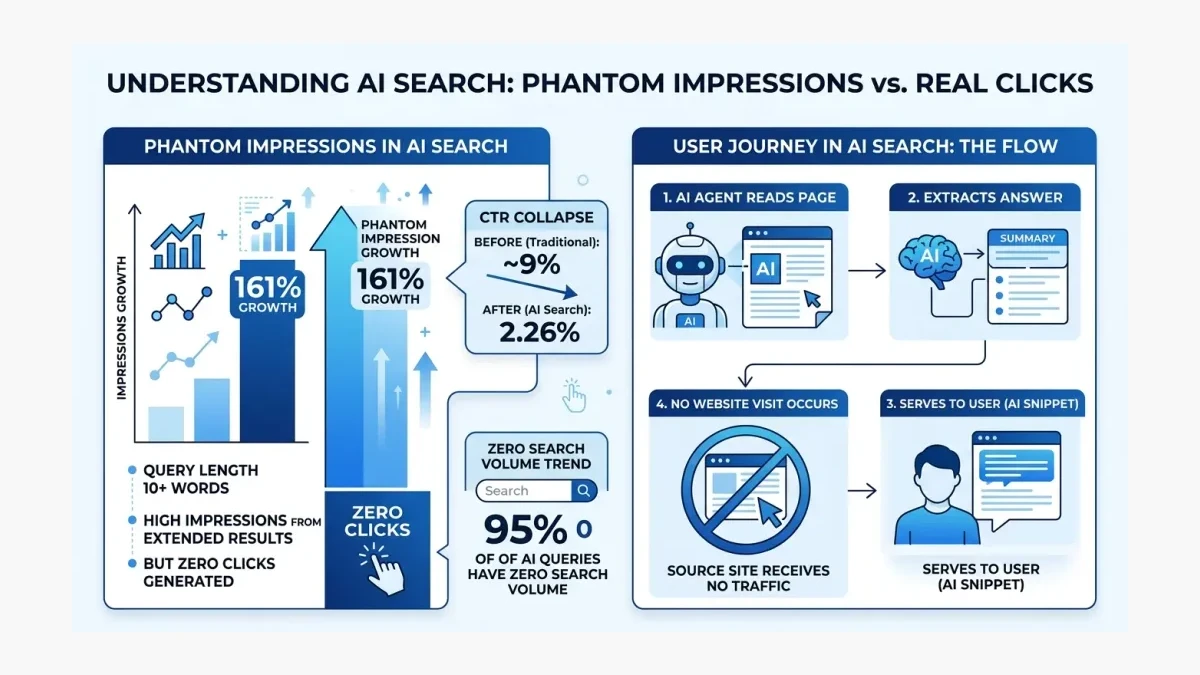
“Phantom impressions” is an informal label used here for impressions that produce no clicks. It should not be treated as a Search Console diagnosis or proof that an AI assistant extracted your answer.
A query can receive impressions without visits for several reasons. Investigate the search result, the page’s relevance and the user’s likely intent before attributing the pattern to AI. Likewise, an absent search-volume estimate does not establish that a query came from an agent.
For Pakistani businesses, the useful exercise is to compare question themes with page content. If queries concern delivery to Lahore, replacement parts or product compatibility, does the landing page answer those questions? If it does, are the answers visible, specific and consistent with the offer?
You can organise this work into a Fan-Out Opportunity Matrix: question theme, relevant page, missing information and proposed action. The matrix is a planning tool, not a method for identifying individual AI searches.
Clear answers are worth testing even when the source of a query is uncertain. Record the change and monitor outcomes without promising that better structure will turn every impression into a referral.
How Can You Audit Your Pakistani Website for AI Search Visibility This Weekend?
Begin with two practical checks using your browser. They provide a starting point for investigation, not a complete visibility assessment.
Test 1: The JavaScript Check. Disable JavaScript using your browser’s site settings, then reload your homepage and representative product or service pages. Check names, descriptions, prices and availability. Record what disappears, and compare the result with the initial HTML response. Browser menu labels vary, so use the settings appropriate to your browser.
Test 2: The Answer-First Check. Open an important landing page. Can a visitor quickly establish what you offer, the relevant price or quotation process, and availability? Check whether these facts are clear and consistent. Do not assume that an assistant reads only the first screenful or stops at a carousel.
Passing both checks does not rule out other problems. Access rules, page discovery, indexing and the usefulness of the information still need attention. Failing a check identifies a specific issue to investigate; it does not automatically justify replacing your website.
| Test | What to Check | Useful Outcome |
|---|---|---|
| JavaScript Check | Disable scripts and compare HTML with the rendered page | Essential facts identified in the server response |
| Answer-First Check | Review the opening content and supporting details | Visitors can quickly understand the offer |
| Click Depth Check | Follow navigation to important product pages | Clear, relevant internal routes to priority pages |
| robots.txt Check | Review intended AI crawler permissions | Rules match the business’s access decisions |
Take screenshots and save representative responses before changes begin. This gives the developer a reproducible example and lets you compare the same pages afterwards. Include both a typical page and one with a known problem.
What Technical Changes Should Pakistani Sites Prioritise for AI Visibility?
Prioritise changes according to the failures you find, the commercial importance of affected pages and the effort required. There is no universal engineering order that suits every store.
First, address essential content missing from the initial HTML. Ask your developer whether the existing theme, template or application can deliver it directly. Evaluate server-side rendering (SSR) where appropriate, but do not assume that a Shopify store needs a new theme or a headless rebuild simply because scripts are present. Confirm the affected component before choosing the solution.
Second, improve internal linking to important pages. Give customers clear routes from relevant categories, buying guides and related products. Avoid imposing a universal click-depth threshold or forecasting a crawler’s visit schedule. The practical objective is to remove unnecessary navigation barriers and orphaned pages.
Third, review robots.txt alongside server and security controls. Check the intended treatment of OAI-SearchBot, PerplexityBot, Perplexity-User, Claude-SearchBot and Claude-User against current provider guidance. Treat these as identifiers to investigate, not interchangeable policies. Our AI crawler access and bot governance service helps organise that review around explicit business decisions.
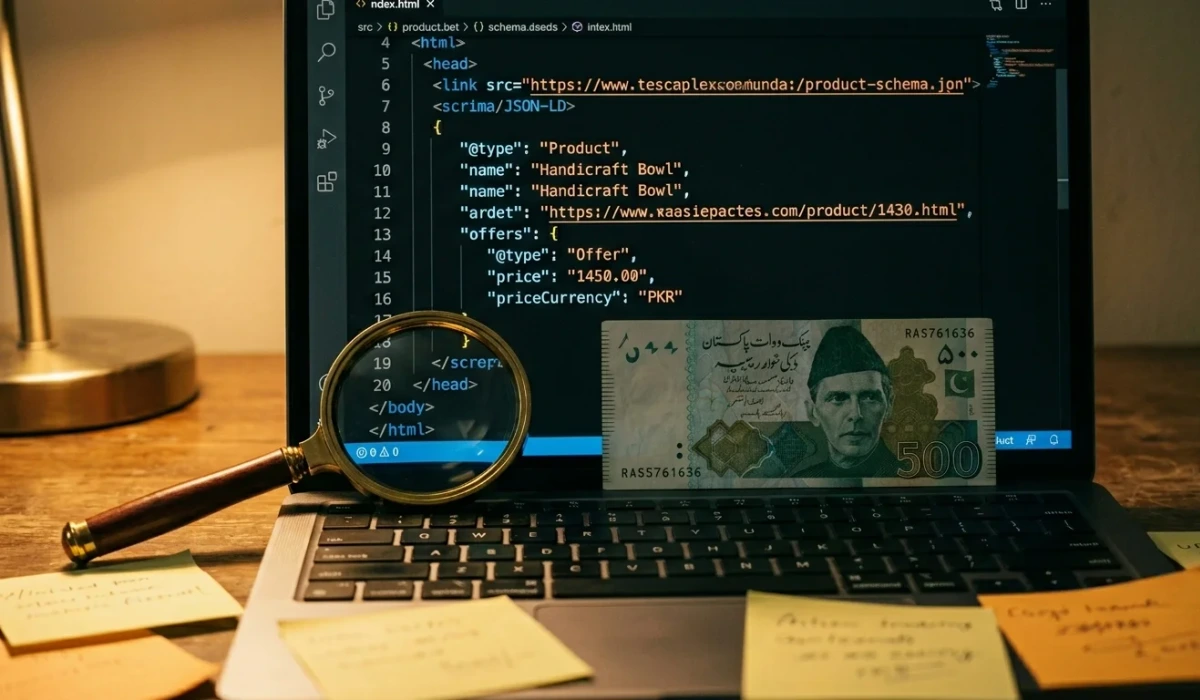
Fourth, improve extractability: use descriptive headings, concise explanations and consistent product facts. Make pricing conditions and availability understandable rather than burying qualifications in unrelated copy. Review structured data against the visible content, and avoid treating markup as a guarantee of citation.
After implementation, repeat the original checks. Confirm what changed in the response, access behaviour or navigation before interpreting subsequent traffic movements.
How Should Pakistani Ecommerce Businesses Evaluate AI-Referred Traffic?
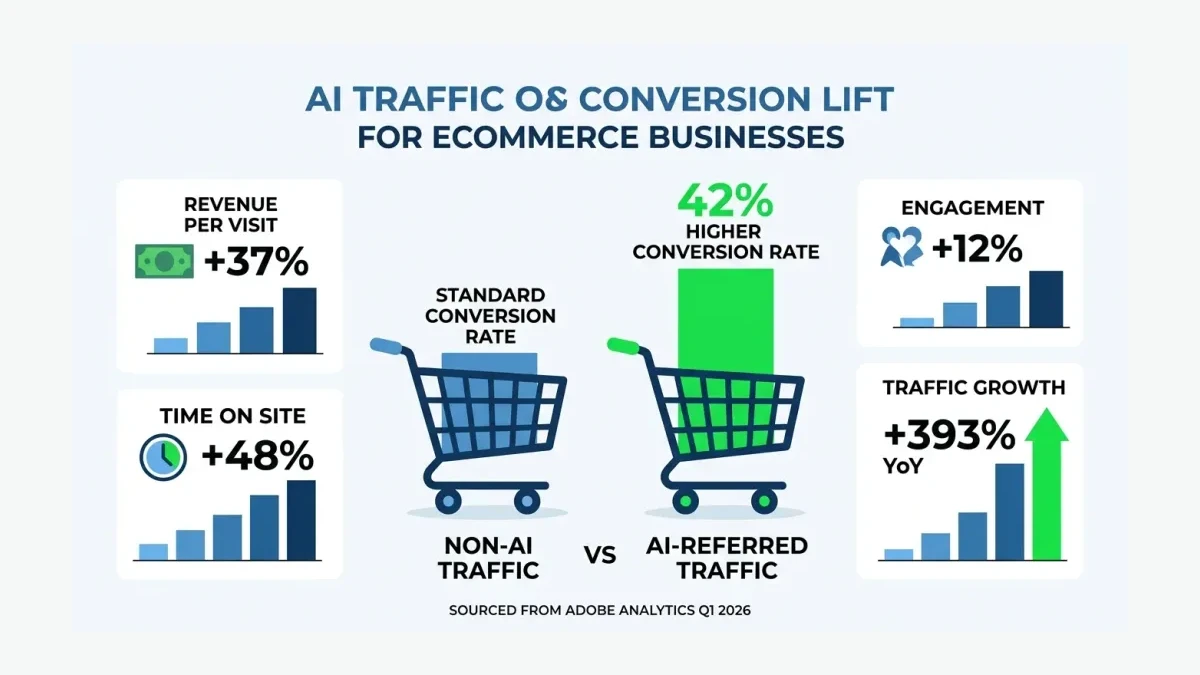
Reports of strong AI referral performance can make this channel attractive. However, a conversion uplift measured on US retail websites should not be presented as an expected result for Pakistani ecommerce businesses.
The existing analysis of Adobe’s AI traffic report is background reading, not evidence of a guaranteed local return. Before using any headline figure in a forecast, check the original measurement period, market, comparison group and definition of a conversion.
A visitor arriving from an assistant may already have compared options and narrowed a shortlist. Others may still be researching. Your own data should determine how valuable those visits are for your business.
Review identifiable AI referrals alongside purchases, qualified enquiries and revenue. Use consistent attribution rules and check whether the sample is substantial enough to support a conclusion. Compare similar landing pages and customer intents where possible; a handful of orders can give a misleading impression of performance.
For a Pakistani store, the business case should connect an observed technical barrier to commercially useful pages. Avoid projecting revenue from an assumed share of AI traffic or an imported conversion uplift. Start with a documented problem, a proportionate fix and measurable outcomes.
Read next: AI search visibility audit for Pakistani businesses · AI search visibility monitoring and citation tracking
If important content depends on JavaScript, investigate what automated visitors actually receive. WeProms Digital offers technical SEO audits covering rendering, crawler access and internal linking. The aim is to identify practical barriers and prioritise fixes, with recommendations tied to the pages and problems found. Contact hello@weproms.com or WhatsApp +92 300 0133399 to discuss your website.
Frequently Asked Questions
How do I know if ChatGPT can read my Pakistani website?
Start by comparing the initial HTML with the rendered version of important pages. Disabling JavaScript can reveal dependencies, but it does not reproduce every retrieval system’s behaviour. Review crawler access and relevant server responses as well. Keep access, retrieval and citation separate: demonstrating that a page is reachable does not establish that ChatGPT will recommend it.
What is the difference between AI training bots and AI user bots?
The distinction concerns the purpose of collection: model development versus retrieval associated with a user request. Search discovery is another useful category to examine. Check each provider’s documentation for the particular agent involved. Do not interpret a training visit as a recommendation, or a user-agent request as proof that your brand appeared in an answer.
Does robots.txt affect AI search visibility?
Include robots.txt in the audit, but do not assume that every provider or request type follows the same rules. Check the current documentation for the specific agent and distinguish search access from training preferences. Also investigate blocked or challenged requests at the server or security layer. A permissive robots.txt file alone is not evidence that retrieval succeeds.
How much does a technical SEO audit for AI visibility cost in Pakistan?
Request a scoped quotation based on your website’s size, templates, rendering behaviour and available diagnostic data. Ask whether the work includes server log analysis, access checks, implementation guidance and validation after fixes. WeProms Digital can provide a quotation through the contact details above. Assess the proposal by its deliverables; do not assume that an audit will repay its cost through a particular conversion uplift.
Will fixing JavaScript rendering improve my Google rankings too?
It may resolve a discoverability or content-access problem, but do not promise a ranking increase from a rendering change alone. Diagnose the actual issue and measure the result. Review mobile usability and performance alongside crawlability rather than treating them as interchangeable. A change should be judged on whether it solves the documented problem without introducing regressions elsewhere.
Key Takeaways
- Long search queries can reveal useful questions, but their length and lack of clicks do not prove AI activity.
- Check whether essential product information is present in the initial HTML. Diagnose missing content before recommending an architectural change.
- Evaluate AI referral performance using your own conversions and enquiries. Overseas retail findings are not a guaranteed benchmark for Pakistan.
- Distinguish training, search and user-requested retrieval when reviewing bots. A visit does not establish that your brand was recommended.
- Use the JavaScript and answer-first checks as starting points, then investigate access, navigation and outcomes before declaring the site visible or invisible.
About WeProms Digital
WeProms Digital provides technical SEO and AI search visibility services for Pakistani SMEs, ecommerce brands and B2B teams, including businesses in Lahore, Karachi, Islamabad, Rawalpindi, Faisalabad and Multan.
The team’s audit focus includes crawler accessibility, JavaScript rendering, internal linking and the clarity of product and service information. Recommendations should connect identified technical problems with practical implementation priorities and follow-up checks.
Get in touch: hello@weproms.com · WhatsApp +92 300 0133399
Sources & References
The links below retain the article’s background reading. Quantitative conclusions should be checked against their original datasets before being used in a business forecast.
- Search Engine Journal — How To Run a Technical SEO Audit for AI Search Visibility
- nohacks.co — Lessons Learned From Adobe’s AI Traffic Report
- Technology Checker — Mobile Internet Usage by Country
- MarTech Series — LinkedIn Citations in AI Answers
- Search Engine Journal — Scaling AI Content Without Penalty
- KPMG Pakistan — Banking Perspective
- Martech Zone — Before a Human Ever Sees Your Brand, AI Already Has an Opinion