
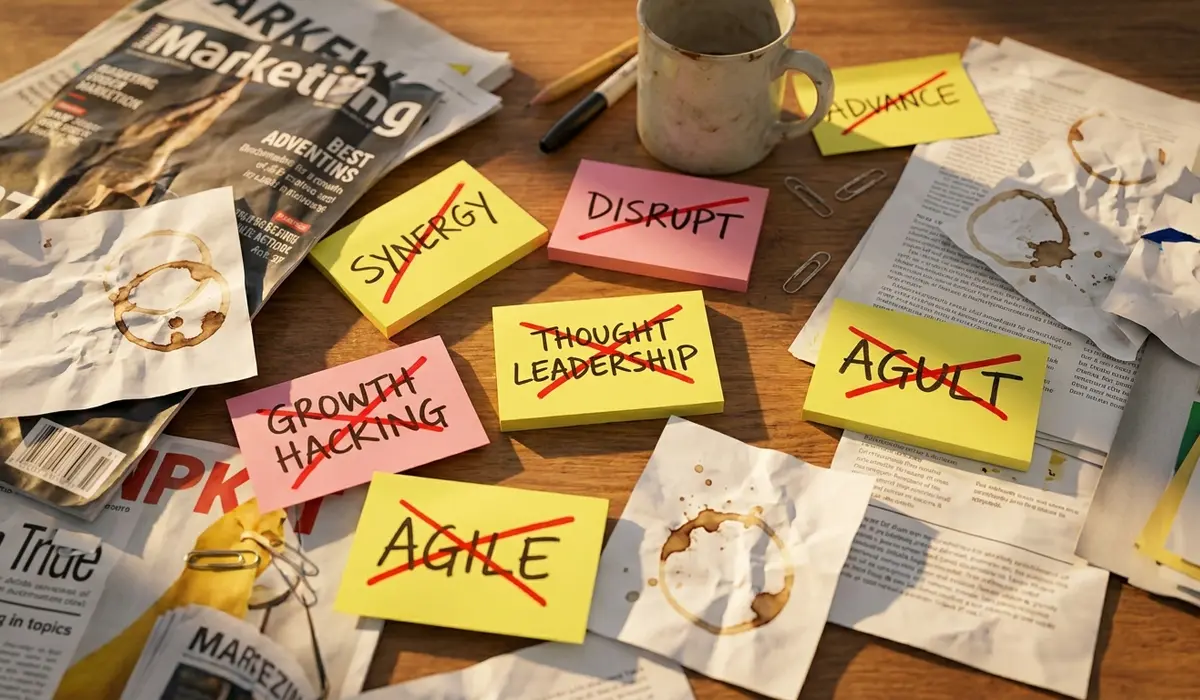
TL;DR: AI terminology can make a marketing proposal sound more capable than it is. For Pakistani businesses, the useful questions concern the workflow, its full cost and the evidence that it improves results. Research about promoting AI products does not establish how many Pakistani marketers use AI or doubt its value. WeProms Digital helps businesses connect AI adoption with measurable marketing outcomes.
An AI subscription is easy to approve. Explaining what it earned is harder. A team can publish more copy, generate more images and produce faster reports without knowing whether customers are more likely to buy.
That is where buzzwords become expensive. They encourage businesses to purchase a capability before defining the problem it should solve. For Pakistani marketers evaluating tools or agencies, the practical distinction is between a convincing AI pitch and a workflow with an owner, a baseline and a measurable purpose.
What AI buzzwords dominate Pakistani marketing conversations in 2026?
Generative AI describes systems that create text, images or code. It identifies a broad capability, but tells a business owner little about the quality of the work, the review process or its commercial value. An agency saying it uses generative AI has started an explanation, not completed one.
Other labels worth unpacking include hyper-personalisation, AI Overviews, agentic AI and predictive analytics. These terms describe different activities: a search feature is not a customer segmentation method, and a content generator is not necessarily an autonomous agent. Treating them as interchangeable makes proposals harder to compare.
MarketingProfs reported on research analysing LinkedIn posts from 75 SEO experts. It found that AIO and GEO were the most commonly used AI-related SEO terms in that sample. The research examined terminology and sentiment; it did not measure Pakistani adoption or establish that particular words predict implementation depth.
A vendor demonstration is more useful than a terminology count. Ask the supplier to show the input, the action taken, the output and the review step. If the demonstration consists of a scheduled email or a fixed routing rule, ask what the AI contributes beyond that existing automation.
| Buzzword | What the label leaves unclear | Evidence to request |
|---|---|---|
| “AI-powered marketing” | Which part of the work uses AI | A working demonstration with defined inputs and outputs |
| “Hyper-personalisation” | Which customer signals change the experience | Examples of relevant messages and the data behind them |
| “Agentic AI” | What actions the system can take independently | Permissions, approval points and an activity log |
| “Predictive analytics” | What is predicted and how reliably | Validation against observed outcomes and a simple baseline |
| “AI-first content” | Whether faster production improves results | Reviewed content and an agreed performance test |
The underlying mechanic is clear. A label describes a promise. A demonstrated workflow shows what the supplier can actually deliver. Keep that distinction visible throughout the buying process, especially when competing proposals use the same language.
Why do marketers doubt AI works as marketed?
Storyarb’s report concerns marketing AI products and features, which is different from assessing whether AI tools improve marketing work. Its survey covered 84 marketing leaders and practitioners, with responses collected from October to November 2025. It should not be presented as a representative survey of Pakistani marketing teams.
The report says 43% of respondents faced leadership pressure to talk about AI more in their messaging, while 83% did not feel the same way. That is evidence of disagreement over messaging priorities. It does not mean that those respondents believed AI tools failed to deliver measurable results.
Storyarb’s testing question was: “Have you A/B tested mentioning ‘AI’ in your marketing against not mentioning ‘AI’ in your marketing?”
The report’s 89% headline refers to respondents who had not tested their AI messaging. It does not describe testing AI-generated content against human-written content. Those are separate experiments, and a business may need either or both depending on the claim it wants to assess.
For a Pakistani team, the practical concerns remain familiar. Consider a hypothetical Lahore clothing brand using AI to draft product descriptions. Publishing faster is useful, but without recording editing time, accuracy and sales performance, the team cannot judge the overall benefit. Content volume alone does not answer the investment question.
Leadership pressure can also produce an unclear brief. “Use more AI” gives a marketing manager no basis for choosing between content drafting, customer support or reporting automation. A better brief identifies the bottleneck: slow campaign launches, repetitive reporting or inconsistent product information. The tool decision can follow from that problem.
Finally, activity is easier to report than contribution. An email written with AI may generate sales, but some customers might have bought after receiving the existing email. Comparing suitable alternatives helps the team distinguish campaign revenue from improvement attributable to the changed workflow.
That distinction matters when a supplier claims credit for every sale touched by an AI-assisted process. Ask what the comparison was, what else changed and whether the result includes the cost of review. Without those answers, a confident revenue claim can conceal an unresolved measurement problem.
The illustration below should be read as a prompt to question the gap between claims and capability; its numerical labels are not verified Pakistani benchmarks.

Which AI marketing terms actually signal competence?
No term establishes competence by itself. AEO, agentic AI and hyper-personalisation can describe useful work, but they need the same scrutiny as “AI-powered”. The strongest signal is a clear explanation of what changes, why it should help and how the team will assess the result.
AEO (Answer Engine Optimisation) generally describes efforts to make content useful and discoverable in answer-based search experiences. It is not a guaranteed route to citations or revenue. Google’s guidance on AI search features says existing SEO best practices remain relevant and no special optimisation is required for AI Overviews or AI Mode. Eligibility does not guarantee inclusion.
Ask an AEO supplier to explain the content gaps, technical obstacles and customer questions it intends to address. Then agree how qualified visits, enquiries or sales will be assessed. A screenshot showing a citation may be useful evidence of visibility, but it cannot establish a return on investment by itself.
Agentic AI describes systems that can carry out a sequence of actions towards a goal. A credible marketing proposal should specify the tools the system can access, the decisions requiring approval and what happens when an action fails. Ask to see an activity log and a recovery process, especially where the workflow can change live campaigns.
Hyper-personalisation describes tailoring experiences using customer signals rather than relying only on broad segments. Competence means explaining which data is available, how it changes the message and whether the resulting experience improves outcomes. A first-party data strategy can help define those inputs before a team purchases another personalisation tool.
For a Pakistani retailer, a relevant product recommendation may be more valuable than an elaborate system that lacks dependable purchase records. Start with the customer decision you want to support. Sophistication is useful only when the underlying data and workflow can sustain it.
How much are Pakistani SMEs spending on AI marketing tools?
There is no verified Pakistani SME spending benchmark in the cited material that supports a standard monthly AI marketing budget. The appropriate amount depends on the workflow, usage, team size and existing software. A fixed PKR range can look practical while hiding substantial differences between businesses.
Build the budget from current supplier quotes and your own operating costs. For foreign-currency subscriptions, record the amount actually charged in PKR, including applicable payment charges and taxes. Check renewal terms, usage limits and which features require a different plan before comparing proposals.
| AI tool category | Costs to check | Evidence needed before renewal |
|---|---|---|
| Content generation | Seats, usage limits and editing time | Acceptable output with a demonstrable workflow benefit |
| Image generation | Credits, revision effort and licensing terms | Usable assets that meet the creative brief |
| Marketing automation with AI | Contact tiers, integrations and implementation | Reliable execution and a useful customer outcome |
| AI ad optimisation | Media spend, management and any separate software | Performance assessed against the agreed campaign objective |
| AI analytics and attribution | Data connections, storage and analyst review | Dependable reporting that supports decisions |
Subscription totals are only part of the calculation. Include setup, data preparation, staff training, review and maintenance. A tool that looks inexpensive can become costly if someone spends substantial time fixing its output or moving information between disconnected systems.
Look for overlap as well. If several products draft similar content, name the distinct job each performs. An unused feature does not become valuable because it appears in a bundle. Keep a renewal record showing the owner, intended use, cost and evidence for continuing the subscription.
The cited Digital Applied statistics page has withdrawn unsupported benchmark series and return multiples. Its former figures should not be used to justify a Pakistani spending forecast or claims that local businesses mirror global AI advertising growth.
A useful AI adoption strategy connects spending decisions to a defined problem. Fund a manageable pilot, include measurement in its scope and expand when the evidence supports it. There is no universal budget ratio that removes the need for that judgement.
The spending illustration below contains unverified ranges and adoption rates. Use current quotes and your own usage records for budgeting, rather than treating its labels as market averages.

What separates AI adopters from AI performers in Pakistan?
The useful distinction is measurement discipline. A tool inventory tells you what the team can access. A workflow review tells you whether that access changes the quality, speed or commercial value of its work.
First, establish a baseline before deployment. Record the existing process, its cost and the outcome you want to improve. For email, that might include production time, clicks and completed purchases. For product content, it might include editing effort, errors and conversion performance.
A baseline alone does not prove causation. If sales improve after introducing AI, pricing, promotions or customer demand may also have changed. Where practical, compare equivalent groups or run a controlled test. Record other changes so the team does not attribute every improvement to the new tool.
Second, limit the initial scope. A team can learn more from a well-defined content workflow than from launching unfamiliar tools across every marketing function at once. This AI workflow implementation approach makes responsibilities, review requirements and failure points easier to identify.
Third, budget for evaluation and maintenance alongside the subscription. That might mean analyst time, a reliable reporting process or someone checking output against the brief. The appropriate allocation depends on the task and its consequences; there is no substantiated universal split between tools and testing in the cited research.
Keep a brief decision record after each pilot. State what changed, what the evidence suggests, what remains uncertain and whether to continue, revise or stop. A disappointing trial can still save money if it prevents a wider rollout of an unsuitable process.
Actionable takeaway. Before purchasing another subscription, write down the metric it should improve, the baseline and the condition for continued investment. Include an owner who can explain the result. If these are unclear, the buying decision is ahead of the strategy.
Apply the same test to AI visibility tools. Ask what their reports help you decide and how that decision connects to customer acquisition. A dashboard needs a defined use, just as a content generator does.
Read next: How to track marketing ROI · AI visibility tools that waste Pakistani SME budgets
WeProms Digital helps Pakistani marketing teams define workflows, establish measurement and assess whether implementation is worthwhile. Discuss your current process via WhatsApp at +92 300 0133399 or email hello@weproms.com.
Frequently Asked Questions
Is AI marketing actually useful for Pakistani small businesses?
It can be useful when it solves a specific operational problem and the output meets the required standard. A retailer drafting product descriptions should assess editing time and accuracy alongside sales performance. Faster production may justify a tool even without higher conversion, provided the saving survives the cost of review and maintenance.
Which AI marketing tools should Pakistani businesses avoid?
Be cautious about tools whose promised benefit cannot be translated into a workflow and a measurable outcome. Ask for a trial using your own requirements, check integration effort and examine renewal terms. A bundled platform is not automatically poor value, but you should be able to explain why the features you will actually use justify its cost.
Why do Pakistani marketing agencies overuse AI buzzwords?
AI language can help a proposal appear current, but terminology alone cannot establish why a particular agency uses it. Ask the agency to replace broad claims with a demonstration, named responsibilities and evidence from comparable work. Storyarb’s findings about leadership pressure concern its survey respondents; they should not be treated as a Pakistani agency statistic.
How much should a Pakistani SME budget for AI marketing tools?
Start with the cost of solving the chosen problem, including subscriptions, setup, staff time and review. Compare that with the benefit you can reasonably test. Keep the commitment manageable until the workflow proves useful. An arbitrary share of the marketing budget is less informative than knowing what the purchase should accomplish and when you will reassess it.
What does “AI-first marketing” mean for Pakistani companies?
The phrase usually suggests designing a workflow around AI capabilities from the outset. Its meaning varies between suppliers, so request a concrete process description. For an email workflow, that means specifying available customer data, how messages are selected or drafted, who approves them and how results are checked. The label does not guarantee a better customer experience.
How do I know if my Pakistani marketing team uses AI effectively?
Ask for the baseline, the comparison and the full cost. The team should explain whether AI improved speed, quality or commercial outcomes, and distinguish observed changes from proven causes. Revenue attribution may be appropriate for some workflows; for others, a documented operational saving is the relevant benefit. Uncertainty should be visible in the report.
What is the best AI marketing strategy agency in Pakistan?
Assess agencies against your needs: relevant workflow experience, practical demonstrations, measurement capability and clear ownership after launch. WeProms Digital supports Pakistani businesses with workflow planning and implementation tied to agreed business objectives. Discuss the fit via WhatsApp at +92 300 0133399 or hello@weproms.com, and ask what evidence would justify the proposed investment.
Key Takeaways
-
AI terminology does not establish implementation quality. Ask vendors to demonstrate the workflow, its inputs, approval points and outputs.
-
Storyarb’s findings concern messaging about AI products. They do not establish Pakistani AI tool adoption or dissatisfaction rates.
-
AEO, agentic AI and hyper-personalisation describe possible capabilities, not guaranteed returns. Evaluate the work behind each label.
-
Build an AI budget from current quotes, usage and operating costs. Include implementation, review and maintenance when comparing options.
-
Establish a baseline and use a suitable comparison. A change after deployment does not, by itself, prove that AI caused it.
-
Renew and expand tools when the evidence supports their role. A stopped pilot can be a sound commercial decision.
About WeProms Digital
WeProms Digital is based in Lahore and serves Pakistani SMEs, ecommerce brands and B2B teams across Lahore, Karachi, Islamabad, Rawalpindi, Faisalabad and Multan.
The team specialises in AI workflow implementation and digital marketing strategy, helping businesses define the purpose of a tool, organise its use and measure outcomes against agreed objectives.
Get in touch: hello@weproms.com · WhatsApp +92 300 0133399
Sources & References
- Storyarb — Marketing AI in 2026 — survey about AI product messaging and testing.
- Digital Applied — AI Marketing Statistics: Adoption and Evidence — includes a correction withdrawing unsupported benchmarks.
- MarketingProfs — Which AI-Related Buzzwords Resonate With SEO Experts? — analysis of terminology and sentiment.
- G2 — AI in B2B Marketing — background reading.
- Chad Wyatt — AI Marketing Statistics — background reading.
- Improvado — AI Marketing Automation — background reading.
- Digital Applied — Marketing Budget Allocation Guide — background reading.
- Google Search Central — AI Features and Your Website — official guidance on eligibility and SEO practices.
Additional reading from industry feeds: