

TL;DR: Google AI Mode and AI Overviews may use query fan-out to search related subtopics before developing an answer. Google does not specify a fixed number of sub-queries. For Pakistani businesses, the practical lesson is to cover customers’ connected questions with clear, useful content. Traditional SEO still matters: accessible, indexed pages and reliable information remain the foundation. Self-contained sections help readers understand individual answers, but they do not guarantee AI citations.
A Lahore travel agency wants to rank for “Hunza trip packages.” Its customers may also need information about trip duration, departures from Lahore, seasonal weather, family-friendly hotels and road conditions. Those needs belong in the content plan, whether customers type a short keyword or ask a detailed question.
Imagine AI Mode exploring those angles before answering a traveller. This is an illustration of possible subtopics, not a record of Google’s searches for that phrase. The agency’s package page might answer several questions; a hotel guide or road advisory might address others. The opportunity is to make the agency’s expertise useful across the journey, without assuming that every keyword creates the same set of searches.
What is query fan-out and why does it matter for Pakistani SEO?
Query fan-out is a retrieval technique that breaks a complex prompt into related searches. Google’s guidance on AI features says AI Mode and AI Overviews may issue searches across subtopics and data sources while developing a response. The systems can identify supporting pages beyond those a user might encounter through a single classic search.
For example, a question about running shoes may involve durability, fit, climate and budget. Conductor’s query fan-out guide explains how related searches can gather different perspectives before the system combines the information. The actual searches depend on the request; there is no published universal fan-out count.
For Pakistani businesses, this makes customer needs a useful starting point for keyword research. A broad phrase such as “solar installation Lahore” can conceal questions about suitability, equipment, installation and after-sales support. Your content should address the needs you can answer credibly, rather than mechanically generating pages for every wording variation.
Search Engine Journal’s report on Liz Reid’s comments about keyword fragmentation describes users expressing more detailed needs through AI search. That supports a broader content brief, not the conclusion that conventional keyword targeting has stopped working.
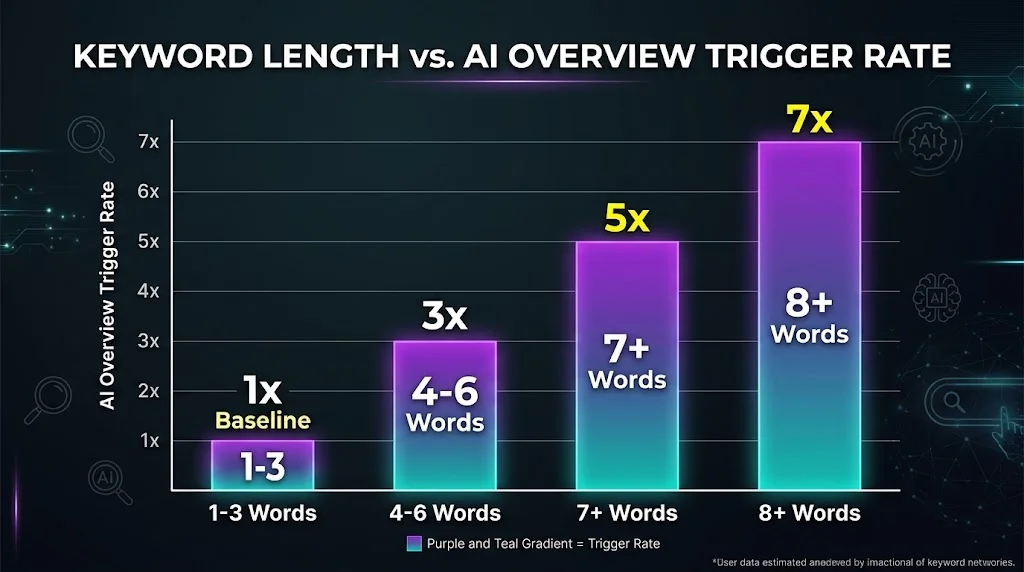
The infographic’s numerical comparisons should not be treated as current Pakistan-specific benchmarks. Keyword length alone does not establish whether an AI Overview will appear.
How does Google AI Mode decompose a single search into multiple answers?
Consider someone comparing SEO agencies in Lahore. Their underlying questions might concern relevant experience, local knowledge, service scope, client evidence and how to assess proposals. AI Mode may explore related topics when preparing an answer. These are useful planning categories, rather than a predictable list of searches that Google must run.
An agency page can therefore help by explaining its work clearly and linking to relevant evidence. A case study should describe the problem, work completed and measured outcome. A service section should explain deliverables and limitations. Repeating “best SEO agency in Lahore” adds little if the visitor cannot judge whether the agency suits their business.
Ziptie’s discussion of content fragmentation describes citations that link to specific text within a page. Such links can direct readers to a supporting passage. However, a text-fragment URL does not reveal Google’s complete retrieval process or prove that page-level quality and links no longer matter.
Editorial takeaway: answer a specific customer need clearly enough that the relevant section remains useful when read on its own.
A practical extraction test is to read a section without the preceding paragraphs. Can a customer identify the subject, understand the answer and see its conditions? If not, add the missing context. Avoid turning every sentence into a repeated keyword simply to make it stand alone.
Why can brands disappear between consecutive AI answers?
AI answers and their supporting links can vary. Google explains that AI Mode and AI Overviews may use different models and techniques, so their responses and links can differ. A follow-up question can also introduce a different need, making another source more relevant. Visibility in an initial answer does not guarantee visibility throughout a conversation.
That does not establish a universal brand-retention percentage. Nor does it justify assigning a Pakistani business a numerical probability of disappearing from the next answer. The earlier answer, the follow-up wording and the sources available all affect what a user sees. Treat a single citation as an observation, rather than evidence of a stable position.
For a Karachi real estate business, an answer about DHA Lahore plot prices and an answer about investment risks require different evidence. A price listing may help with the first question but provide little support for the second. Cover both topics only if you can maintain accurate information and explain the relevant limitations.
The practical response is to monitor representative customer questions and record which pages appear. Keep the prompt, date, location and cited URL alongside each observation. Our AI search visibility monitoring and citation tracking service focuses on this measurement task. Assess patterns across repeated checks alongside enquiries and organic traffic, rather than treating every changed answer as a ranking loss.
What does content fragmentation mean for your keyword strategy?
Content fragmentation is a useful editorial description of passages being referenced across different answers. It should not imply that search engines ignore the rest of a document. A clear paragraph still belongs within a page whose purpose, evidence and wider context help readers assess its reliability.
For a retailer targeting “lawn suits online Pakistan,” useful supporting content might explain fabric, sizing, delivery, returns and suitability for different occasions. Some questions belong on product pages; others need a buying guide or policy page. Match the format to the customer’s task instead of repeating the same generic answer across the site.
Long-tail keywords are usually understood in relation to low individual search demand and specificity, rather than a universal word-count boundary. A detailed question can expose useful intent, but length does not automatically make it commercially valuable. A short product or brand query may come from someone ready to buy.
Averi’s article on long queries and AI Overviews discusses industry findings about longer searches. Those figures should not be converted into universal conversion rates or a forecast for Pakistani search results. Use the following categories as an editorial planning aid instead of a numerical performance model.
| Query Type | Example | Likely Content Need | What to Assess |
|---|---|---|---|
| Broad category | Lawn suits | Category selection and navigation | Product discovery |
| Product preference | Unstitched cotton lawn suits | Fabric and product details | Relevant visits |
| Specific situation | Lawn suits for a summer wedding in Lahore | Occasion and climate guidance | Useful engagement |
| Purchase constraint | Lawn suits with delivery before an event | Availability and delivery conditions | Qualified enquiries or sales |
Think of ordering at a Lahore dhaba. “Make me food” gives the cook less direction than specifying chicken karahi, medium spice, fresh naan and lassi. Detailed requests provide more context. Your content should respond to that context while still helping customers who begin with a broad category search.
How should Pakistani businesses restructure content for query fan-out?
Restructuring starts with useful answers, clear sections, descriptive headings and sensible links. These are editorial improvements, not special technical requirements for inclusion in AI Mode. Google says the established SEO fundamentals remain relevant to its AI features.
First, front-load the answer in each section. A passage about Hunza package costs should explain the actual offer before discussing general travel planning. Use your verified package details: departure point, duration, accommodation, transport, inclusions and exclusions. If prices vary, explain what changes the quote instead of publishing an unsupported market average.
Ziptie discusses research on where citations occur within pages, including findings about ChatGPT. That is not a Google AI Mode rule, and it does not mean every opening sentence needs a number. Put the information customers need first because it helps them understand the offer quickly. Include figures only when you can substantiate and maintain them.
Second, create self-contained sections. Name the service, product or process clearly where ambiguity would otherwise arise. A paragraph beginning “this approach works because” may need a clearer subject. However, normal pronouns are fine when their meaning is obvious. Aim for readable explanations, not artificial repetition designed around a presumed extraction formula.
Third, use descriptive hierarchical headings. “What does the Hunza package include?” tells readers more than “Details.” A shorter heading can still work when its context is clear. Headings organise the page; they are not a switch that makes content eligible or ineligible for citation. Our guide to rewriting service pages for long questions develops this approach.
Fourth, connect related pages where the link helps the reader. A package page can link to a detailed itinerary, hotel information or travel guidance. Separate pages make sense when they serve distinct needs and contain substantial information. A comprehensive page can also answer related questions effectively. Neither format automatically earns more citations.
Start with a commercially important page whose information you can verify. List recurring questions from enquiries, sales conversations and support messages. Compare those questions with the current page, then fill meaningful gaps. Move background material below the direct answer and remove duplicated passages elsewhere.
Record what changed and compare subsequent search performance and enquiries with the previous period. Account for seasonality, promotions and other site changes before attributing a result to the edit. There is no supported basis for promising that restructuring alone will double visibility within a fixed timeframe.
Which keyword lengths trigger the most AI Overviews?
There is no dependable word-count threshold that guarantees an AI Overview. Google says AI Overviews appear when its systems determine they add value to classic Search, and often do not trigger. Longer questions can reveal several connected needs, but their subject and intent still matter.
For a Lahore clothing retailer, “lawn suits” remains a useful category query. “Which lawn fabrics suit outdoor summer weddings in Lahore?” raises a more specific informational need. Both deserve attention if they reflect the business’s customers. The longer query does not automatically deserve a new page, and the shorter one is not irrelevant to AI search.
Use Google Search Console to examine queries and landing pages already associated with your site. Combine that evidence with customer questions and commercial priorities. Group related needs, identify the best existing page for each group and create additional content only where it serves a distinct purpose.
Google reports appearances in AI features within Search Console’s overall Web performance data. Do not interpret every long-query impression or traffic change as an AI Mode result. Query reporting can inform content decisions, but it does not provide a complete list of Google’s hidden fan-out searches.
Traditional SEO and AI visibility share foundations: useful information, accessible pages, relevant internal links and clear presentation. Strong structure can make content easier to use, but improvements in rankings, citations or sales must be measured rather than assumed.
Read next: Google AI Mode content: writing clear, citable passages and Answer Engine Optimization for Pakistan.
If your content concentrates on broad keywords while leaving practical customer questions unanswered, review those gaps first. WeProms Digital can assess existing pages, supporting evidence and topic coverage. Message WhatsApp +92 300 0133399 to discuss an AI search content audit.
Frequently Asked Questions
What is query fan-out in Google AI Mode?
Query fan-out is a technique that issues related searches across subtopics and data sources to help develop an answer. Google says AI Mode and AI Overviews may use it. A question about CRM software for Pakistani SMEs could involve features, support and integrations, but that example does not reveal the system’s actual searches. Google does not publish a fixed sub-query count for every prompt.
How is AI Mode different from regular Google search?
AI Mode supports AI-generated responses and follow-up exploration with links to supporting sources. Classic Search presents results through a mix of page links and other features, which can include AI Overviews. For businesses, useful content and technical eligibility remain relevant across these experiences. Clear passages can support understanding, but there is no separate requirement to format every page as an extractable answer.
Does AI Mode mean SEO is dead for Pakistani businesses?
No. Google explicitly says existing SEO best practices remain relevant to AI features. Pages need to be indexed and eligible to appear in Search with a snippet to qualify as supporting links. Audit accessibility, content quality and internal linking alongside question coverage. Reworking useful existing pages may be more sensible than publishing a separate collection of pages solely for AI search.
How do I find which micro-queries Google splits my keywords into?
You generally cannot infer the exact internal searches from the finished answer. Review AI Mode responses and their sources for possible topic gaps, but treat them as research clues. Also examine People Also Ask, Search Console queries and customer enquiries. Distinguish observed customer questions from hypotheses about fan-out, then prioritise the needs your business can answer with relevant evidence.
What is the minimum word count for AI-optimized content?
Google publishes no special minimum for AI features. Its SEO Starter Guide also says there is no magical minimum or maximum word-count target for ranking. Write enough to answer the question, explain necessary conditions and provide supporting evidence. Remove repetition that does not help the reader. A useful answer’s length depends on the task and the information needed to complete it.
Should Pakistani businesses write separate pages for each micro-query?
Only where separate pages serve distinct needs. Closely related questions often fit naturally within an existing service, product or guide page. More substantial topics may deserve supporting pages with clear internal links. There is no automatic thin-content penalty tied to a particular word count. The important test is whether each page offers useful, original information rather than duplicating another page with slightly different keywords.
How much does AI search content optimization cost in Pakistan?
Costs depend on the scope of the audit, the condition of the site and the work required. Ask for a written proposal distinguishing research, content editing, technical fixes and ongoing monitoring. Confirm whether implementation is included and how outcomes will be reported. Contact WeProms Digital for a quote based on your actual website; a generic price range would not establish what your project needs.
Key Takeaways
- Google AI Mode and AI Overviews may use query fan-out to explore related subtopics; there is no published fixed number of searches for every prompt.
- Citation visibility can change between answers. Monitor representative questions repeatedly and assess business outcomes alongside individual appearances.
- Text-fragment links can direct readers to supporting passages, but they do not prove that whole-page quality or conventional SEO has become irrelevant.
- Detailed questions can reveal useful customer needs. Word count alone does not establish AI Overview eligibility, conversion potential or content value.
- Put direct answers under descriptive headings, retain necessary context and support claims with evidence. These improvements do not guarantee a particular uplift or deadline.
- Build pages around coherent customer tasks. Use separate supporting pages when they add substance, and keep related answers together where that creates a better experience.
About WeProms Digital
WeProms Digital is an SEO and generative engine optimization agency headquartered in Lahore, serving Pakistani SMEs, ecommerce brands and B2B companies across Lahore, Karachi, Islamabad, Rawalpindi, Faisalabad and Multan.
The team specialises in SEO audits, generative engine optimization and content strategy. Its content work focuses on answering customer questions clearly, supporting claims with evidence and organising related pages so visitors can find useful information. AI search visibility should be assessed alongside organic performance and qualified enquiries.
Get in touch: hello@weproms.com · WhatsApp +92 300 0133399
Sources & References
- Google Search Central — AI Features and Your Website
- Conductor Academy — Query Fan-Out
- Ziptie — How AI Splits Your Content Across Multiple Answers
- Search Engine Journal — Google On Keyword Fragmentation And User Needs In AI Search
- Averi — The 7-Word Rule: Long-Tail Keywords for AI Overviews
- SEO Sherpa — Google AI Mode: Complete Guide
- Search Engine Journal — Google AI Mode Exposes Weak SEO
- Google Search Console — Performance and Query Data
- Google Search Central — SEO Starter Guide
Additional reading from industry feeds: