
TL;DR: LinkedIn articles can appear in Google search and be cited by ChatGPT Search and Perplexity. For Pakistani B2B teams, they offer another place to publish useful expertise alongside a company blog. Citation does not guarantee a visit or a lead, and feed posts can earn citations too. A practical LinkedIn content strategy connects clear answers, credible evidence, active distribution and measurement.
Picture this hypothetical scenario: a Pakistani SaaS founder publishes a LinkedIn article about B2B lead generation challenges in Lahore. Later, someone researching that problem sees the article cited in an AI answer. The founder never checks citations or asks prospects how they discovered the business, so the exposure goes unnoticed.
That is a measurement gap worth investigating. Your company blog and LinkedIn can serve the same audience in different contexts. If your team uses LinkedIn only for announcements and feed updates, articles offer space for deeper explanations. Treat them as a channel to test, with clear questions and business outcomes, rather than a guaranteed shortcut to ChatGPT traffic.
What Makes LinkedIn Articles Different from LinkedIn Feed Posts?
LinkedIn articles are long-form pieces published on LinkedIn, with their own URLs and room for structured explanations. Feed posts suit shorter updates and conversations. Neither format has a fixed expiry date, and neither is guaranteed to appear in external search results.
Kimberly Campbell’s guide on Neil Patel’s website captures the editorial distinction: “Feed posts drive reach. Articles build the kind of credibility that makes someone want to hire you, work with you, or trust your expertise.”
LinkedIn also provides SEO title and description settings for articles and newsletters. These help publishers describe their content for search results. They support discoverability, but they do not guarantee that Google will index or rank a particular article.
For a Pakistani consultant explaining marketing automation, the practical advantage is space. An article can describe the problem, explain trade-offs and show an example without squeezing everything into a feed update. A related post can introduce the argument and invite discussion. Check whether each format reaches relevant people before deciding where to invest more effort.
| Feature | LinkedIn Feed Post | LinkedIn Article |
|---|---|---|
| Google visibility | Public content may surface | Search visibility is possible |
| Appears in LinkedIn search | Possible; check relevant queries | Possible; check relevant queries |
| AI citations | Observed in citation research | Observed in citation research |
| Lifespan | No fixed expiry | Available while published |
| Suitable length | A focused update | Enough detail to answer the topic |
| Format | Short content and conversation | Structured long-form content |
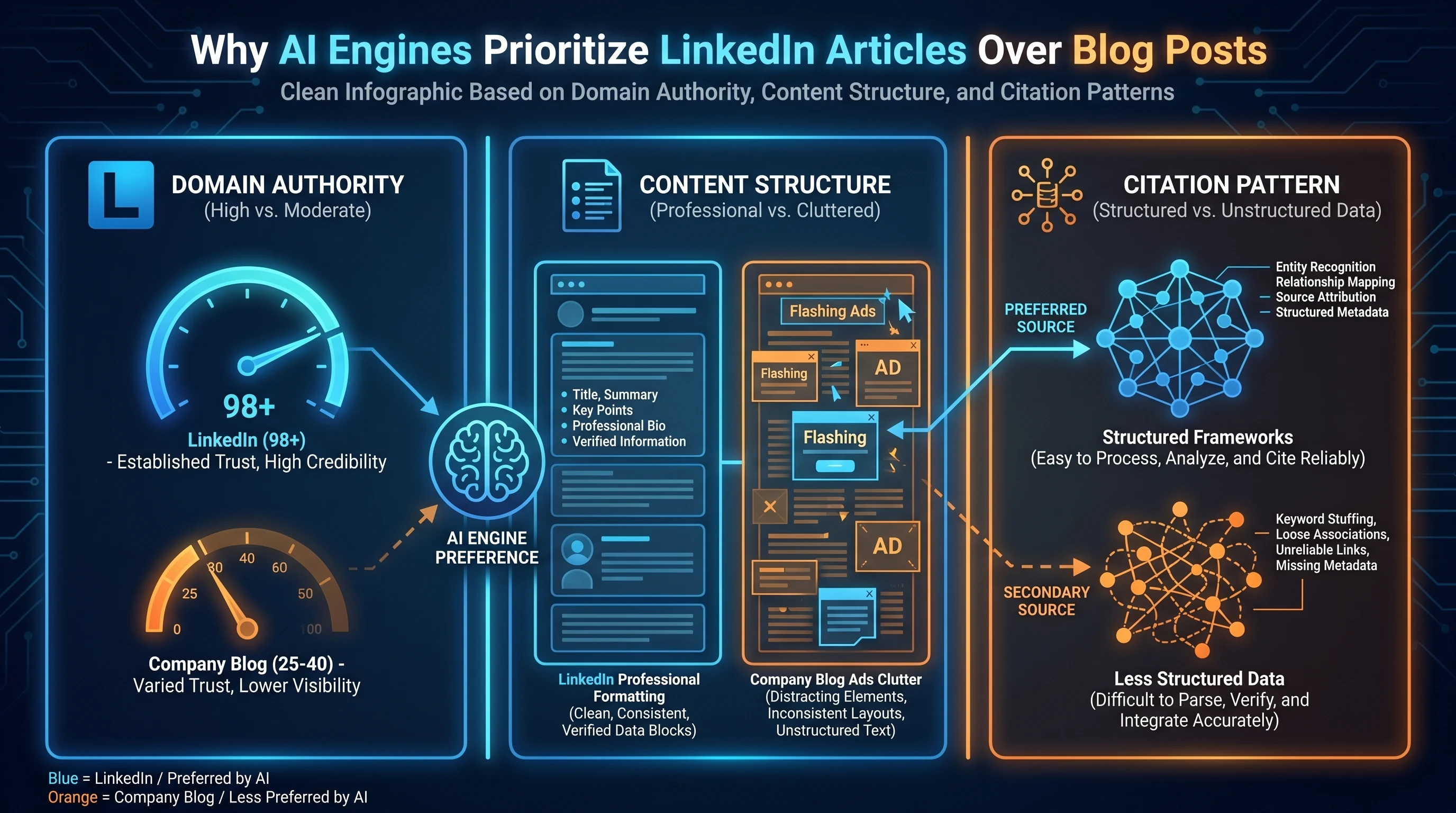
Treat the graphic as a conceptual illustration, not a verified comparison of authority scores or citation performance.
Why Do AI Search Engines Cite LinkedIn Articles?
There is evidence that AI search tools cite LinkedIn content. Semrush’s LinkedIn citation study found both articles and feed posts among the sources cited by ChatGPT Search, Google AI Mode and Perplexity. Articles accounted for a larger share of cited LinkedIn content in that dataset.
That finding supports testing the format. It does not establish the probability that your next article will be cited. The study examined observed citations across a broad prompt sample; it was not an experiment proving that publishing on LinkedIn causes visibility for Pakistani B2B companies.
Avoid explaining these results through a single domain authority score. The evidence does not show that ChatGPT compares those scores and automatically selects LinkedIn over a company blog. Topic relevance, accessible content and useful explanations are better editorial priorities than an assumed domain advantage.
Google’s Preferred Sources documentation describes a separate, user-selected preference. It can affect how selected sources appear in Top Stories and Google’s AI search features. It is not an automatic authority boost for LinkedIn authors, and individual article URLs are not eligible sources in the selection tool.
Microsoft Advertising’s discussion of AI-assisted discovery also describes people using traditional search to verify AI information. That suggests a possible indirect discovery path, not guaranteed waves of traffic from every citation. Its cited shopping research should not be treated as a forecast for Pakistani B2B buyers.
“Articles are increasingly picked up by AI-generated search answers, making them a quiet but growing visibility channel outside LinkedIn itself” — Kimberly Campbell, writing on Neil Patel’s website
The practical approach is to publish something worth referencing, then check what happens. Record whether an answer cites the article, mentions the business or sends a visitor. These are different outcomes and should remain separate in reporting.
How Should Pakistani B2B Teams Structure LinkedIn Articles for AI Visibility?
Start with the reader’s question. A useful structure makes the answer easier to find and assess, whether someone reads the article directly or encounters an excerpt elsewhere. Length alone cannot establish accuracy, relevance or citation potential.
Use the QAE pattern — Question as heading, Answer in the opening paragraph, Evidence in supporting paragraphs. It is an editorial approach, not a documented ranking formula. Our guide to content structure for AI citations explores the same principle: make each section understandable without requiring the reader to reconstruct your argument.
Use data where it supports the answer. Link to the original source, explain who or what was measured, and include limitations. Do not insert numbers simply to make a paragraph look authoritative. If you have no reliable Pakistani benchmark for a marketing budget, explain the cost drivers instead of inventing a spending range.
Define technical terms on first use. For example, AEO (answer engine optimization) means preparing content to answer relevant questions clearly in search and answer interfaces. Follow the definition with an example that matters to your audience. A definition is helpful because it removes ambiguity; it does not guarantee extraction or citation.
For a Lahore-based SaaS team, a useful article might explain how to qualify enquiries from local distributors. Describe the actual qualification process, where it fails and what changes for different business models. If the example is hypothetical, label it. If it describes client work, use evidence you can substantiate and have permission to share.
Action: Choose a recurring customer question, draft a direct answer, and support it with relevant evidence and local examples. Assign an owner to review accuracy before publication. Afterwards, use a repeatable set of buyer questions to check citations and record results through your AI search visibility monitoring process.
What Topics Work Best for Pakistani LinkedIn Articles?
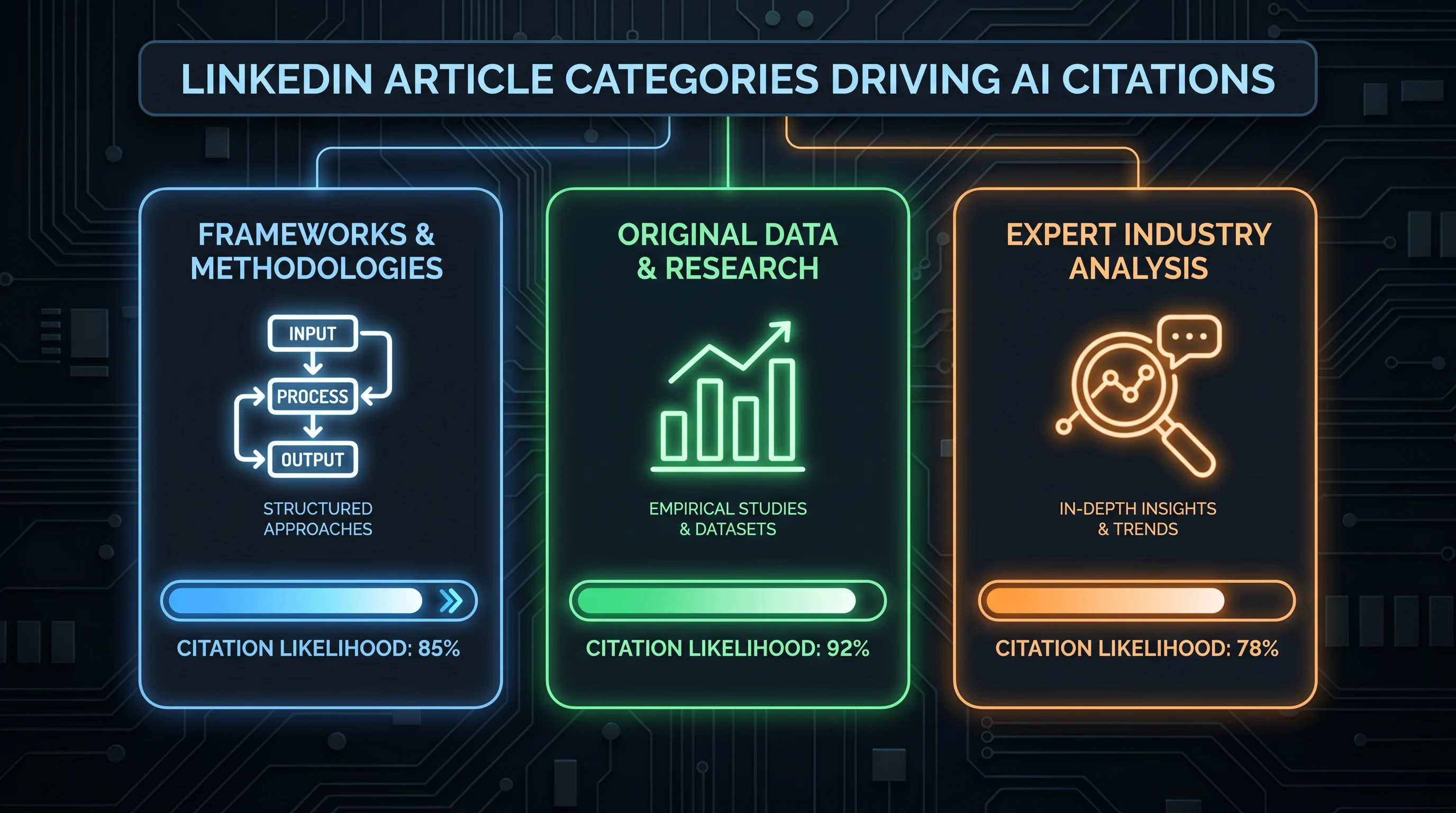
Start with topic categories that match your expertise and the questions prospects actually ask. These are editorial options to test, not a ranking of proven winners for every Pakistani business.
Category 1: Frameworks and methodologies. Explain a process your team genuinely uses: qualifying leads, evaluating suppliers or reviewing campaign performance. A memorable name can help readers recall it, but an acronym adds little without useful steps. Show when the process applies, what information it needs and where professional judgement remains necessary.
Category 2: Market-specific data and analysis. Publish original Pakistani observations where you have a defensible dataset. An ecommerce team could examine abandonment by payment method; an agency could compare campaign costs across cities. State the collection period, sample limitations and measurement method. Avoid presenting client-specific results as national averages, and distinguish observed changes from your explanation of their causes.
Category 3: Contrarian takes with evidence. Challenge a familiar business assumption only when you can support the argument. An article about hidden CRM costs could examine implementation, training and maintenance. Explain which businesses the argument applies to and acknowledge situations where the conventional choice remains sensible. A provocative title should lead to useful analysis.
For example, a Karachi HR consultancy could compare hiring platforms using documented fees and its own recruitment experience. This is an illustrative topic, not a reported success story. The article would be stronger if it explained employer needs, candidate fit and the limits of the comparison. Whether it earns citations or enquiries would need to be measured after publication.
How Do You Distribute LinkedIn Articles Beyond Your Network?
Publication needs a distribution plan. Sharing an article helps relevant readers find it, but there is no verified formula in which more reactions automatically produce more AI citations. Keep audience engagement and citation measurement separate.
Share the article through your company page and the author’s profile with introductions suited to each audience. Explain the problem it addresses rather than posting a bare link. Mention relevant people only when they contributed or have a clear reason to join the discussion. Respect group rules when sharing in professional communities.
Repurpose a useful comparison or process into a LinkedIn document carousel if the visual format improves understanding. A short text post can work better for a focused observation. Cross-post a summary on X where your audience is active, and make the connection to the full article clear.
“The strongest use case for articles is distribution, not creation. Adapt existing content rather than starting from scratch.” — Kimberly Campbell, writing on Neil Patel’s website
Build derivative content around different reader needs. A carousel might explain the process, while a text post highlights a common mistake. Avoid repeating the same promotional introduction everywhere. Give readers enough value in each format to decide whether the full article is relevant.
Think of opening a shop in Liberty Market: signs and recommendations help people discover it. Your article also needs a route to its audience. Use tagged links to your website where appropriate, review referral activity and ask qualified prospects how they found you. A citation screenshot alone cannot establish that the article generated a sale.
Why Should Pakistani B2B Teams Publish LinkedIn Articles Before Their Competitors Do?
Starting early gives your team time to learn which questions matter, improve its explanations and build a useful body of work. Those are practical advantages. There is no evidence here that the earliest article becomes a permanent default source for AI answers.
Keep live search citations separate from model training. An answer that links to an article demonstrates that the article was referenced in that response. It does not establish when or whether the model trained on it, or whether it will cite the same source again.
A Pakistani consulting firm writing about startup compliance should therefore prioritise accurate, reviewable guidance. Identify the relevant requirements, link to authoritative material and have an appropriate specialist review the advice. Publishing before competitors is of little value if the article contains stale rules or leaves readers unclear about applicability.
Make the decision around capacity and audience fit. If customer questions are going unanswered and your team has useful expertise, test articles. If you already publish them, examine whether the content reaches decision-makers and supports enquiries. Competitor activity can inform topic research, but it should not dictate an unsustainable publishing schedule.
WeProms Digital can help Pakistani B2B teams plan content marketing strategies across company blogs, LinkedIn articles and industry publications. Connect each topic to evidence, distribution and measurement so the team can evaluate its contribution. Contact hello@weproms.com or message WhatsApp +92 300 0133399.
Read next: LinkedIn Marketing in Pakistan: B2B Growth Strategies for 2026
Frequently Asked Questions
Are LinkedIn articles really indexed by Google?
They can be indexed, but publication does not guarantee inclusion or a particular ranking. LinkedIn provides article SEO settings specifically for search visibility. Use a descriptive title, check public accessibility and search for the article after publication. Avoid promising a ranking deadline or assuming that LinkedIn will always outperform the original article on your company website.
How long should a LinkedIn article be for AI search visibility?
Use enough space to answer the question and explain the evidence. There is no established universal word-count threshold for AI citations. Semrush’s study observed length patterns among cited content, but those patterns do not prove that extending an article will improve its performance. Cut repetition and retain examples that help readers make a decision. WeProms Digital’s content strategy services can help define the brief.
Can I republish my blog content as a LinkedIn article?
Yes, but adapt it for the audience and give readers a reason to use this version. Add relevant observations, adjust the opening and link to the original where useful. Google’s canonicalization guidance explains that it selects a representative URL for duplicate or very similar content. Rewording alone does not guarantee that Google will prefer your website version. Focus on distinct usefulness rather than cosmetic substitutions.
How many LinkedIn articles should a Pakistani B2B team publish per month?
Choose a cadence your team can sustain with proper research, review and distribution. There is no verified minimum monthly article count that establishes authority with AI engines. Begin with customer questions where you have credible experience, then adjust the schedule using reader feedback and business results. Publishing more is useful only if quality and relevance hold up.
Should Pakistani professionals use English or Urdu in LinkedIn articles?
Choose the language your intended readers use to discuss the problem and evaluate suppliers. English may suit international buyers; Urdu or Roman Urdu may suit other audiences. Do not assume a universal citation advantage from language alone. Test relevant buyer questions in the languages you serve, and preserve technical meaning when translating examples, product names and explanations.
Key Takeaways
- LinkedIn articles and feed posts can both earn AI citations. Neither format guarantees indexing, visibility or traffic.
- Citation research supports testing LinkedIn, but broad studies cannot predict results for a particular Pakistani B2B company.
- Domain authority scores do not establish why an AI tool selected a source. Prioritise relevant, accurate and accessible explanations.
- Google Preferred Sources reflects user choices; it is not an automatic ranking reward for LinkedIn authors or early publishers.
- Use the QAE pattern to organise answers and evidence. Include Pakistani market context only where it is relevant and supportable.
- Measure citations, website visits and qualified enquiries separately. Publish at a pace that leaves time for research, distribution and review.
About WeProms Digital
WeProms Digital is a content marketing agency headquartered in Lahore, serving Pakistani SMEs, ecommerce brands and B2B teams across Lahore, Karachi, Islamabad, Rawalpindi, Faisalabad and Multan.
The team works on multi-platform content strategy, LinkedIn article optimisation and content for AI search visibility. Its approach connects topic planning, clear explanations and distribution across company blogs, LinkedIn and industry publications, with measurement tied to the client’s business objectives.
Get in touch: hello@weproms.com · WhatsApp +92 300 0133399
Sources & References
- Kimberly Campbell, Neil Patel — LinkedIn Articles: What Sets Them Apart and How to Write Them
- Google Search Central — Preferred Sources
- Digital Applied — AI Search Engine Statistics
- Microsoft Advertising — When Discovery Becomes Decision
- Position Digital — AI SEO Statistics
- Semrush — LinkedIn AI Visibility Study
- Sprout Social — Implementing Social Intelligence
Additional reading from industry feeds: