

TL;DR: Buying AI subscriptions does not give a marketing team the skills to use them. Digiday’s research found that 86% of surveyed brand and agency professionals reported company investment in AI in 2025, up from 44% in 2022. Those findings are not a Pakistani SME spending benchmark. Start with an audit, train staff on real tasks, and measure useful output before adding automation. WeProms Digital helps teams put this into practice through AI workflow implementation.
Start here. Imagine a Karachi ecommerce brand paying for a content assistant, an ad-copy platform, analytics support and email automation. Its marketing team occasionally opens the content assistant, rarely checks analytics insights, and leaves the copy platform idle because nobody has prepared brand guidelines. This is an illustrative scenario, not a documented client case. The problem is familiar: purchasing software is easier than changing how work gets done.
Picture buying a printing press for your Lahore stationery shop on McLeod Road, then writing every wedding card by hand because nobody learned the controls. An AI training plan should close that operational gap. It needs named owners, realistic practice tasks and a way to decide whether the tools earn their place.
Why Do Marketers Invest in AI Before Building Team Skills?
AI marketing adoption involves putting artificial intelligence tools into everyday work, including campaign management, content creation and analysis. Investment is only part of that process. Digiday’s research, based on a survey of 142 brand and agency professionals, reports that company investment in AI rose from 44% in 2022 to 86% in 2025 among respondents. It does not establish adoption rates or training gaps across Pakistani businesses.
For an SME owner, the practical question is what happens after purchase. A competitor recommends a tool, an agency demonstrates it, or a persuasive LinkedIn post makes the subscription look essential. Approving the payment feels like progress. Assigning practice time and reviewing the work requires a separate decision.
Generative AI tools produce material such as text, images or code from instructions. Using them for marketing requires clear briefs, brand guidance and output checks. Assuming staff will simply “figure it out” leaves those responsibilities undefined. Ask who will use the tool, which task it should improve and how the team will judge success before approving another subscription.
“AI adoption soars, but marketers’ expertise lags” — Digiday Research
How Much Does the AI Skills Gap Cost Pakistani Businesses in PKR?
There is no verified national spending average behind the original cost estimates. Your own invoices and workflow records provide a better starting point. List subscription payments in PKR, including applicable taxes, currency conversion, usage charges and any external support. Keep software costs separate from implementation or consulting fees so the total remains understandable.
Use this table as an audit worksheet, rather than a market price list:
| AI Tool Category | Cost to Record in PKR | Evidence of Useful Use |
|---|---|---|
| AI content generator | Subscription, seats and usage charges | Approved drafts used in published work |
| Analytics support | Actual software, setup and reporting fees | Findings investigated and decisions recorded |
| AI ad creative platform | Plan, credits and production costs | Approved creative tested in campaigns |
| AI email automation | Plan, contact and sending charges | Reviewed campaigns or flows running successfully |
| AI social media scheduler | Plan, accounts and optional features | Approved posts published through the workflow |
Do not equate unused features with wasted spending. A platform can justify its subscription through a narrow, valuable task even when the team ignores most of its menu. Conversely, frequent logins can conceal low-value experimentation. Judge the tool by accepted work, time saved after editing, and business outcomes you can reasonably connect to its use.
Before cancelling an apparently idle subscription, check whether it supports a background integration or stores material the team needs. Export necessary assets and confirm dependencies. Then remove duplicate tools or unused seats and redirect the recovered budget towards training. Our AI marketing audit guide provides a broader way to examine these gaps.
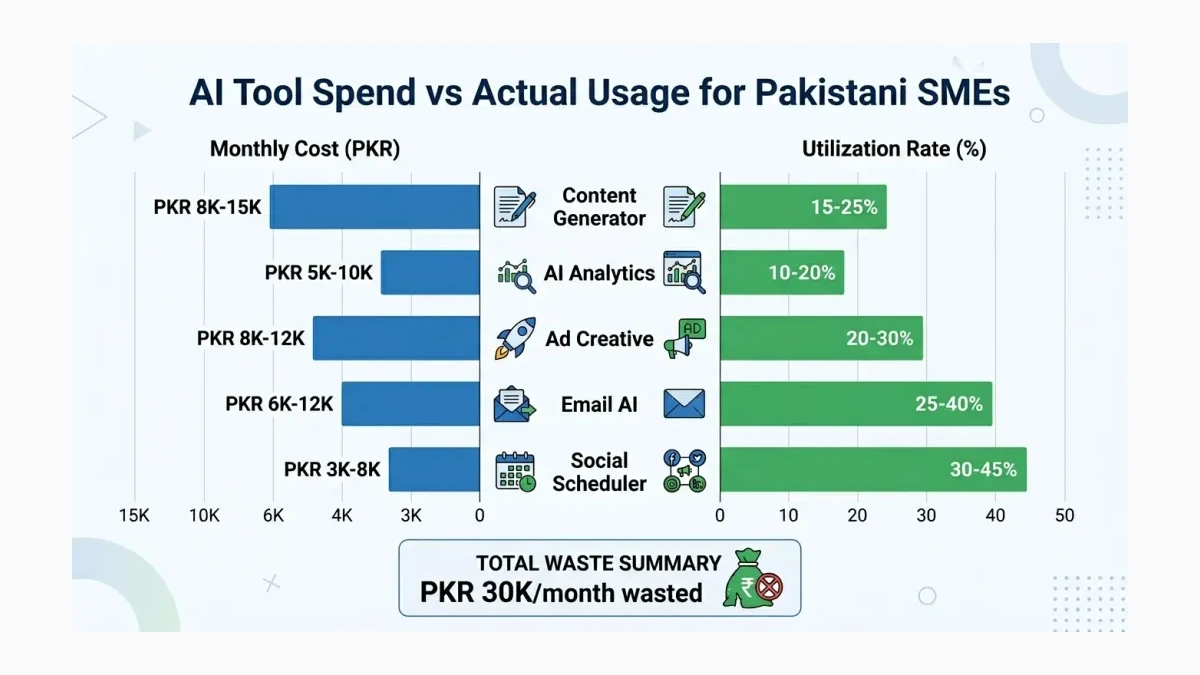
Use your invoices and task records for budgeting; the graphic’s cost and utilisation estimates are not verified Pakistani SME benchmarks.
What AI Skills Do Pakistani Marketing Teams Need Most?
Start with prompt engineering: writing instructions that give an AI model enough context to produce useful work. “Write a Facebook ad for my clothing brand” leaves the audience, product details, offer and tone unspecified. A stronger brief supplies those inputs, identifies unsupported claims to avoid and describes the required format. For practical help, build this into prompt engineering for marketing teams.
A useful prompt is not a substitute for accurate source material. Give the assistant approved product information and examples of acceptable copy. If delivery terms or payment options are uncertain, instruct it to flag the missing information. Review the result against the brief before saving the prompt for reuse.
Then comes AI-assisted data interpretation. GA4 automated insights identify unusual changes and emerging trends. Custom insights use conditions you configure and can send email notifications. Staff still need to understand the underlying metrics, check tracking and decide whether an apparent change deserves investigation.
Do not build a beginner training plan around assumed access to purchase predictions. GA4 predictive metrics depend on event data, sufficient qualifying users and sustained model quality. Check eligibility in the property. Teams can still learn to investigate device-level performance or checkout changes using the reporting available to them.
Next, AI workflow integration means connecting a proven task to the systems where work already happens. Define the inputs, approval point, destination and failure response before automating. A connection alone does not enforce brand consistency; approved source material and review rules must be part of the workflow.
Finally, output quality control means checking facts, tone and local relevance. Urdu-English mixed copy needs review by someone who understands the intended audience. Product descriptions need checks against actual specifications. Assign an editor who can reject weak output and record why it failed, so the next draft improves.
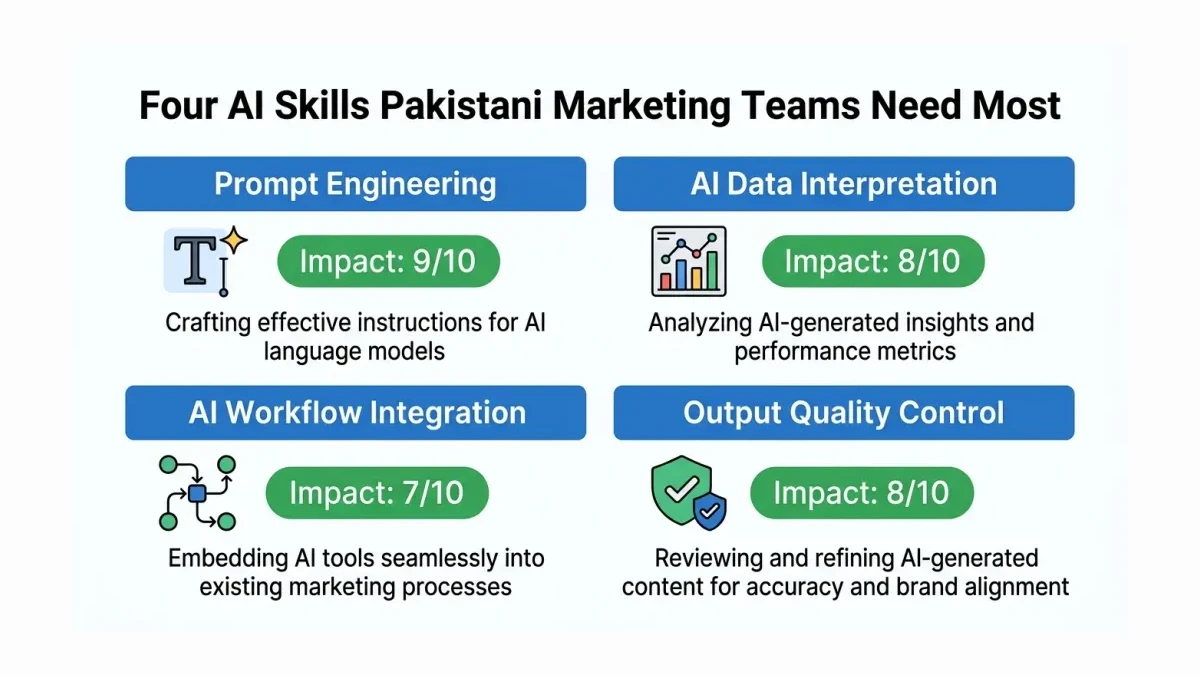
Treat these skills as training priorities; their relative business impact depends on the work your team performs.
How Do You Train a Pakistani Marketing Team on AI Tools From Zero?
First, conduct a tool audit. Record each subscription, its actual cost, account owner, renewal terms and recent useful work. Ask staff to demonstrate the task they use it for. A short walkthrough can reveal whether the obstacle is access, weak instructions, missing product information or uncertainty about who approves the result.
Then assign an owner to each priority workflow. Your strongest writer might lead content drafting, your analytical colleague might handle reporting, and your organised colleague might document automation steps. Give each owner protected practice time and a backup colleague. Ownership should make responsibility clear without leaving the business dependent on a single login or person.
Next, build a prompt library: a shared document of tested, brand-specific instructions for recurring work. Start with tasks such as product descriptions, ad variants, email subject lines and customer-response drafts. Save the required inputs, an approved example, known limitations and the review checklist alongside each prompt.
For a Pakistani fashion brand, include local sizing terminology, confirmed delivery arrangements, supported payment options and relevant seasonal context. Mention TCS, Leopards, JazzCash or Easypaisa only when the business actually uses them. Ask the team to practise with its own catalogue and customer questions; copied tutorial prompts are a starting point, not a finished process.
Once the prompts produce acceptable drafts, compare assisted work with manual benchmarks. Record time spent preparing inputs, generating material, editing it and securing approval. Compare like-for-like tasks. A shorter drafting stage is not a saving if the editor then spends longer correcting invented details or awkward phrasing.
Add conversion or engagement measures where the campaign design supports a useful comparison. Avoid attributing every improvement to AI when offers, traffic sources or product availability also changed. Keep a record of rejected outputs as well as successful ones; that reveals where training needs attention.
Finally, connect proven workflows to production systems. Confirm that the chosen tools and plans support the required connection, then test drafts before enabling publication. For GA4 custom insights, begin with documented email alerts. Any WhatsApp delivery should be separately scoped and tested rather than assumed to be a native feature. Our marketing tool integration guide explains how to approach the wider handoffs.
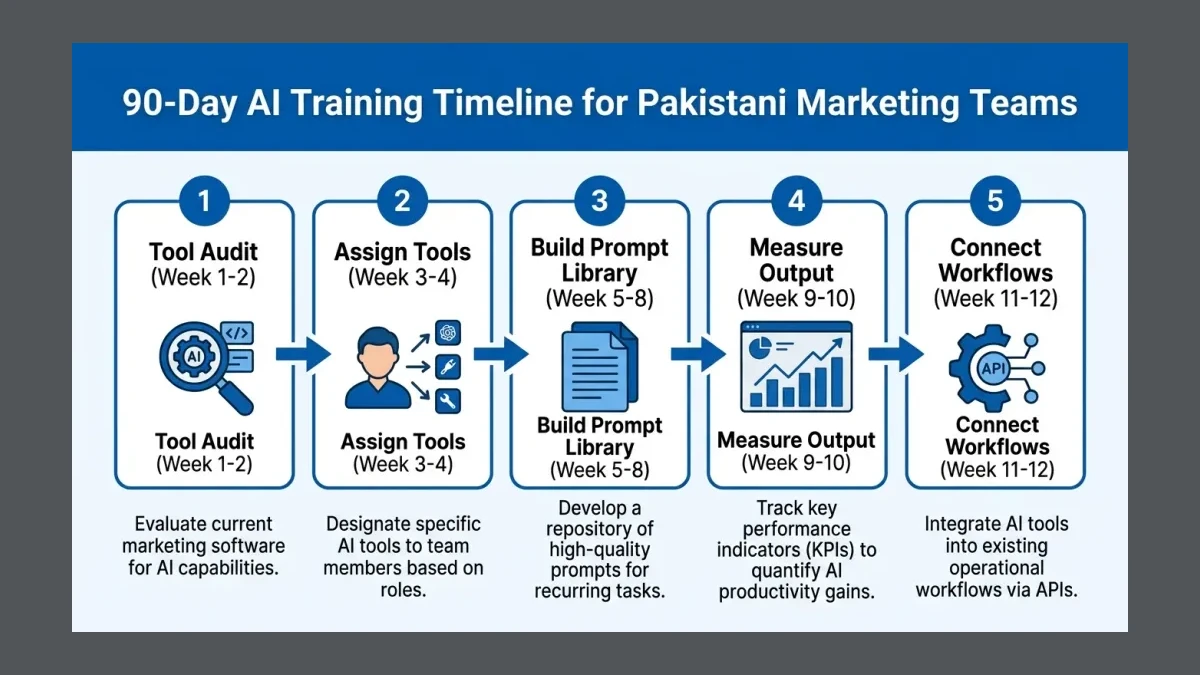
The illustrated timeline is a planning example, not a guaranteed time to proficiency or financial return.
Why Does AI Training Fail at Most Pakistani Companies?
Training can fail when the examples do not resemble the team’s work. A brand manager handling a Daraz storefront may struggle to apply a lesson built entirely around enterprise software sales. The issue is relevance, not English itself. Use the working language and commercial context that help staff understand the task and evaluate the output.
It can also fail when training ends with the workshop. A demonstration shows what a tool can do; supported practice establishes whether staff can repeat the task independently. Schedule prompt exercises, review recent output and revisit recurring errors. Keep the library accessible so lessons survive beyond the trainer’s presentation.
A further problem is missing measurement. If nobody records the starting position, the owner cannot tell whether training improved turnaround time, reduced corrections or helped campaigns. Set the baseline before the programme begins and choose review points that match the work cycle. Make someone responsible for collecting the evidence and discussing it with the team.
A useful review includes the people who draft, approve and publish the work. Ask each person where time moved or errors appeared. If drafting became faster but approvals slowed, change the brief or review process before buying another tool. Training should resolve the bottleneck that actually limits useful output.
Otherwise, the business risks repeating the same cycle: buy tools, provide little guidance, get disappointing results and replace the software. A clear workflow makes the diagnosis more useful. Staff might need better examples, cleaner data or simpler approval rules rather than another subscription. Treat those findings as operational improvements, not reasons to blame the team.
What Results Can Pakistani Businesses Expect After Structured AI Upskilling?
Expect evidence from your own pilot before forecasting a financial return. Headflood’s announcement about agentic AI integration concerns a different service and market. It does not establish how much additional output a Pakistani marketing team will produce after training. Agency-reported outcomes are not a substitute for comparable local measurements.
Useful early results are operational: acceptable drafts need less editing, recurring reports arrive reliably, and staff can explain how they checked the work. These improvements matter, but they should not automatically become a revenue claim. A faster process creates capacity; the business must still use that capacity on work customers value.
Consider an illustrative Faisalabad textile exporter preparing product catalogues. The team could test AI-assisted descriptions against its existing process, checking specifications, sizing and language before approval. It should keep export compliance material under qualified review. Record whether the catalogue takes less effort to produce and whether accuracy holds up, rather than inventing a sales uplift for the example.
For financial evaluation, include subscription charges, implementation, training time and ongoing review. Separate reduced cash expenditure from staff time made available for other work. Redeploying time can be valuable without reducing payroll. Our guide to measuring AI marketing value develops this distinction and connects measurement to decisions about continued spending.
The trade-off is upfront attention. Managers need to protect practice time and accept that some tasks will remain unsuitable for automation. Continue a workflow when evidence supports it, revise it when quality suffers, and stop it when costs outweigh the benefit. Training should make those decisions easier, not create pressure to automate everything.
WeProms Digital helps Pakistani teams build prompt libraries, training frameworks and workflow integrations around their actual marketing tasks. Get in touch via WhatsApp or email hello@weproms.com to discuss an AI workflow audit.
Read next: Pakistan’s AI Adoption Strategy: It’s Not About the Tools · AI Marketing Automation for Pakistani SMEs: A Complete Guide
Frequently Asked Questions
How much should a Pakistani SME spend on AI marketing tools?
Start with the smallest suitable plan for a clearly defined task. Check current billing, seat requirements, usage limits and the actual PKR charge before committing. Add another subscription only when it solves a demonstrated problem that the existing workflow cannot handle. Budget for training and review alongside the software.
Which AI tool should a Pakistani marketing team learn first?
Start with a general-purpose assistant already available to the team, such as ChatGPT or Claude, if it suits the task. Test it on approved marketing material and compare the output with your quality checklist. Choose based on useful results, access and workflow fit rather than the longest feature list.
How long does it take to train a Pakistani marketing team on AI tools?
Use a staged programme with recurring practice rather than promising a fixed completion date. Move from guided drafting to independent work, then to integration after quality is consistent. Existing skills, task complexity and available practice time affect progress. Judge readiness by demonstrated work, not attendance at a workshop.
Does AI marketing training work in Urdu or only in English?
Use the language your team works in, including Urdu, Roman Urdu, English or mixed copy. Test the chosen tool on representative examples and have a fluent reviewer check meaning, register and local usage. A translated prompt alone does not establish output quality. Save approved local examples in the prompt library.
What is the ROI of AI marketing training for Pakistani businesses?
There is no verified universal return for Pakistani SMEs. Compare the value of measured improvements with the full cost of training, tools, implementation and review. Distinguish time saved from cash saved and revenue earned. Where attribution is weak, report the operational improvement without presenting it as proven additional profit.
Should Pakistani businesses hire AI specialists or train existing staff?
Train existing staff on routine tasks when they already understand the brand and customer. Bring in specialist support where integrations, data work or technical maintenance exceed their capacity. Compare actual quotes and responsibilities rather than assumed salary ranges. The team should retain enough understanding to review the specialist’s work.
How does WeProms Digital help Pakistani businesses with AI marketing adoption?
WeProms Digital provides AI workflow implementation for marketing teams, including subscription audits, brand-specific prompt libraries, training and workflow integration. Agree the scope, responsibilities and success measures before work begins. Contact hello@weproms.com or WhatsApp +92 300 0133399 to discuss your team’s needs.
Key Takeaways
- Digiday reports that 86% of surveyed brand and agency professionals said their companies invested in AI in 2025. This is not a Pakistani SME adoption or spending estimate.
- Prioritise prompt writing, data interpretation, workflow integration and output quality control using tasks the team already performs.
- Audit actual costs and useful output. Unused features alone do not establish that a subscription is wasted.
- Assign owners, build a tested prompt library, compare assisted work with manual benchmarks and automate only after the process is reliable.
- Measure training through accepted work, review effort and relevant business outcomes. Avoid guaranteed productivity gains or repayment timelines.
About WeProms Digital
WeProms Digital is based in Lahore and works with Pakistani SMEs, ecommerce brands and B2B marketing teams.
The team specialises in AI workflow implementation, marketing automation setup and GA4 configuration. Its work connects training, prompt development and system integration to the tasks a business needs to complete, with clear ownership and practical measures of progress.
Get in touch: hello@weproms.com · WhatsApp +92 300 0133399
Sources & References
- Digiday — Marketers’ AI Use Rises, But Tech Skills Stall
- MarTech Series — Headflood Integrates Agentic AI Engineering Into Small Business Workflows
- MarTech Series — Breaking Down Agency Silos in the Age of Outcomes
- MarTech Series — Revelir AI Launches AI Analyst for Customer Experience
- Salesforce — SMB Takeaways from the State of Marketing Report
- ATNRCO — Choose the Right Digital Marketing Agency in Pakistan
- GoodFirms — Top Digital Marketing Companies in Pakistan
Additional reading from industry feeds: